A diesel engine turns rather less than half the energy in its fuel into work at the flywheel. Roughly a quarter to a third of the rest leaves as heat carried away by the coolant, and on a loaded Class 8 truck that is a genuinely large amount of energy to move — comparable in scale to the power the engine is producing. The radiator's job is to get rid of it, continuously, in whatever weather the truck is working in.
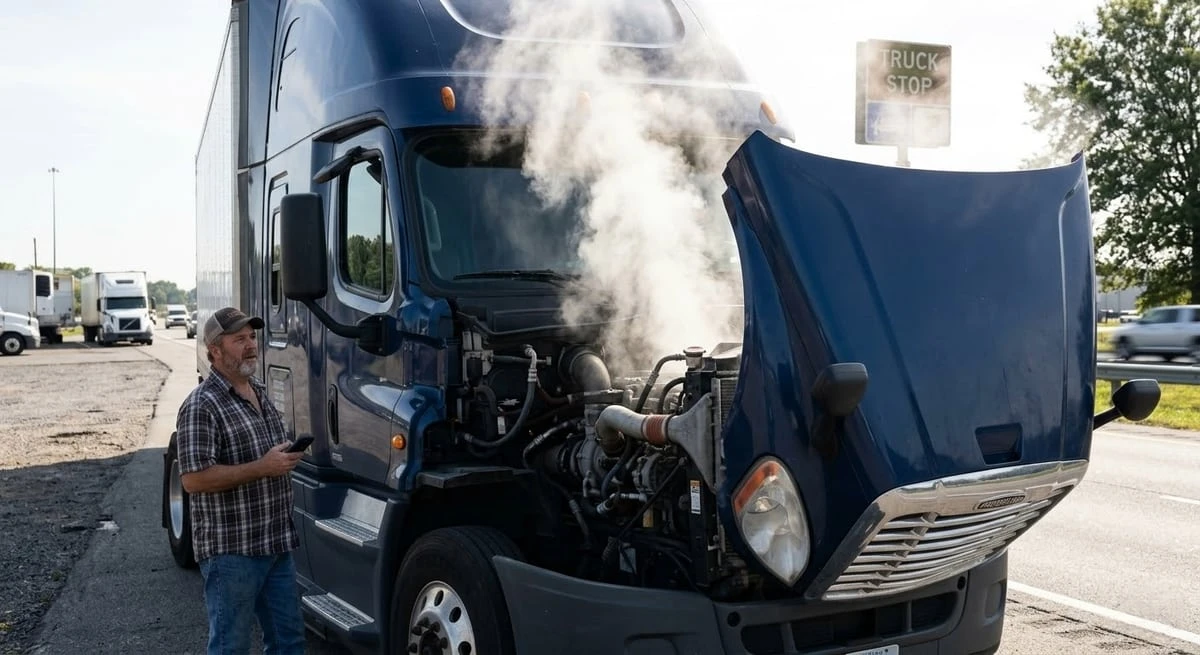
That framing matters, because it explains why cooling problems escalate so quickly. A radiator that has lost a fraction of its capacity is fine at idle and fine on the flat. It fails on a grade in August, under load, which is the worst moment for it to happen.
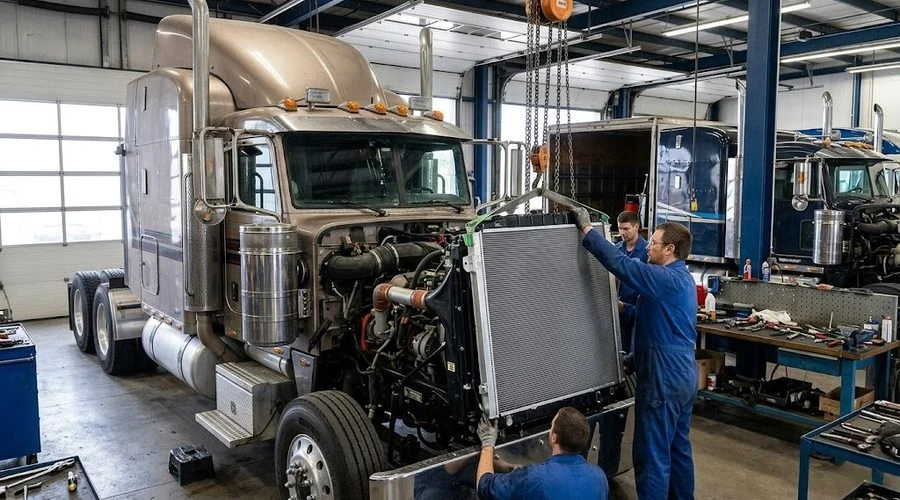
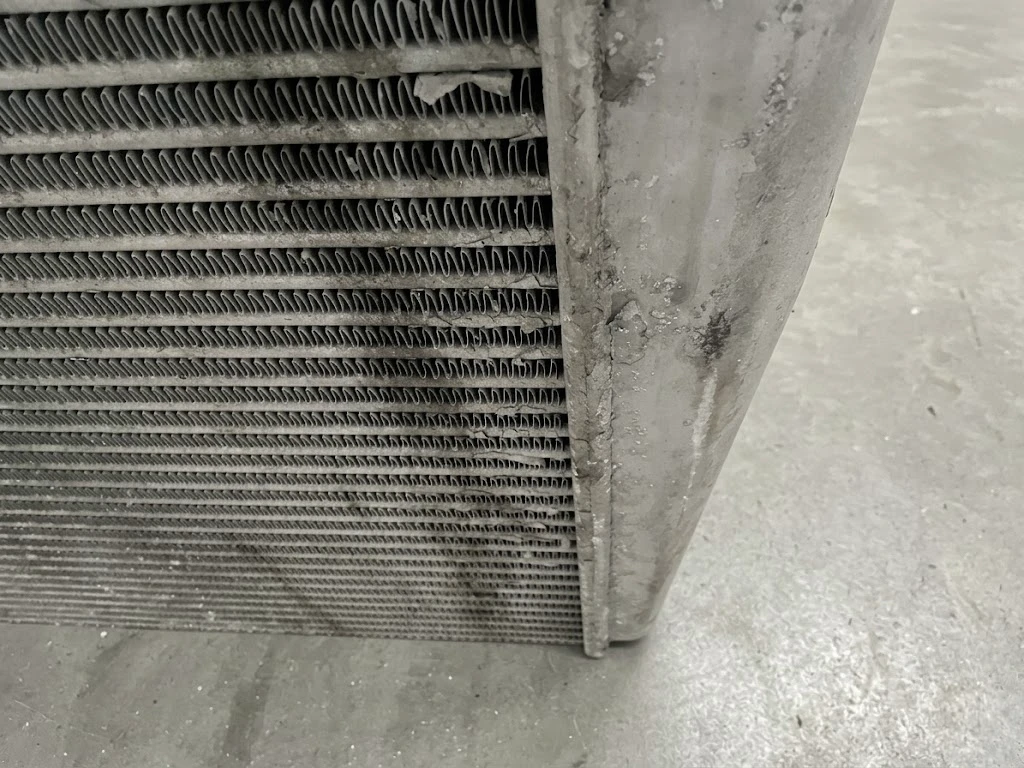
A Class 8 radiator out of the truck. The core is the ribbed block in the middle; the tanks at either end are what the hoses connect to, and where the design decisions that govern fitment actually live.
Driving a Cascadia? See Cascadia cooling system problems for the year-by-year radiator breakdown.
In this article
- What a Radiator Actually Does
- The Cooling Loop, Start to Finish
- Inside the Core: Tubes and Fins
- Downflow or Crossflow?
- Why the System Runs Pressurised
- The Oil Cooler in the Bottom Tank
- Where the Radiator Sits
- Why Identical Cores Are Not Interchangeable
- What Goes Wrong
- What a Radiator Costs
- Frequently Asked Questions
What a Radiator Actually Does
A radiator is a heat exchanger. It does not cool the engine directly and it does not touch the engine at all. What it does is take hot coolant that has already absorbed heat from the block and cylinder heads, expose that coolant to moving air across a very large surface area, and hand the heat over to the air.
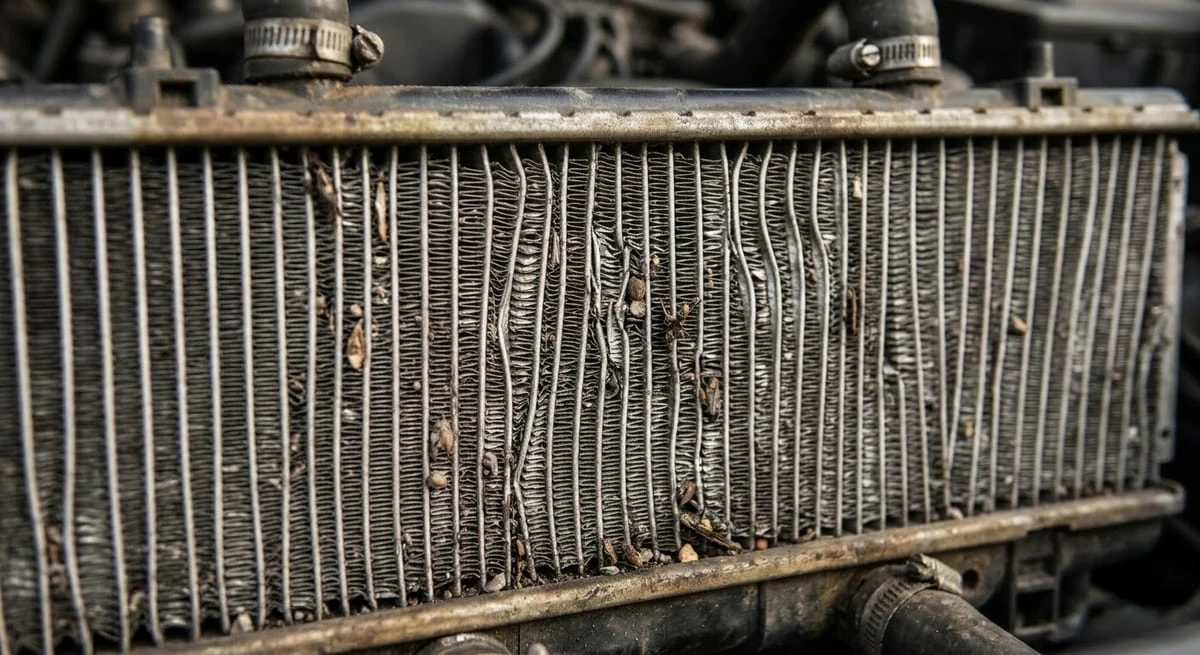
The name is a little misleading. Very little of the heat leaves by radiation. Almost all of it leaves by convection — air moving across metal that is hotter than the air. That is why a radiator that is perfectly sound will still overheat the engine if the airflow through it is blocked, and why a grille packed with bugs or a bent fin pack matters as much as a leak does.
The practical consequence: two thirds of radiator problems are airflow problems, not coolant problems. Before condemning a radiator, look through it at a light. If you cannot see daylight through the fin pack, the core is blocked, and no amount of new coolant will fix that.
The Cooling Loop, Start to Finish
Follow one litre of coolant around a Class 8 engine and the whole system makes sense:
- The water pump pushes coolant into the block. It is belt or gear driven off the engine, so flow scales with engine speed.
- Through the block and heads, the coolant runs past the cylinder walls, the valve seats and the injector bosses — the hottest metal in the engine — and picks up heat.
- The thermostat decides where it goes next. Cold, it stays shut and the coolant bypasses the radiator entirely so the engine warms up quickly. At operating temperature it opens and lets coolant through to the radiator.
- Into the radiator, entering one tank, passing through the core, and leaving the other tank measurably cooler.
- Back to the water pump, and round again.
Two other components sit on that loop. The degas bottle gives the coolant somewhere to expand as it heats, and separates air out of it. The fan — usually on a viscous or air-actuated clutch — pulls air through the core when road speed alone is not providing enough, which is exactly the situation on a slow climb.
The thermostat is worth dwelling on, because a stuck-open one produces no dramatic symptom at all. The engine simply runs cool, takes a long time to warm up, and quietly costs fuel and cylinder wear. A stuck-shut one overheats the engine within minutes while the radiator stays cold to the touch — which is a useful diagnostic in itself.
Inside the Core: Tubes and Fins
The core is the part that does the work, and it is a simple idea executed precisely. Coolant runs through flat tubes. Between the tubes sit thin corrugated fins. The tubes carry the heat out of the coolant; the fins take that heat from the tubes and give it an enormous surface area to hand over to the passing air.
The fins are most of the reason a radiator works at all. Without them the tubes alone would present a few hundred square centimetres to the airflow. With them, the effective surface area runs to many square metres folded into a package you can carry.
Across the 128 radiators in our catalogue with recorded core dimensions, the cores run from 20.5 to 51.6 inches tall and 16 to 42.3 inches wide, with a median of roughly 36 by 33 inches. Depth ranges from 1 inch to just over 3, and the median is 2.25.
Depth is the specification people most often overlook. A deeper core holds more tube surface and rejects more heat, but it also resists airflow more. Radiator design is a balance between those two, settled by the manufacturer for a particular truck and engine, which is one reason fitting a "bigger" radiator is not automatically an upgrade.
Downflow or Crossflow?
This describes which way the coolant travels through the core, and it is set by where the tanks are.
- Downflow — tanks at the top and bottom. Coolant enters the top tank, falls through vertical tubes, and collects in the bottom tank.
- Crossflow — tanks on the left and right. Coolant enters one side, crosses through horizontal tubes, and collects on the other.
Neither is inherently better. Crossflow allows a shorter, wider package, which suits a low hood line. Downflow suits a tall, narrow opening and is the traditional heavy truck arrangement. In our own catalogue the split is 90 downflow to 33 crossflow, which is a fair reflection of how Class 8 trucks are built.
For your purposes the orientation is a fitment fact rather than a performance one. A downflow radiator cannot replace a crossflow one, because the hoses arrive in entirely the wrong places.
Why the System Runs Pressurised
A cooling system is deliberately sealed and pressurised, and the pressure cap is what holds it there — typically around 90 to 110 kPa on a Class 8 truck.
The reason is boiling point. Water boils at 100 °C at sea level, and a 50/50 coolant mix at around 107 °C. Neither leaves much headroom over an engine that runs in the nineties and spikes higher under load. Raising the pressure raises the boiling point by roughly 25 °C, and that margin is what keeps the coolant liquid where it matters most — against the hottest metal in the head, where a local boil would form a vapour pocket and stop cooling that spot entirely.
This is why a weak pressure cap is a real fault and not a trim item. A cap that no longer holds pressure lowers the boiling point of the whole system. The truck will run normally in mild conditions and boil over on the first hard climb of the summer.
The Oil Cooler in the Bottom Tank
Many heavy truck radiators carry a second, smaller heat exchanger inside one of the tanks, usually the bottom one. Oil is routed through it and gives up its heat to the coolant surrounding it.
Of the radiators in our catalogue with full specifications, 50 carry an integral oil cooler and 69 do not. That is close enough to an even split that you cannot assume either way, and it is one of the most common reasons a replacement radiator does not fit: the core and the tanks match, and there is nowhere to connect the oil lines.
It also means a failure inside that cooler mixes oil into the coolant, or coolant into the oil. If you find oil in the degas bottle on a truck whose radiator has an integral cooler, that cooler is a prime suspect.
Where the Radiator Sits
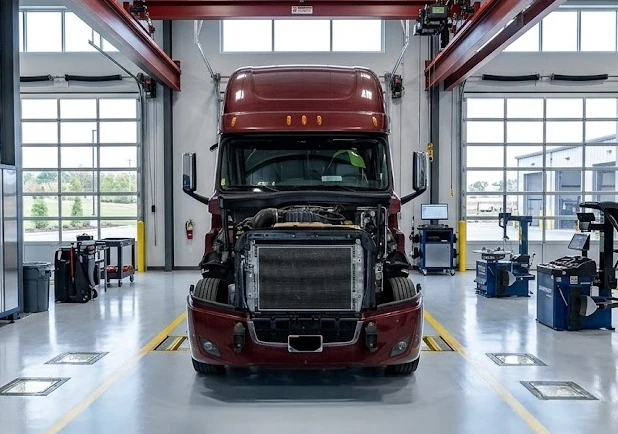
On a Class 8 tractor the radiator is one element of a stack of heat exchangers sharing the same airflow. From the front: the charge air cooler, then the radiator, and on many trucks the A/C condenser mounted alongside or ahead of both.
They share air, so they share problems. A charge air cooler with a fin pack full of bugs reduces the air reaching the radiator behind it, and coolant temperature climbs even though nothing is wrong with the radiator at all. When you are chasing a temperature complaint, inspect the whole stack rather than the component the gauge seems to be blaming.
Why Identical Cores Are Not Interchangeable
This is the part that costs people money, so it is worth stating plainly. Matching the core dimensions is not enough to confirm a radiator will fit. Two radiators with the same height, width and depth are routinely not interchangeable, because the things that actually decide fitment are elsewhere:
- Inlet and outlet position. Which side, and how high. A radiator whose outlet is bottom left will not plumb into a truck expecting bottom right.
- Connection diameter. Commonly 2 to 2.5 inches on Class 8, and the hose has to match.
- Oil cooler, or none. As above, and if fitted, at which end.
- Filler neck, or none. Many modern trucks fill at the degas bottle and the radiator has no neck at all.
- Mounting and isolator positions. Where the brackets sit on the tanks.
Every radiator on our radiators page lists those positions where we hold them, precisely so a part can be matched on specification rather than on a photograph. If you have the number off the old unit, that is faster and safer still — search it directly.
What Goes Wrong
Radiators fail in a small number of recognisable ways:
- External leaks at a tank seam, a tube-to-header joint, or an impact point
- Blocked fins from bugs, chaff and road debris — an airflow failure rather than a coolant one
- Internal scaling from old or wrong coolant, which insulates the tubes from the inside
- Physical damage to the fin pack from stones, which is cumulative and rarely noticed until capacity is well down
- Oil cooler failure inside the tank, mixing oil and coolant
For the symptom side of this, see 5 signs your radiator needs replacing, and for temperature complaints more broadly, semi truck overheating causes. Scaling in particular is preventable, and flushing the system on schedule is how.
What a Radiator Costs
Rather than quote an industry average, here is what our own catalogue shows across the 80 radiators we currently publish a price for:
- Range: roughly $700 to $5,500 CAD
- Median: a little under $1,200 CAD
The spread is wide because a radiator for a medium-duty cab-over and one for a heavy vocational tractor are very different objects. Size and construction drive the price far more than the badge on the truck does. Labour is on top, and depends mostly on how much of the front end has to come apart.
Set against that, the cost of running a marginal cooling system is a warped head or a cracked block, which is an order of magnitude more expensive and takes the truck off the road while it is dealt with.
Frequently Asked Questions
How does a semi truck radiator work, in one sentence?
It passes hot coolant from the engine through a core of thin tubes and fins, and moving air carries that heat away — shedding the roughly quarter of the fuel's energy that leaves the engine as heat rather than work.
What is the difference between a downflow and a crossflow radiator?
Where the tanks are, and therefore which way the coolant travels. Downflow has tanks top and bottom and the coolant falls through vertical tubes; crossflow has tanks left and right and the coolant crosses through horizontal tubes. Neither performs better in principle, but they are not interchangeable, because the hose connections end up in completely different places.
Why is a cooling system pressurised?
To raise the boiling point. A 50/50 coolant mix boils at about 107 °C unpressurised, which is uncomfortably close to normal operating temperature. The cap holds roughly 90 to 110 kPa, which lifts the boiling point by about 25 °C and stops the coolant vaporising against the hottest metal in the cylinder head.
Can I fit a radiator with the same core dimensions?
Not reliably. Inlet and outlet position, connection diameter, whether an integral oil cooler is fitted and at which end, whether there is a filler neck, and the mounting positions all have to match as well. Identical cores that are not interchangeable are common rather than unusual.
Does a blocked radiator cause overheating even if the coolant is fine?
Yes, and it is one of the most common causes. Almost all the heat leaves by convection into moving air, so a fin pack blocked with bugs and debris cuts capacity regardless of the coolant's condition. Look through the core at a light: if daylight does not come through, airflow is the problem.
What does the oil cooler inside the radiator do?
It is a second heat exchanger inside one of the tanks, usually the bottom, that cools oil by handing its heat to the surrounding coolant. Roughly half the radiators we stock have one. If it fails internally, oil and coolant mix — oil in the degas bottle on such a truck points straight at it.
How long should a semi truck radiator last?
There is no fixed interval, and most fail through damage, corrosion or scaling rather than wear. Coolant maintained on schedule is the single biggest factor. See how long a semi truck radiator lasts for the detail.
Where can I get a semi truck radiator in the GTA?
True Truck Parts stocks 307 radiators for Freightliner, International, Western Star, Mack, Peterbilt, Kenworth, Volvo, Hino and Sterling, with core dimensions, inlet and outlet positions and OEM cross-references listed. Contact us with the number off the old unit and we will confirm fitment. Same-day pickup in Vaughan, shipping Canada-wide.