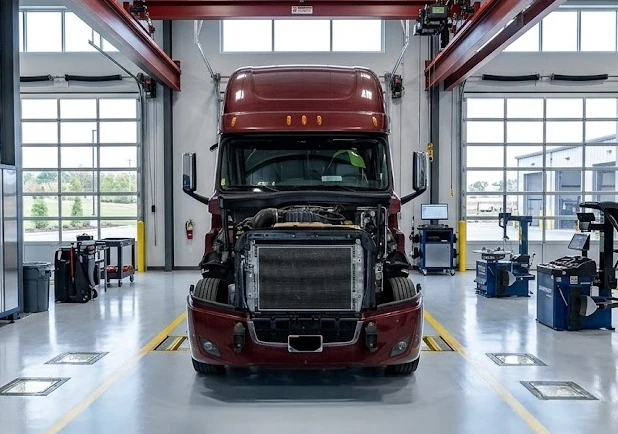
Most drivers don't think about the cooling system until something goes wrong. A healthy radiator keeps engine temps in the 160–220°F range. When it starts to fail, that window closes fast.
In a diesel engine pushing 400–600 horsepower, overheating doesn't just slow you down — it can destroy an engine worth tens of thousands of dollars in minutes.
The good news: radiator failure almost always gives you warning. Catch the signs early and a parts swap is all it takes. Ignore them and you're looking at blown head gaskets, warped cylinder heads, or a full engine rebuild.
This guide covers the five most reliable warning signs, what's causing them, and what the numbers look like if you wait too long.
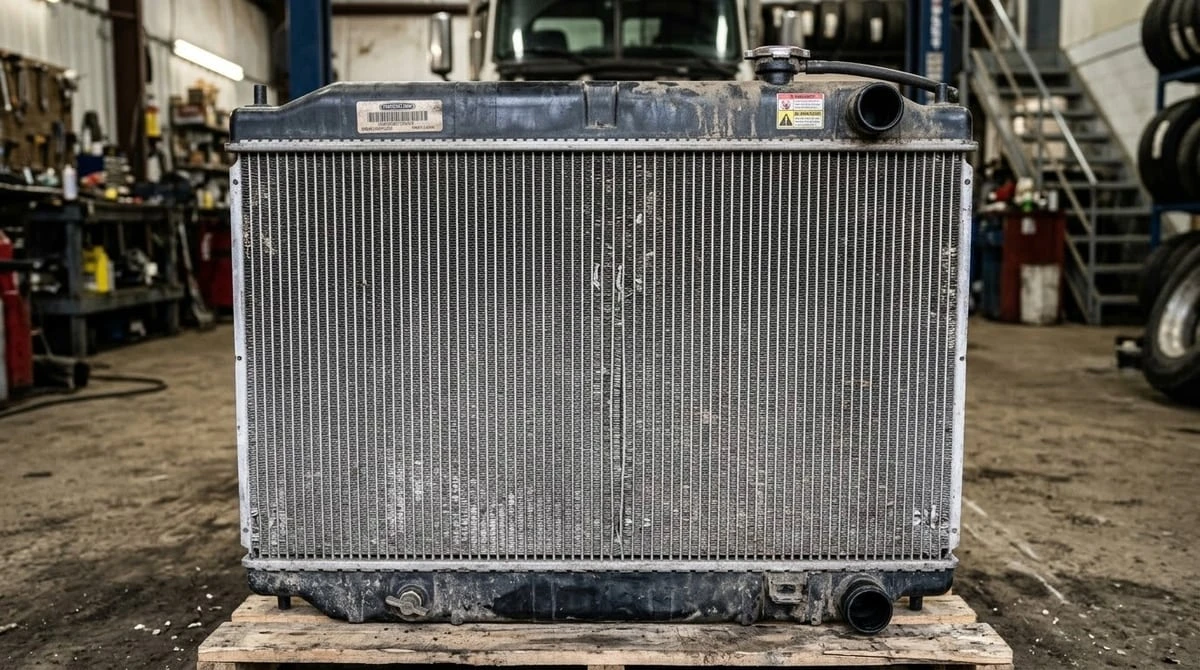
A Class 8 truck radiator core. The aluminum fins dissipate heat — when they get clogged or corroded, the whole system suffers.
How a Semi Truck Radiator Works — and Why It Fails
The radiator is the heart of the truck's cooling loop. Hot coolant leaves the engine block, flows through dozens of narrow aluminum tubes inside the radiator, and exits cooled — ready to absorb heat all over again. Thin fins around those tubes push the heat out into the airflow from the fan and from the truck moving forward.
Over time, the tubes corrode from the inside when the coolant breaks down. The fins get clogged with road debris, blocking airflow. Pressure spikes from a stuck thermostat crack the core. And in cold climates, freeze-thaw cycles crack the plastic end tanks.
None of these happen overnight. They build up over months and show up as symptoms you can catch — if you know what to look for.
For the full picture — the coolant loop end to end, what the core actually is, downflow against crossflow, and why two radiators with identical cores often will not interchange — see how a semi truck radiator works.
FMCSA regulations (49 CFR Part 396) require all carriers to inspect and maintain vehicle systems — including cooling. For owner-operators, that responsibility is yours alone.
1 The Temperature Gauge Runs Consistently High
This is the clearest sign your cooling system is losing capacity. A healthy diesel engine — DD15, Cummins ISX, PACCAR MX-13 — runs in a tight temperature band. If your gauge keeps creeping toward the upper range on routes that never caused issues before, take it seriously.
One spike on a hot day while hauling uphill isn't a radiator problem on its own. A bad thermostat, low coolant, a clogged charge air cooler, or a failing water pump can all cause a temporary rise.
But if the gauge is running higher than it used to — especially in mild conditions or at highway speeds — the radiator is a strong suspect.
Check these first: Confirm your coolant level, look at the fins for debris blockage, and make sure the cooling fan is engaging. If everything checks out and temps are still high, have the radiator pressure-tested.
On Freightliner Cascadias with DD15 or DD13 engines, this is one of the most common issues past the 600,000-mile mark. Kenworth T680s and Peterbilt 579s with PACCAR engines show the same pattern. The tubes plug up slowly, cutting coolant flow — with no visible leak on the outside.
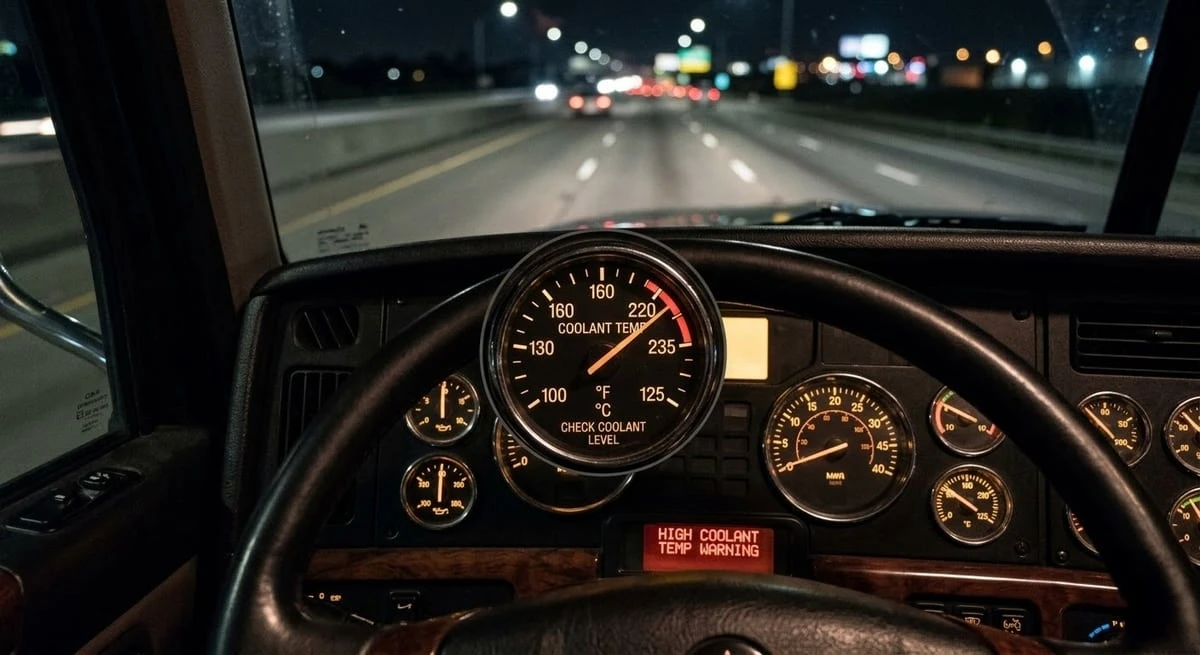
A temperature gauge creeping into the upper range is the first sign to act on — don't wait for the warning light.
2 You're Topping Off Coolant Too Often
A healthy cooling system is a closed loop. You should rarely need to add coolant between service intervals. If you're topping it off more than once between services, coolant is going somewhere — and you need to find out where.
External leaks are the most common cause. They start small — a hairline crack in the plastic end tank, a weeping joint, a corroded seam. Look for dried coolant residue around the radiator, or a sweet chemical smell from the engine bay. On a loaded truck in summer heat, a slow leak can turn fast in a hurry.
Internal leaks are harder to spot and more dangerous. If coolant gets into the combustion chamber — usually through a blown head gasket — you'll see white smoke from the exhaust, especially at startup. By that point, the radiator issue has already caused bigger damage.
Check your coolant reservoir tank level on every pre-trip. A healthy tank holds its level for weeks. If it's dropping between trips, don't let it slide.
3 Your Coolant Looks Wrong
With the engine cold, pull the radiator cap and look at the coolant. It should be bright and clear — green, orange, or pink depending on your truck's type. What you never want to see: brown, dark, cloudy, or oily fluid.
Discolored coolant usually points to one of three problems:
- The rust inhibitors have broken down and corrosion is building inside the system
- Someone mixed two coolant types — a common shop mistake that speeds up corrosion
- Engine oil is getting into the cooling system, pointing to a head gasket or oil cooler problem
Never mix coolant types: Extended Life Coolant (ELC/NOAT) and conventional green coolant don't mix. When they combine, the inhibitors cancel each other out and the system corrodes from the inside. The industry standard is a full drain and flush before switching — never top off one type with another.
If the coolant looks fine but there's an oil film on the inside of the cap, that's a red flag. Engine oil or combustion gases are getting into the cooling loop — often the result of prolonged overheating from a worn radiator.
The Technology and Maintenance Council (TMC) recommends checking coolant concentration and pH at every oil change. Do a full flush every two to five years, depending on the coolant type.
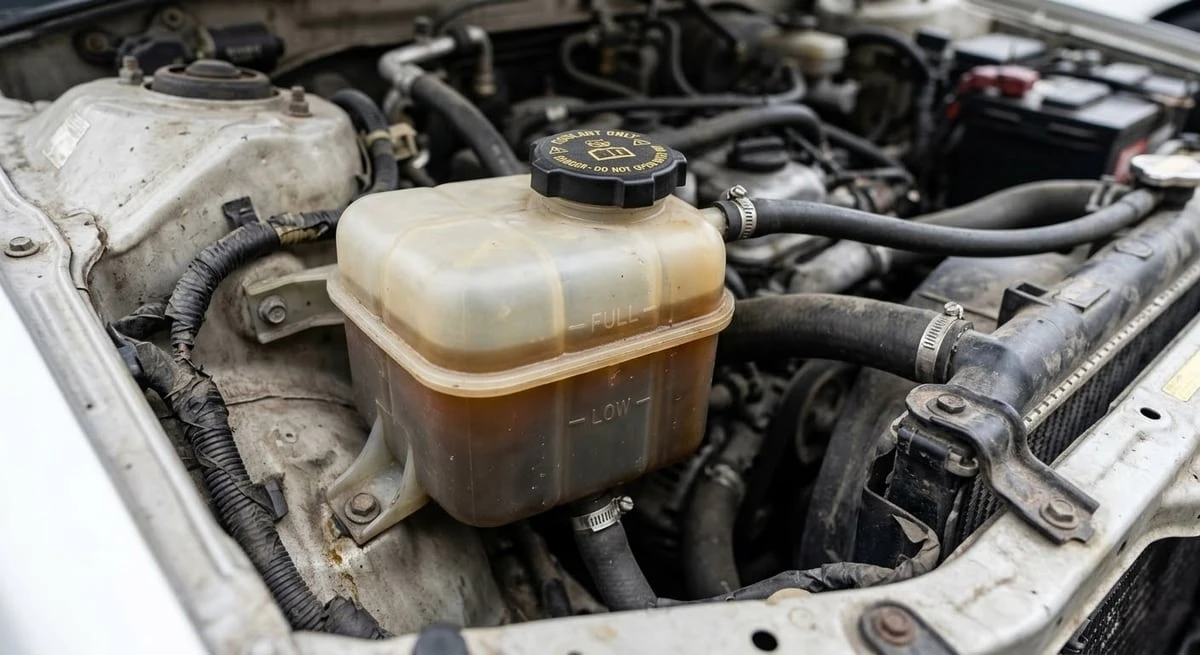
Healthy coolant is bright and clear. Dark, cloudy, or rusty fluid means the inhibitors have broken down — and corrosion is already happening inside.
4 Visible Physical Damage — Fins, Tanks, or Core
Walk to the front of the truck and actually look at the radiator. Most drivers skip this step. Physical damage is the one sign you can confirm with your eyes — no tools needed.
Here's what to look for:
- Bent or crushed fins — common on trucks that run gravel roads or construction sites. Flattened fins block airflow and cut cooling performance, even when damage looks minor.
- Rust or corrosion stains on the core or along the seams — both get worse over time, not better.
- Cracks on the plastic end tanks — the top and bottom tanks on aluminum-core radiators are a common weak point, especially in cold climates. Cracks start small and are easy to miss if you're not looking closely.
- Green or white residue on any seam or fitting — dried coolant that leaked, evaporated, and left mineral deposits behind.
On Volvo VNL trucks, plastic end tank cracks are a known issue as mileage adds up. On Mack Anthems and International LT Series trucks, check for corrosion along the lower mounting bracket. Road salt and heavy service cycles take a toll on every make.
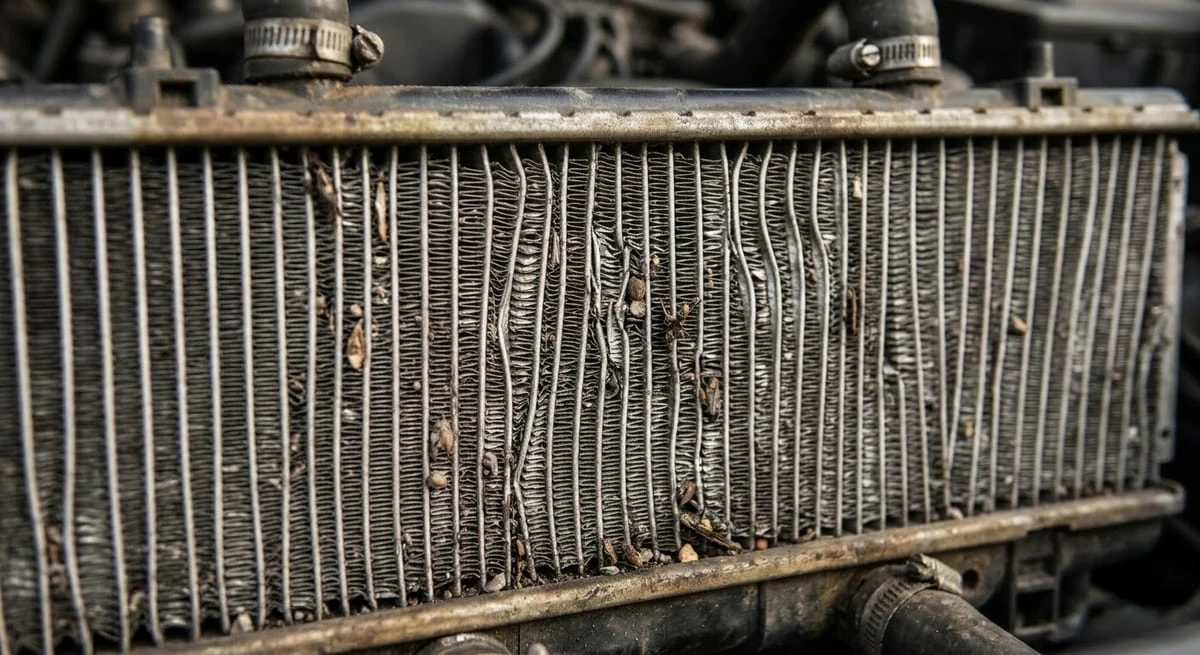
Bent fins block airflow and reduce cooling capacity. Even partial damage across a few rows makes a measurable difference.
Browse semi truck radiators
Freightliner, Kenworth, Peterbilt, Volvo, Mack and more.
5 Steam or Unusual Smell From the Engine Bay
Steam from under the hood is not subtle. It means coolant is hitting a hot surface it shouldn't be touching — exhaust manifold, turbo housing, or something else running very hot. By the time you see steam, you already have an active leak.
Coolant has a distinctive smell — sweet and slightly chemical, nothing like burning oil or rubber. If you catch it during your pre-trip walk-around and can't find the source, start at the radiator. Small leaks often burn off before leaving a puddle on the ground.
Don't keep driving a truck that's steaming. A small leak can turn into a full overheating event fast. The damage — blown head gasket, warped head, scored cylinder walls — turns a parts swap into a full engine rebuild.
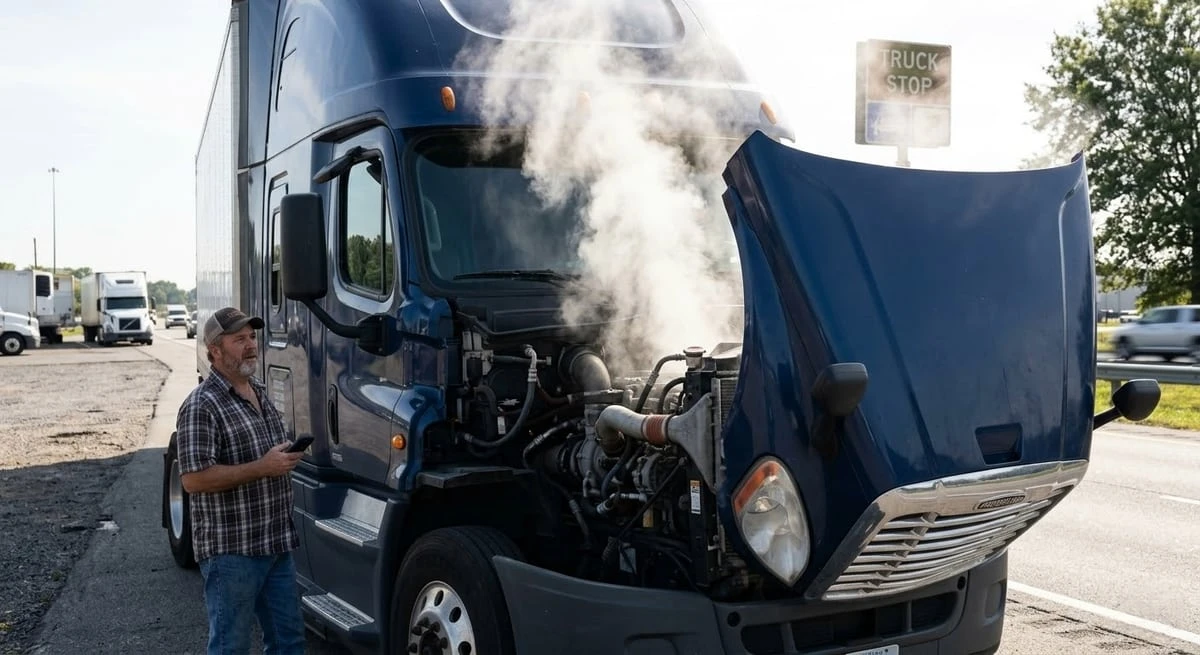
Steam from under the hood is an advanced symptom. Pull over immediately — driving through it risks engine damage within minutes.
The Real Cost of Ignoring These Signs
The math is simple. A replacement radiator for a Class 8 truck — depending on the make, model, and OEM vs. aftermarket — costs several hundred to a few thousand dollars, plus labour. That's a real expense, but it's predictable and you control the timing.
An engine rebuild after an overheating failure is a completely different story. Warped heads, blown gaskets, damaged pistons, scored liners — that repair takes weeks and costs far more than the radiator would have. For an owner-operator, add lost revenue and missed contracts on top of the repair bill.
The data: Fleet Equipment Magazine cites research showing over 53% of premature heavy-duty engine failures are directly tied to cooling system neglect. The cooling system isn't something you fix when it breaks — it needs regular attention.
There's another cost to consider: your CSA score. FMCSA's Vehicle Maintenance BASIC tracks maintenance violations. A cooling system failure during a roadside inspection can put your truck out of service — hitting both your wallet and your compliance record at the same time.
How Long Does a Semi Truck Radiator Last?
A quality radiator in commercial service typically lasts 5 to 10 years, or 500,000 to 800,000 miles under normal conditions.
"Normal" matters. Trucks that idle a lot, run in extreme heat, or haul heavy loads every day stress the cooling system more — and tend to see shorter radiator life.
Coolant maintenance makes a big difference. Trucks running degraded coolant — low pH, worn-out inhibitors, rust — corrode their radiators from the inside. Keeping to the coolant change schedule (every 2 years or 120,000 miles for conventional fluid, up to 5 years for extended-life coolant) directly extends how long your radiator lasts.
OEM vs. Aftermarket: Does It Matter?
For Class 8 trucks, a quality aftermarket radiator built to OEM specs performs just as well as a dealer unit in most applications. The key word is quality — the aftermarket varies widely.
Before you buy, check: core dimensions, row count and fin density, inlet/outlet size and position, and whether it meets the original pressure rating.
OEM makes more sense for high-stress work — vocational trucks, heavy haul, severe-duty cycles — where precise fit and long-term durability matter most. For most line-haul and regional routes, a well-specced aftermarket unit is a solid choice.
Not sure what fits? Search by make, model, and year in our radiator catalog. Every listing shows the compatible vehicle range so you can confirm the fit before ordering.
Don't Forget the Rest of the Cooling Stack
The radiator doesn't work alone. When you inspect or replace it, check the parts around it — especially on high-mileage trucks or if you've been chasing overheating issues for a while.
- Charge air cooler (CAC) — cools compressed air before it enters the engine. A clogged or leaking CAC drops power and raises temps. On any turbocharged Class 8, it's a high-wear part worth inspecting at the same time.
- Coolant overflow / degas tank — a cracked tank or worn cap seal drops system pressure and lowers the coolant boiling point. That makes overheating more likely, even with a healthy radiator.
- Thermostat — a stuck thermostat is one of the most common cooling problems, and one of the cheapest fixes. Always check it before replacing the radiator.
The Bottom Line
A failing radiator gives you plenty of warning before it causes serious damage. High temps, coolant loss, bad-looking fluid, visible damage, steam or a sweet smell — any one of these is a reason to act. You don't need all five.
Fix it now for hundreds. Wait and pay thousands. And catching it early means you pick the timing — not the shoulder of a highway at 2am.
If you're seeing any of these signs on a Freightliner, Kenworth, Peterbilt, Volvo, Mack, Western Star, or International, browse our semi truck radiator catalog — or contact us and we'll help you find the right fit for your truck.
Filed under