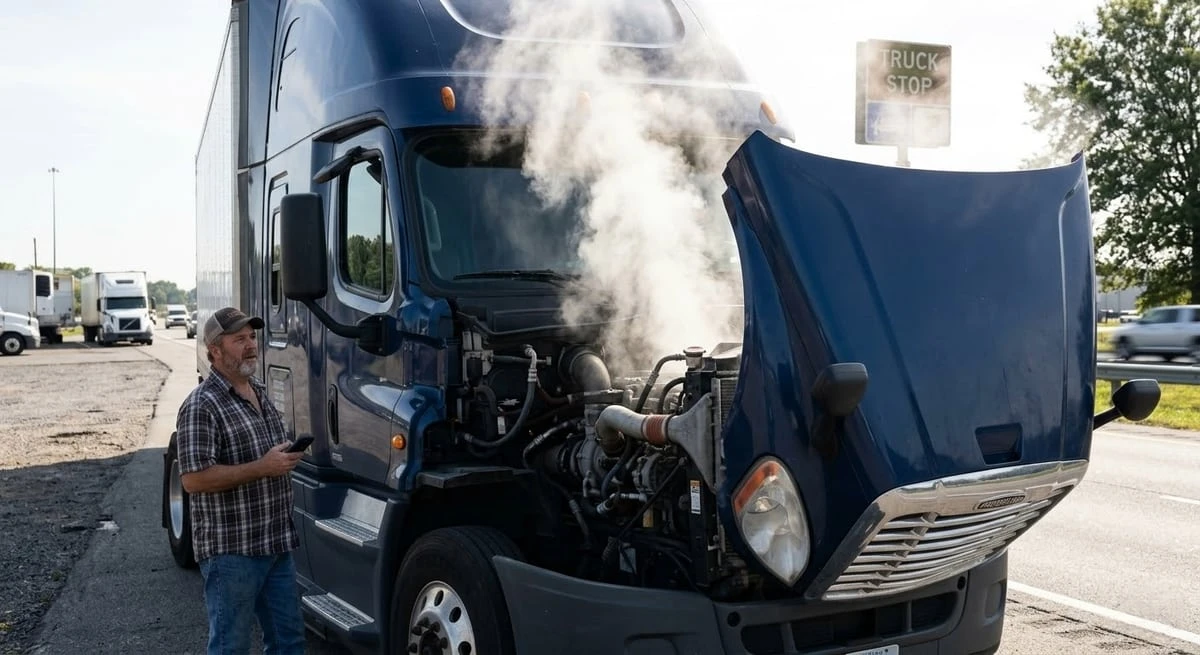
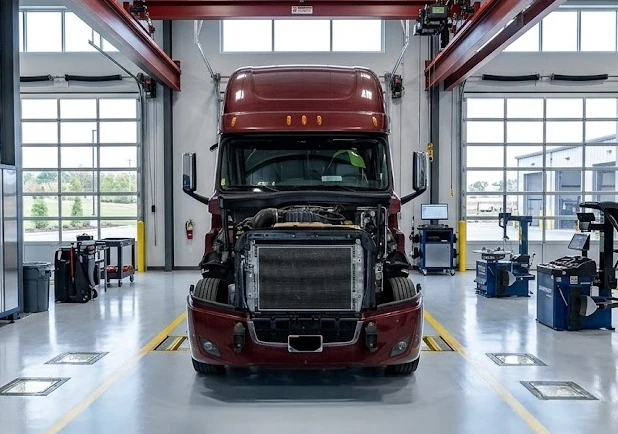
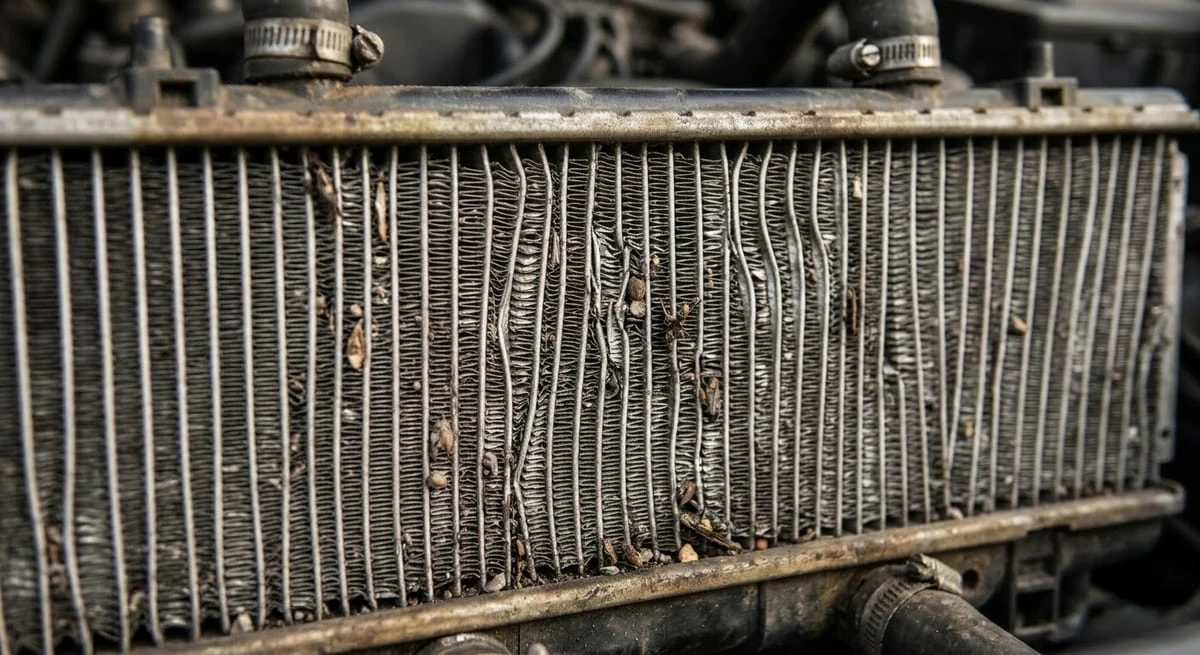
A cracked coolant reservoir is one of the most deceptive failures on a semi truck. Unlike a blown radiator hose that soaks the engine bay, a cracked degas bottle loses coolant slowly — a small weep at a seam that only leaks when the system is hot and pressurized. By the time a driver notices the low coolant warning light, the system may have been losing coolant for days or weeks. Left unaddressed, it ends in an overheating event that can warp a cylinder head or crack a block.
This guide covers what a coolant reservoir actually does, the five symptoms that point to a failing tank, why plastic tanks crack in the first place, and what replacement looks like by truck make.
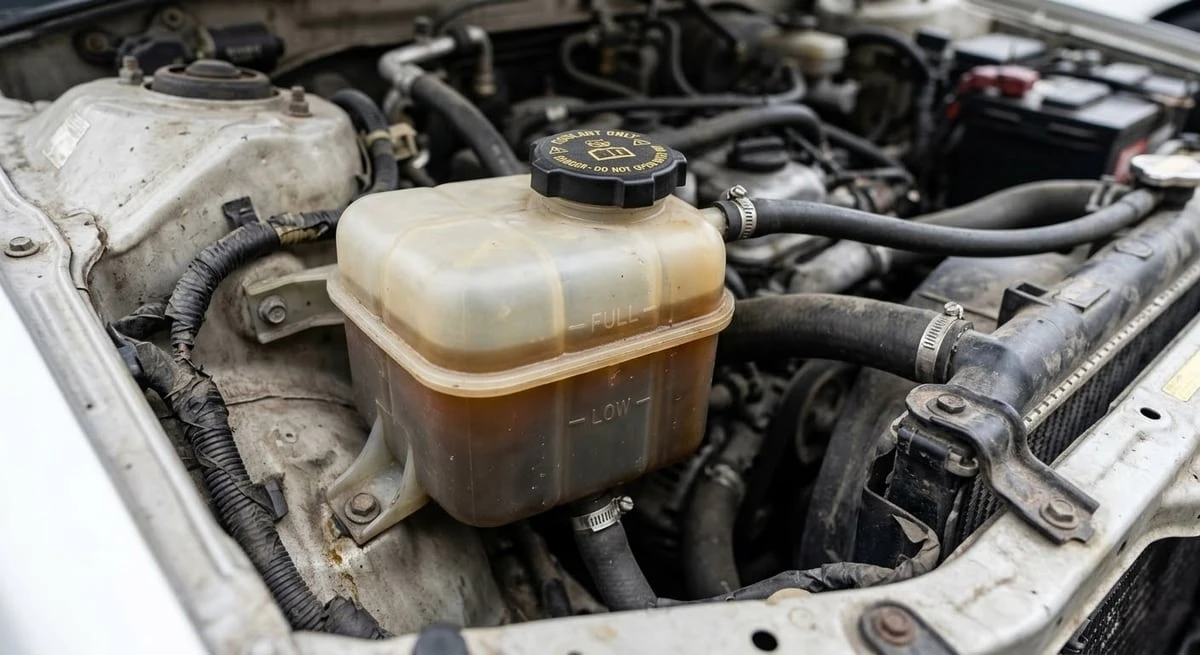
Coolant condition in the reservoir tells the story of the entire cooling system. Rust-brown, milky, or oil-contaminated coolant visible through the tank wall is a sign the system needs immediate attention.
Driving a Cascadia? See Cascadia cooling system problems for the year-by-year radiator breakdown.
In this article
What a Coolant Reservoir Actually Does
The terms "coolant reservoir," "degas bottle," "overflow tank," and "expansion tank" are often used interchangeably — but on modern Class 8 semi trucks, the degas bottle is not simply an overflow container. It is a pressurized component that performs three specific functions:
- Coolant expansion buffer: As the engine heats up, coolant expands by roughly 10% in volume. The reservoir absorbs this expansion, preventing pressure spikes that would blow hoses or damage the radiator. As the engine cools, coolant contracts and is drawn back from the reservoir into the system.
- Air and gas separation: The "degas" in degas bottle refers to degassing — separating entrained air bubbles from the coolant. Air in the cooling system creates hot spots and reduces heat transfer efficiency. The bottle sits at the highest point in the system so bubbles rise into it and are released through the pressure cap.
- System pressure maintenance: The reservoir cap controls the pressure of the entire cooling system — typically 90–110 kPa on Class 8 trucks. Maintaining higher pressure raises the boiling point of the coolant, which is essential for engine temperatures that regularly exceed 90°C.
Because the degas bottle is pressurized and thermally cycled every time the engine runs, it is under constant stress. This is fundamentally different from the simple unpressurized overflow bottles used on older trucks — which is why cracked or leaking degas bottles are more common and more consequential than people expect.
Key distinction: On most modern semi trucks, the degas bottle is the primary coolant fill point — not the radiator. Adding coolant directly to the radiator on these systems bypasses the degas function and can introduce air into the system. Always fill at the reservoir unless the service manual says otherwise.
5 Symptoms of a Failing Coolant Reservoir
1 Coolant Level Drops with No Puddle Under the Truck
This is the defining symptom of a cracked degas bottle — and the reason it goes unnoticed for so long. A hairline crack along a seam or at a mounting point only opens under heat and pressure. When the engine is cold, the crack closes or weeps so slowly it evaporates before reaching the ground. You top up the coolant, it looks fine cold, then a week later it's low again.
If coolant level drops repeatedly with no coolant visible under the truck, no milky oil suggesting internal leaks, and no steam from the exhaust, the reservoir itself is almost always the source. A pressure test of the cooling system will confirm it.
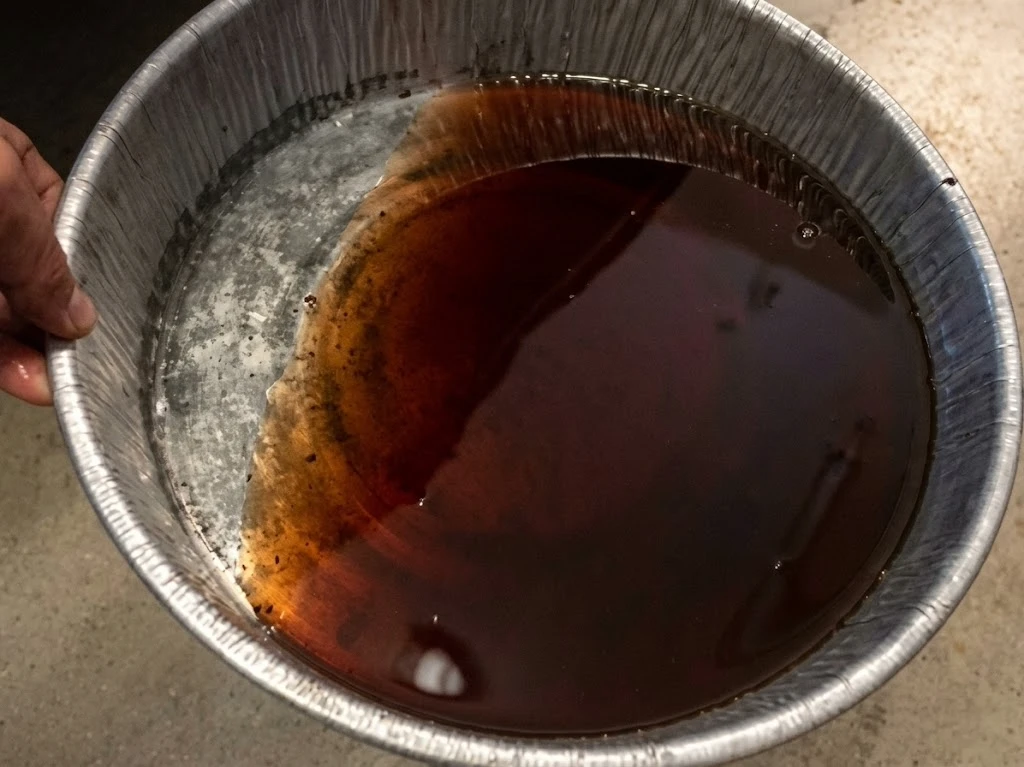
Rust-brown coolant indicates the inhibitor package has failed. Acidic, depleted coolant accelerates corrosion of the plastic reservoir and aluminium radiator components from the inside.
2 White Mineral Deposits Around the Reservoir
Coolant that seeps from a crack leaves a white or orange mineral residue when it evaporates. Look carefully around the reservoir seams, at the cap neck, at the hose connections, and at the mounting bracket contact points. Even a small chalky deposit means coolant has been escaping at that location. On light-coloured reservoirs this is easy to spot; on darker plastic it can be easy to miss. Run your finger along the seams — if it comes away with white powder, the tank is weeping.
3 Temperature Gauge Creeping Higher Than Normal
A cooling system that's slowly losing coolant eventually loses enough volume that heat transfer is compromised. The temperature gauge begins to read higher than usual — not alarming at first, but trending up over days or weeks. If your truck's temperature gauge has moved from its normal position without a change in load or ambient conditions, loss of coolant volume is one of the first things to investigate. Check the reservoir level cold, every morning, for a week.
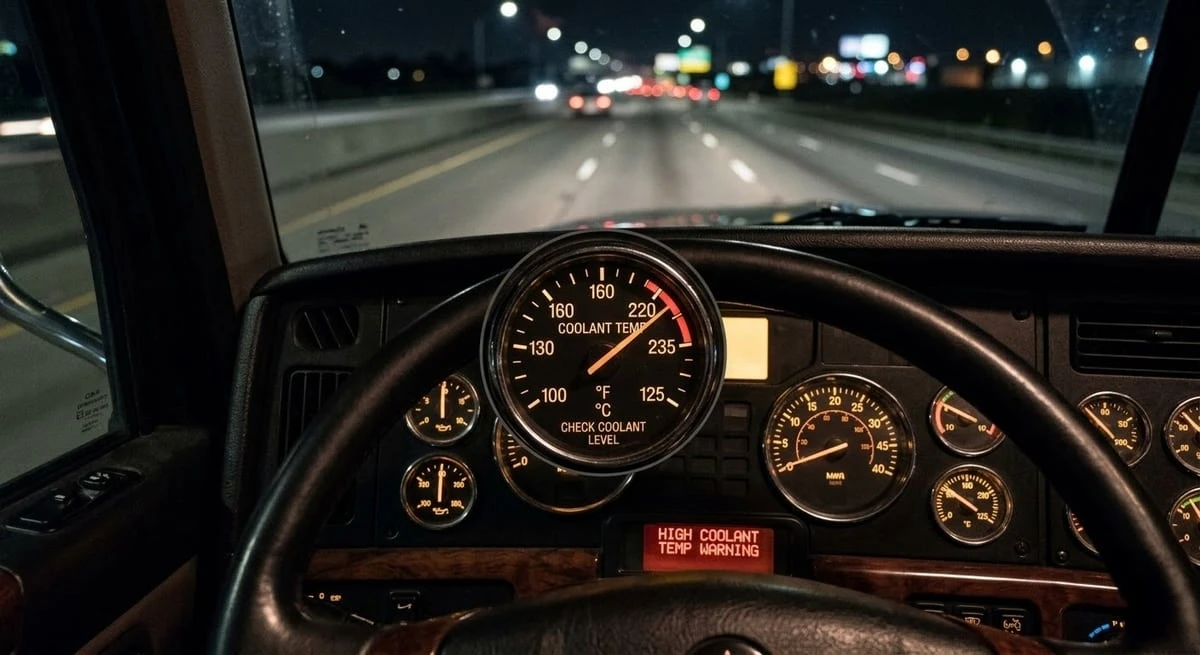
A temperature gauge that trends higher over time — rather than spiking suddenly — typically points to gradual coolant loss. Check the reservoir first before opening the radiator cap.
4 Visible Cracks, Discolouration, or Deformation on the Tank
Inspect the reservoir visually with a flashlight. Look for:
- Hairline cracks along the seam welds (where the tank halves join)
- Crazing — a network of fine surface cracks on the plastic, often seen near heat sources
- Yellowing or browning of the plastic, which indicates heat damage and brittle material
- Bulging or deformation of the tank walls, which means the plastic has softened from heat cycles
- Corrosion or stress cracking at the mounting bracket attachment points
Any of these is a reason to replace the reservoir before it fails completely. A degas bottle that has visible crazing is weeks away from a seam opening under pressure.
5 Coolant Smell Inside the Cab
On cab-over and conventional trucks where the reservoir is mounted near the firewall, a leaking degas bottle can allow coolant vapour to enter the cab through the HVAC fresh-air intake. If you smell a sweet, slightly chemical odour in the cab that's not exhaust-related, check the reservoir and the fresh-air intake path. Coolant vapour is not just unpleasant — glycol inhalation over extended periods causes respiratory irritation.
Never open a pressurized cooling system on a hot engine. The degas bottle cap controls system pressure. Opening it while the engine is hot and the system is pressurized releases a violent burst of boiling coolant. Wait at least 30 minutes after shutdown and confirm the cap is cool to the touch before opening.
Need a replacement coolant tank?
OEM-fit degas bottles for Freightliner, Kenworth, Peterbilt, Hino, Mack & Volvo. Same-day quotes, GTA pickup or ships Canada-wide.
Why Plastic Coolant Tanks Crack
Understanding why degas bottles fail helps predict when yours is at risk. There are four primary causes:
Thermal Cycling Fatigue
Every engine start-and-stop cycle takes the reservoir from ambient temperature to 90–110°C and back again. Plastic expands and contracts with each cycle. Over hundreds of thousands of kilometres, the material fatigues — particularly at the seam welds and at stress concentration points like mounting holes and hose barbs. Urban trucks doing 60–80 stops per day cycle the cooling system far more aggressively than highway trucks covering the same distance.
Coolant Chemistry Degradation
Fresh coolant contains inhibitors that protect metal and plastic components. As those inhibitors deplete — typically over 2–3 years or 150,000–200,000 km — the coolant becomes acidic. Acidic coolant attacks the plastic reservoir from the inside, making it brittle and susceptible to cracking. A truck running long-overdue coolant is far more likely to develop a cracked reservoir than one on a proper coolant change schedule.
Physical Damage from Vibration
The reservoir mounting brackets take constant vibration from the drivetrain and road surface. If a bracket is loose, corroded, or missing a rubber isolator, the tank vibrates against the bracket and develops stress cracks at the contact points. On trucks with significant frame flex — heavy haul, off-road, construction — this is accelerated. Check bracket condition at every reservoir replacement.
Age and UV Degradation
Plastic becomes brittle with age regardless of use. UV exposure from sunlight accelerates this on reservoirs mounted in exposed locations. A reservoir on a 10+ year old truck may fail from age even with excellent maintenance history. High-mileage trucks should have the reservoir inspected carefully regardless of visible symptoms.
How to Inspect and Diagnose a Failing Reservoir
Visual Inspection (Cold Engine)
With the engine cold, remove the reservoir cap and check:
- Coolant level: Should be between MIN and MAX marks. If consistently low, track it daily for a week.
- Coolant colour: Should match the factory spec (pink/red LLC on most modern trucks, green on older systems). Brown, rust-coloured, or milky coolant indicates contamination.
- Cap condition: The pressure cap contains a spring-loaded valve. Press the valve — it should move smoothly and snap back. A cap that doesn't hold pressure causes the system to lose coolant through boiling at lower-than-normal temperatures.
- Tank exterior: Run your fingers along all seams. Look with a flashlight for cracks, crazing, mineral deposits, and deformation.
Pressure Test (Most Reliable)
A cooling system pressure tester — a hand pump that attaches to the reservoir filler neck — pressurizes the system to the cap's rated pressure (usually 90–110 kPa). If the system cannot hold pressure for 5 minutes, there is a leak. To isolate the reservoir: remove it from the system, cap its hose barbs, and pressurize it directly. Bubbles in a water bath pinpoint the exact leak location.
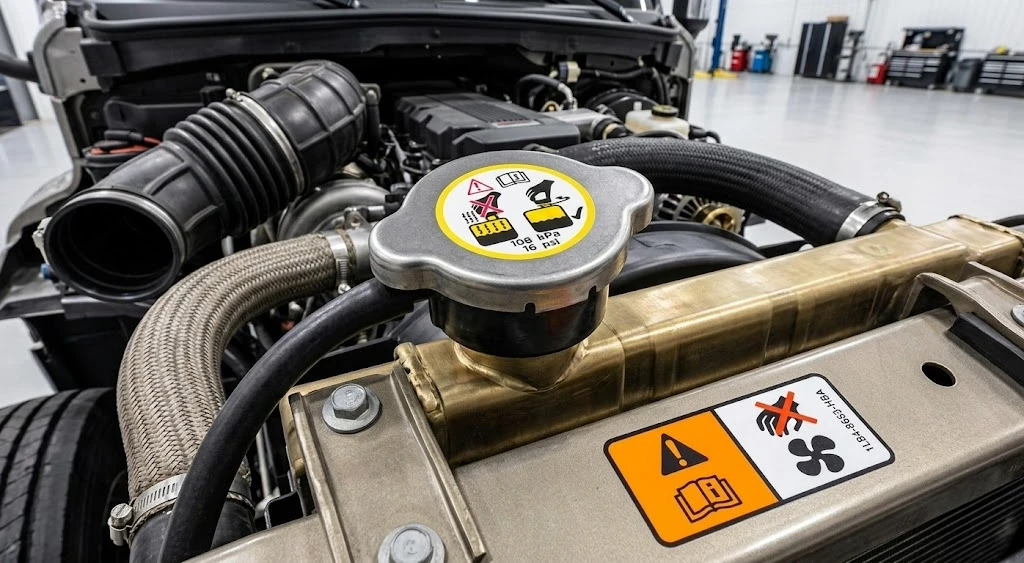
A failed reservoir cap is often mistaken for a cracked tank — the symptoms are identical. Always test the cap separately before condemning the reservoir itself. Caps are a $15 fix; reservoirs are $80–$200.
Notes by Truck Make
Freightliner Cascadia
The Cascadia's degas bottle is mounted on the passenger side of the engine compartment, high up near the firewall. The most common failure point is the upper seam weld and the cap neck — the cap neck takes repeated stress from cap removal and reinstallation during coolant checks. Freightliner Cascadias on long-haul routes with coolant changes every 3 years typically see reservoir failure at 500,000–700,000 km. Urban-spec trucks on city delivery routes fail faster — 250,000–400,000 km is common. We stock Freightliner-fit coolant reservoirs for same-day pickup.
Kenworth T680 / T880
The T680's reservoir is positioned near the top of the cooling stack and is visible through the hood opening. Kenworth uses a clear-plastic reservoir on many configurations, which makes level checking easy but also makes UV degradation more visible — yellowing plastic is a clear indicator the material is aging. The hose connections on the T680 reservoir use push-lock fittings that can loosen with age; check fitting security when inspecting the tank.
Peterbilt 389 / 579
Peterbilt 389s with pre-emission Cummins or Caterpillar engines often have older-style expansion tanks that predate the modern degas design — these are non-pressurized and have a different failure mode (cap seal degradation rather than tank cracking). Peterbilt 579s with PACCAR MX engines use a full pressurized degas bottle similar to the T680. Know which system your truck has before ordering a replacement.
Hino 268 / 338
Hino's coolant reservoir is one of the highest-frequency replacements we see from GTA fleets. The urban delivery cycle — 60–100 engine start-stops per day — thermally cycles the reservoir far more aggressively than highway trucks. Hino 268 and 338 owners in GTA fleet service should budget for reservoir replacement at 200,000–300,000 km as preventive maintenance. The part is inexpensive; the downtime from a failure during a busy delivery shift is not. We keep Hino degas bottles in stock at our Vaughan location for same-day pickup.
Volvo VNL (D13)
Volvo VNLs use a separate degas bottle distinct from the radiator overflow system. The Volvo reservoir incorporates a float-style coolant level sensor that triggers the low coolant warning light — if the warning light comes on but the reservoir appears full, the sensor may have failed rather than the coolant being genuinely low. Confirm actual level against the MIN/MAX markings before adding coolant. Volvo reservoirs are generally durable but become brittle after 800,000+ km on the original plastic.
Mack Anthem / Granite
Mack trucks — particularly the Granite in vocational applications — see high thermal stress from repeated heavy-load operation. The reservoir mounting bracket on the Granite is exposed to significant vibration, and bracket-induced stress cracking at the mounting tabs is the most common Mack reservoir failure mode. When replacing a Mack reservoir, inspect and replace the rubber isolators on the mounting bracket — they harden and lose their damping function with age.
Replacement: What to Do at the Same Time
Replacing a coolant reservoir is a straightforward job — drain the coolant, remove the hose connections and mounting hardware, swap the tank, reconnect and refill. But since the cooling system is being opened anyway, a few additional steps protect the investment:
- Replace the reservoir cap. The cap controls system pressure. A cap that is worn or set to a lower pressure than spec causes the system to run at lower pressure — which lowers the boiling point and causes overheating at temperatures that should be within range. A new cap costs $15–$25 and is always replaced with a new reservoir.
- Flush and replace the coolant if it is more than 2 years old or shows any discolouration. Putting a new reservoir on a system with degraded acidic coolant simply accelerates failure of the new part. See our semi truck cooling system flush guide for the step-by-step procedure.
- Inspect radiator hoses. Hoses that are more than 4 years old or feel soft and spongy should be replaced at the same time. An unexpected hose failure shortly after a reservoir replacement means opening the system again.
- Check the coolant level sensor if the truck has a reservoir-mounted sensor. Replace it if it has been submerged in degraded coolant for an extended period.
Coolant type matters: Most modern semi trucks require OAT (Organic Acid Technology) or HOAT coolant — not conventional green antifreeze. Mixing coolant types destroys the inhibitor package in both. Check the reservoir cap or service manual for the correct specification before adding coolant. Using the wrong coolant type accelerates corrosion of aluminium components and voids cooling system warranties.
Frequently Asked Questions
What is the difference between a degas bottle and a coolant overflow tank?
A degas bottle is pressurized and is the primary fill point for the cooling system — it actively separates air from coolant and maintains system pressure. An overflow tank (older style) is simply an unpressurized container that catches coolant overflow as it expands. Most modern Class 8 semi trucks use a degas bottle. If the cap on the tank shows a pressure rating (e.g., 90 kPa), it is a pressurized degas bottle.
How do I know if my coolant reservoir is cracked or if I just have a bad pressure cap?
Test the cap separately with a cap tester — most shops have one. If the cap holds its rated pressure, the cap is fine and the reservoir itself is the leak source. If the cap fails the test, replace the cap first and recheck. A bad cap costs $15–$25; misdiagnosing it as a cracked reservoir costs $100–$200 unnecessarily.
Can I drive with a cracked coolant reservoir?
Not recommended. A cracking reservoir loses coolant gradually and will eventually lose it quickly. If the reservoir fails completely at highway speed and the system loses its coolant charge rapidly, the engine can overheat in minutes — potentially causing head gasket failure or a cracked block. Replace it as soon as it is identified.
What coolant should I use in a semi truck?
Most modern semi trucks (2010 onward) specify OAT or HOAT extended-life coolant — typically pink/red in colour. Older trucks may specify conventional green antifreeze or SCAs (supplemental coolant additives). Never mix types. Check the reservoir cap label or your truck's maintenance manual. In Canada, use a coolant concentrate mixed to -40°C protection, not pre-diluted coolant.
How much does a semi truck coolant reservoir cost?
OEM-fit replacement degas bottles typically cost $80–$200 CAD depending on the truck make and model year. Labour to replace is 1–2 hours at a shop. Total cost including coolant replacement runs $250–$500 CAD at a shop, or less if you do it yourself. This compares favourably to the $8,000–$25,000 cost of repairing engine damage from an overheating event caused by coolant loss.
Where can I get a coolant reservoir for a Hino truck in the GTA?
True Truck Parts stocks OEM-fit Hino coolant reservoirs for the 268, 338, and XL series at our Vaughan location. Contact us with your model year for same-day availability. We also ship Canada-wide for next-day delivery across the GTA.