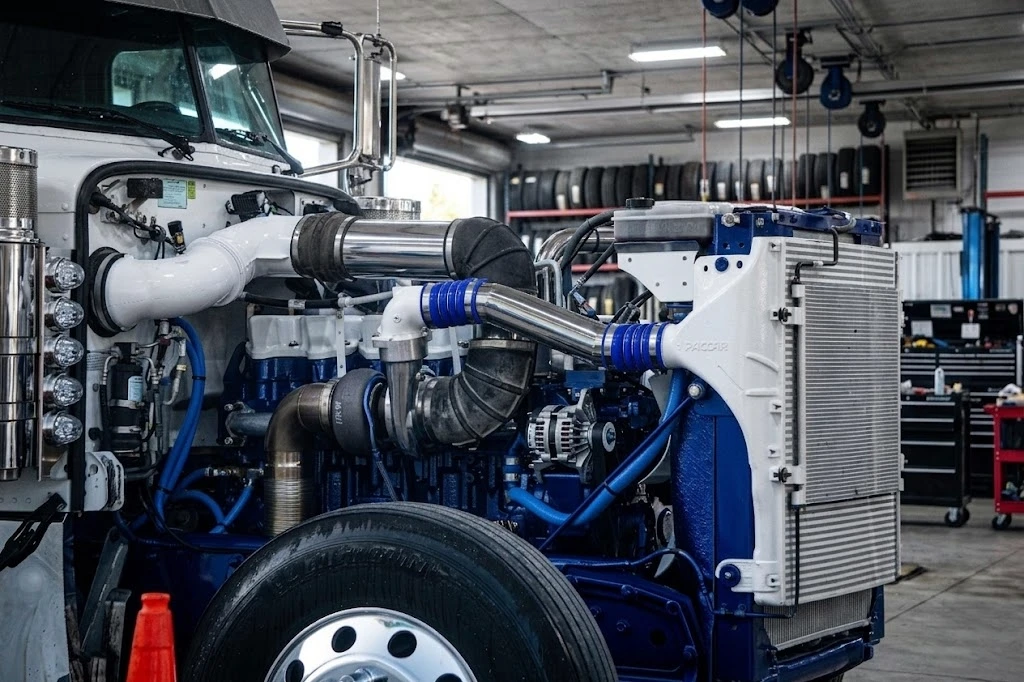
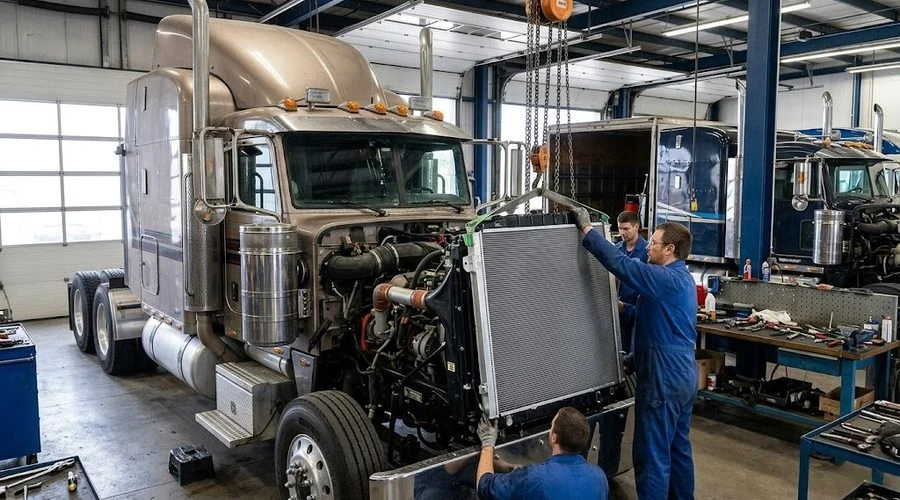
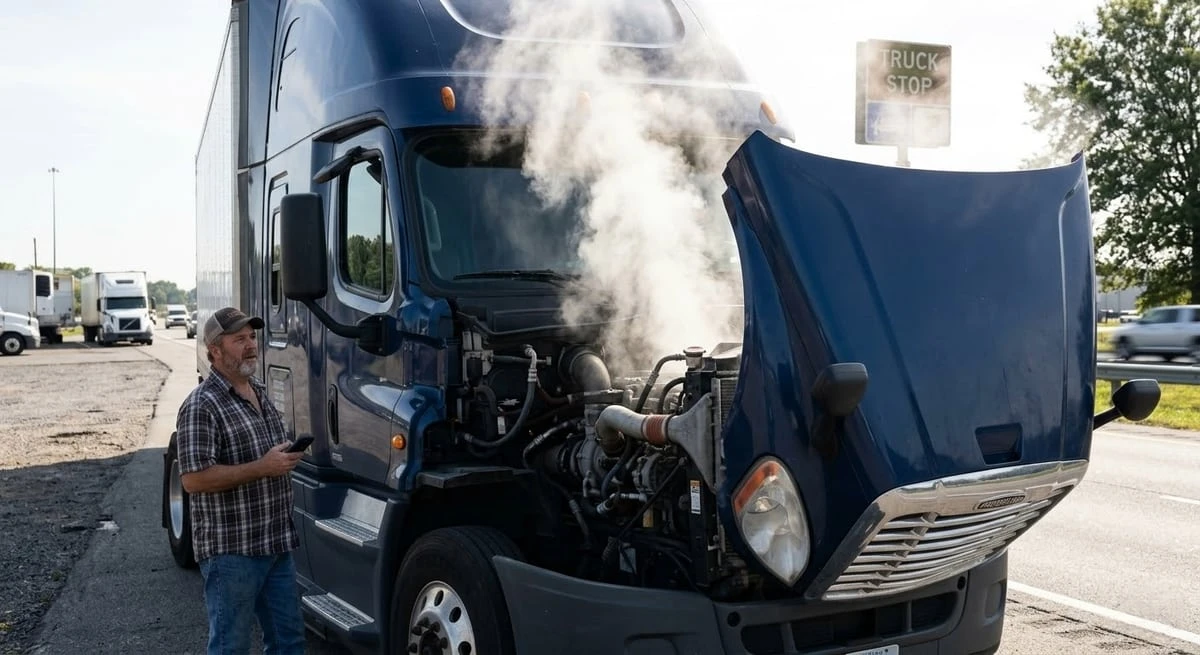
The most common question we get on Cascadias is some version of "what radiator fits a 2012?" — and the honest answer is not one part number. A 2012 Cascadia matches five different radiators in our own stock. A 2023 matches six.
That is not a cataloguing failure. It is what happens when one model name covers nearly two decades, three generations, several engine families and both day cab and sleeper configurations. The model year narrows the field. It does not decide it. This guide covers what actually does, and the failures that bring most Cascadias into a shop in the first place.
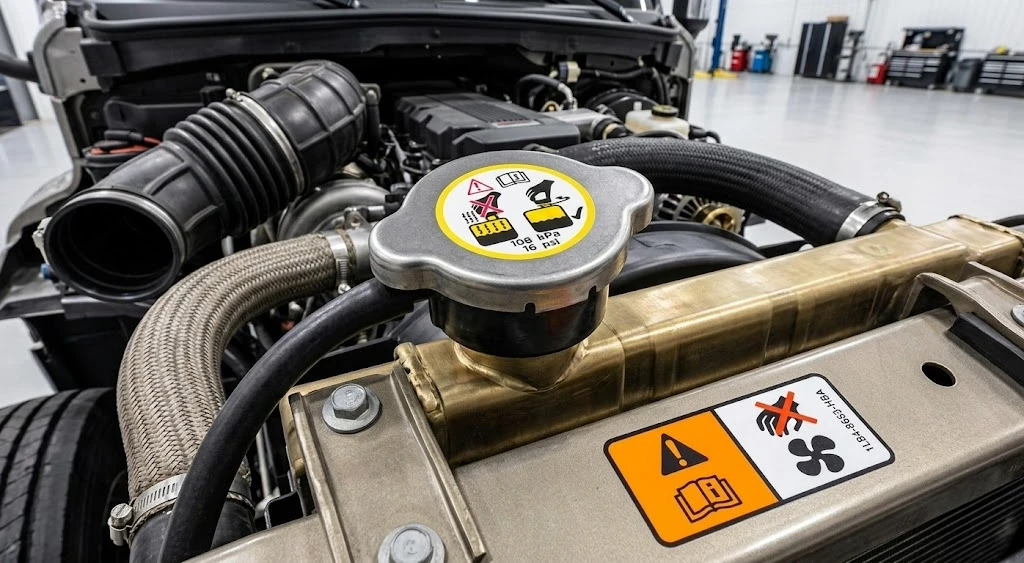
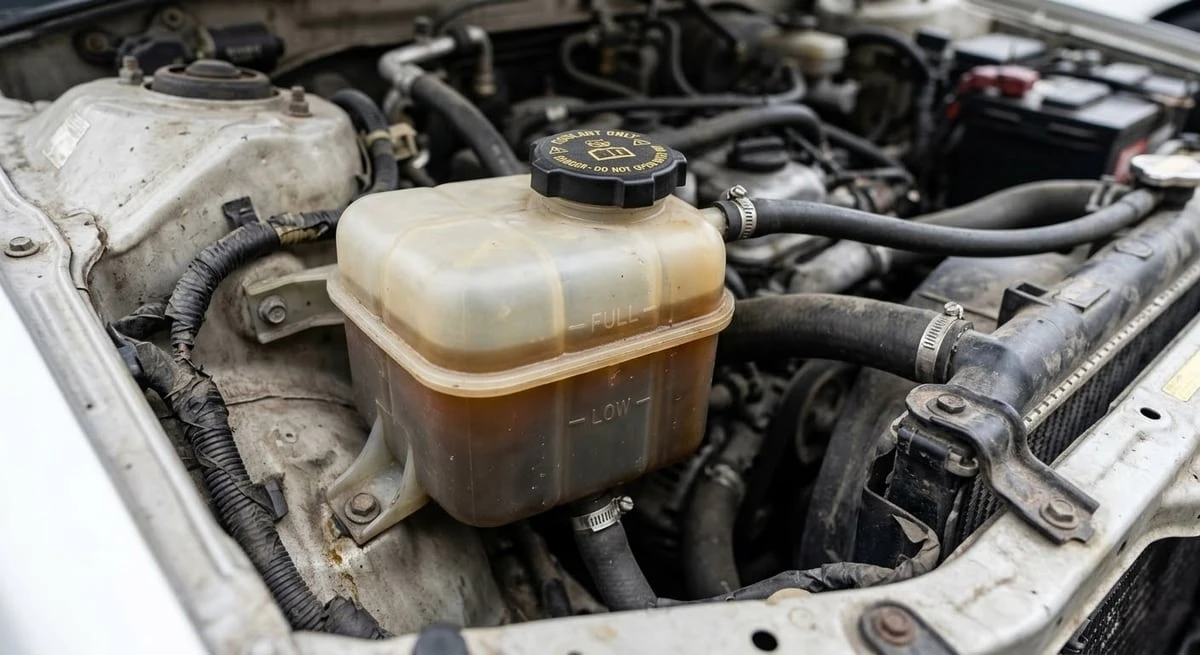
The pressure cap is the cheapest part of a Cascadia's cooling system and one of the most consequential. A cap that no longer holds its rating lowers the boiling point of everything behind it.
In this article
Why the Model Year Is Not Enough
Search "2012 Freightliner Cascadia radiator" and you will get confident answers from a dozen sellers. Check them against each other and they will not agree, because the question is underspecified.
Here is what a model year actually resolves to in our catalogue:
- 2010 — 4 radiators fit
- 2012 — 5 radiators fit
- 2015 — 4 radiators fit
- 2019 — 5 radiators fit
- 2023 — 6 radiators fit
Those are not duplicates of one another. They differ in core height, core width, core depth, whether an oil cooler is built into the tank, and where the inlet and outlet sit. A 2012 Cascadia built as a day cab with one engine option does not take the same radiator as a 2012 sleeper with another.
The single most useful thing you can do is read the number off the old radiator before ordering. It resolves in one step what a year, a model and a guess cannot resolve at all. Every radiator we list carries its OEM cross-references, so searching that number lands directly on the part.
The Generations, and What Changed
The Cascadia name has covered three fairly distinct trucks. Knowing which one you have narrows the field faster than the year alone:
- Original Cascadia, roughly 2008–2016. The launch truck. Detroit Series 60 early on, then DD13 and DD15. Radiators in this era commonly carry an integral oil cooler in the bottom tank.
- Cascadia Evolution, roughly 2014–2016. An aerodynamic and driveline update rather than a new cab. It is catalogued separately because the cooling package differs — we hold a distinct radiator for it.
- New Cascadia, 2018 onward. A new cab and a substantially revised front end. Fleets commonly call the 2018–2021 trucks Generation 4 and the 2022 refresh Generation 5, and parts catalogues have followed that usage, including ours.
The practical consequence: a radiator for a 2017 truck and one for a 2019 truck are different parts even though only two years separate them, because the cab changed in between. That single boundary explains a large share of the wrong-part returns on this model.
How to Identify the Right Radiator
In order of how reliably each one settles the question:
- The number on the old part. Definitive. Nothing else comes close.
- Inlet and outlet position. Which side, and at what height. A radiator whose outlet is bottom left will not plumb into a truck expecting bottom right, whatever the core measures.
- Integral oil cooler, or none. Roughly half of the heavy truck radiators we stock have one. If yours does and the replacement does not, there is nowhere to land the oil lines.
- Core dimensions. Height, width and depth. Depth is the one people skip and it changes both capacity and airflow.
- Filler neck, or none. Most modern Cascadias fill at the degas bottle and the radiator has no neck at all.
- Model year. Useful for narrowing. Never sufficient on its own.
Our Freightliner radiator listings carry those positions and dimensions where we hold them, so a part can be matched on specification rather than on a photograph.
Every Cascadia radiator we stock, by year
The table is the catalogue itself. Find your year in the range column and you will usually see several rows — that is the point. The columns to the right are what separates them.
| Part | Years | Core H x W x D | Oil cooler | Price |
|---|---|---|---|---|
| TFR0039 | 2007–2011 | 45.625" x 38.625" x 2" | Bottom | on request |
| TFR0011 | 2008–2013 | 45.625" x 38.625" x 2" | Bottom | $1,374 |
| TFR0026 | 2008–2015 | 42.125" x 38.625" x 2" | Bottom | on request |
| TFR0040 | 2008–2015 | 42.125" x 38.625" x 2" | Bottom | on request |
| TFR0031 | 2012–2018 | 35.75" x 38.625" x 2" | Bottom | on request |
| TFR0041 | 2012–2014 | — | — | $1,089 |
| TFR0022 | 2014–2015 | 35.75" x 38.625" x 2" | Bottom | on request |
| TFR0001 | 2016–2026 | — | — | on request |
| TFR0002 | 2017–2025 | — | — | on request |
| TFR0023 | 2017–2020 | 35" x 38.5" x 2" | Bottom | on request |
| TFR0003 | 2018–2026 | — | — | $1,039 |
| TFR0065 | 2018–2026 | — | — | on request |
| TFR0004 | 2022–2025 | — | — | $1,139 |
| TFR0020 | 2022–2025 | — | — | on request |
A dash in the core column means we have not recorded those dimensions for that unit yet — ask and we will measure it. Where two rows overlap your year, the oil cooler column is usually the deciding one, and after that the inlet and outlet positions listed on each part's own page.
5 Failures That Account for Most Complaints
1 Radiator Tank and Seam Leaks
Plastic end tanks are crimped onto an aluminium core over a gasket. Thermal cycling works that joint loose over years, and it usually weeps under pressure and load rather than dripping on a cold truck in a yard. If you are topping up coolant and finding no puddle, pressure-test before replacing anything.
2 A Cracked Degas Bottle
The Cascadia fills at the degas bottle, which is pressurised and thermally cycled every run. A hairline crack at a seam or mounting boss loses coolant slowly and invisibly. This is the single most under-diagnosed cooling fault on the model — see the degas bottle guide for the symptom pattern.
3 Charge Air Cooler Boost Leaks
The charge air cooler sits ahead of the radiator and shares its airflow. A leaking CAC does not raise coolant temperature directly, but it does cost power and raise exhaust gas temperature, and its fin pack blocks the air the radiator needs. Cascadia CAC problems covers this in depth.
4 A Blocked Fin Pack
Almost all the heat leaves by convection into moving air, so a core packed with bugs, chaff and road film loses capacity regardless of coolant condition. Hold a light behind the stack: if daylight does not come through, airflow is your problem and no new coolant will fix it.
5 Thermostat and Pressure Cap
The two cheapest parts in the system and the two most often skipped. A stuck-open thermostat produces no drama at all — the engine simply runs cool, warms slowly and quietly costs fuel. A cap that no longer holds its rating lowers the boiling point of the whole system, so the truck behaves normally in April and boils over on the first hard climb in July.
Diagnosing Cascadia Overheating, in Order
Working cheapest and most likely first saves replacing a radiator that was never the problem:
- Look through the stack at a light. Blocked fins are the most common cause and cost nothing to rule out.
- Check the coolant level cold, and the cap. Test the cap against its rating rather than eyeballing it.
- Pressure-test the system. This finds the degas bottle and seam leaks that never show as a puddle.
- Check the thermostat by feel. A radiator that stays cold while the engine climbs points straight at a stuck-shut thermostat.
- Check the fan clutch engages. A fan that never locks up will hold temperature fine on the highway and lose it on a grade.
- Only then suspect the core. Internal scaling from old coolant is real, but it is the last thing to conclude, not the first. Flushing on schedule is what prevents it.
For the full list of causes beyond this model, see semi truck overheating causes.
What the Parts Cost
From our own catalogue rather than an industry average — these are the Freightliner parts we publish a price for:
- Radiators: $709 to $1,709 CAD, across 27 priced units of 68 in stock
- Charge air coolers: $844 to $1,349 CAD, 22 priced of 26
- A/C condensers: $189 to $329 CAD, 15 priced of 16
Labour is on top and depends mostly on how much of the front end has to come apart. Against that, the cost of running a marginal cooling system is a warped head, which is an order of magnitude more and takes the truck off the road while it is sorted.
Frequently Asked Questions
What radiator fits a 2012 Freightliner Cascadia?
Five different radiators in our stock list a 2012 Cascadia in their fitment. They differ in core depth, oil cooler presence and inlet/outlet position, so the year alone cannot pick between them. Read the number off the old radiator, or send us the VIN and we will confirm which one your truck takes.
Why do so many radiators fit the same year?
Because one model year covers several build configurations — day cab and sleeper, different engine families, with and without an integral oil cooler. Each of those can take a different cooling package. The year narrows the field; the build decides it.
Is a 2017 Cascadia radiator the same as a 2019?
No. The New Cascadia arrived for 2018 with a new cab and a substantially revised front end, so parts either side of that boundary are different despite the years being close. This is one of the most common sources of wrong-part returns on the model.
What is the difference between Generation 4 and Generation 5 Cascadia?
Fleets and parts catalogues generally use Generation 4 for the 2018–2021 New Cascadia and Generation 5 for the 2022 refresh. It is trade usage rather than a Freightliner model designation, but it is how parts are commonly listed, including in our own catalogue.
My Cascadia loses coolant with no visible leak. Where is it going?
Most often a cracked degas bottle. It is pressurised and thermally cycled, and a hairline crack weeps only when hot and under pressure, then evaporates before it reaches the ground. A cooling system pressure test finds it in minutes.
Does a leaking charge air cooler cause overheating?
Not directly — it carries no coolant. But it sits ahead of the radiator and shares its airflow, so a damaged or blocked CAC reduces the air the radiator gets, and the boost leak itself raises exhaust gas temperature. Inspect the whole stack rather than the component the gauge seems to blame.
How long should a Cascadia radiator last?
There is no fixed interval. Most fail through seam fatigue, stone damage or scaling rather than wear, and coolant maintained on schedule is the single biggest factor. See how long a semi truck radiator lasts.
Where can I get Cascadia cooling parts in the GTA?
True Truck Parts stocks 39 Cascadia-specific cooling and A/C parts, including 14 radiators, within a Freightliner range of 156 parts. Core dimensions, inlet and outlet positions and OEM cross-references are listed on each. Send us the number off the old part or your VIN and we will confirm fitment. Same-day pickup in Vaughan, shipping Canada-wide.