Not sure what the charge air cooler does? See what a charge air cooler is and how it works first.
Driving a Cascadia? See Cascadia cooling system problems for the year-by-year radiator breakdown.
In this article
What the Charge Air Cooler Does on a Freightliner Cascadia
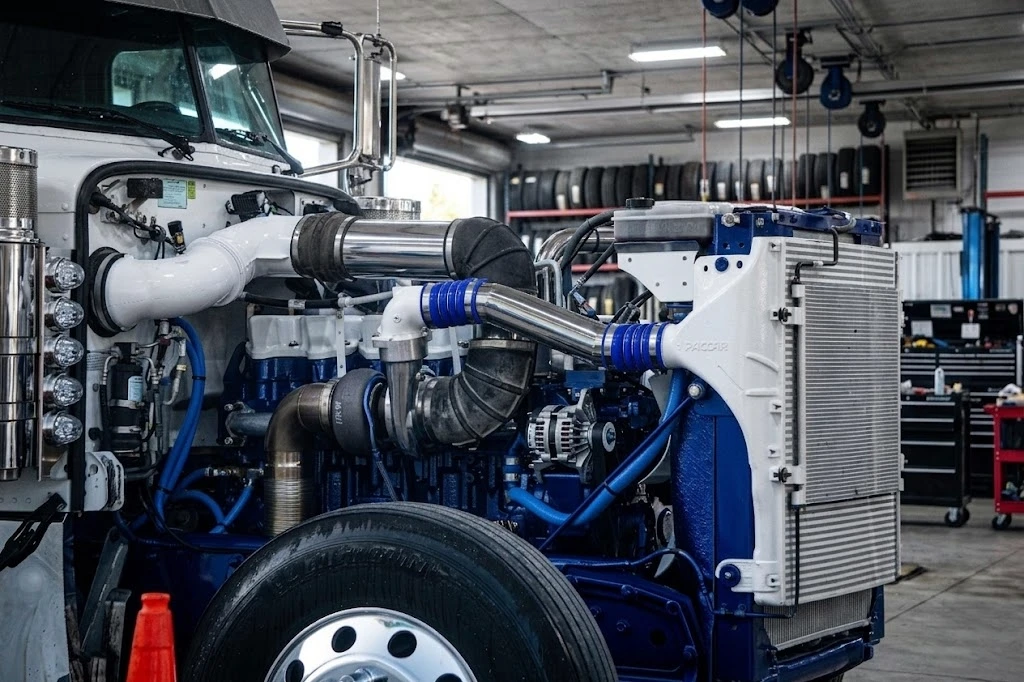
When a turbocharger compresses intake air, that air heats up — and hot air is less dense, which means less oxygen per stroke, less combustion, less power. The charge air cooler (CAC), also called an intercooler or air-to-air cooler, sits between the turbo outlet and the engine intake. It takes that compressed, scalding air and runs it through an aluminium core mounted behind the grille where passing air cools it back down before it enters the cylinders.
On a Cascadia, a properly functioning CAC drops charge air temperature by 50–80 °C. That temperature drop increases air density enough to improve fuel economy, reduce EGT (exhaust gas temperature), and let the engine make full rated power. A leaking or plugged CAC starves the engine of dense air — and your charge air cooler becomes the bottleneck for everything downstream.
Cascadia CAC Specs by Engine
The Freightliner Cascadia has been offered with several engine families, and the CAC dimensions, inlet/outlet sizes, and part numbers differ. Knowing your engine matters before you order a replacement.
| Engine | Years | Core Size (approx.) | Notes |
|---|---|---|---|
| Detroit DD13 | 2008–present | 900 × 600 × 52 mm | Most common in regional/LTL Cascadias; end-tank cracking is the #1 failure |
| Detroit DD15 | 2008–present | 950 × 630 × 52 mm | Long-haul spec; higher boost pressure, slightly larger core; check boost lines first |
| Detroit DD16 | 2012–present | 950 × 650 × 60 mm | Heavy-haul; less common; same plastic end-tank failure mode |
| Cummins ISX15 / X15 | 2008–2017 | 900 × 610 × 52 mm | Plastic-to-aluminium crimped joint is the weak point |
The Cascadia Evo (2018+) is dimensionally the same body as the pre-Evo for CAC purposes — both use the same front-mount layout behind the bumper fascia. The 2022+ Cascadia uses a revised bracket system but the core dimensions are unchanged.
6 Signs Your Freightliner Cascadia CAC Is Failing
A Cascadia CAC fails in two main ways: it develops a leak (boosted air escapes before reaching the intake) or it becomes internally plugged (oil from a worn turbo or rings coats the fins and reduces airflow). Both kill performance, but the symptoms are slightly different.
1 White or Grey Smoke at Cold Start That Clears Quickly
If your Cascadia puffs white or thin grey smoke for 30–60 seconds at cold start then runs clean, you likely have oil contamination inside the CAC. A worn turbo or failing piston rings lets oil vapour into the boost circuit. That oil sits pooled in the lowest point of the CAC overnight, then burns off at startup. It's not always the CAC itself that's failed — but the CAC is collecting the evidence. Pull an end boot and look inside with a light: if the inside of the CAC inlet tube is wet with oily residue, the core needs to come out for cleaning or replacement.
2 Noticeable Power Loss Under Load, Especially on Grades
This is the most common complaint we hear from Cascadia drivers: "She used to pull strong, now she's lazy going uphill." A leaking CAC dumps boosted air into the engine bay instead of the intake. The ECM sees lower-than-expected boost pressure at the manifold and either limits fuelling to protect the engine or simply doesn't have the air density needed to make power. The loss is proportional to the size of the leak — a pinhole crack might cost you 5–8% power; a cracked end tank can drop it 20% or more.
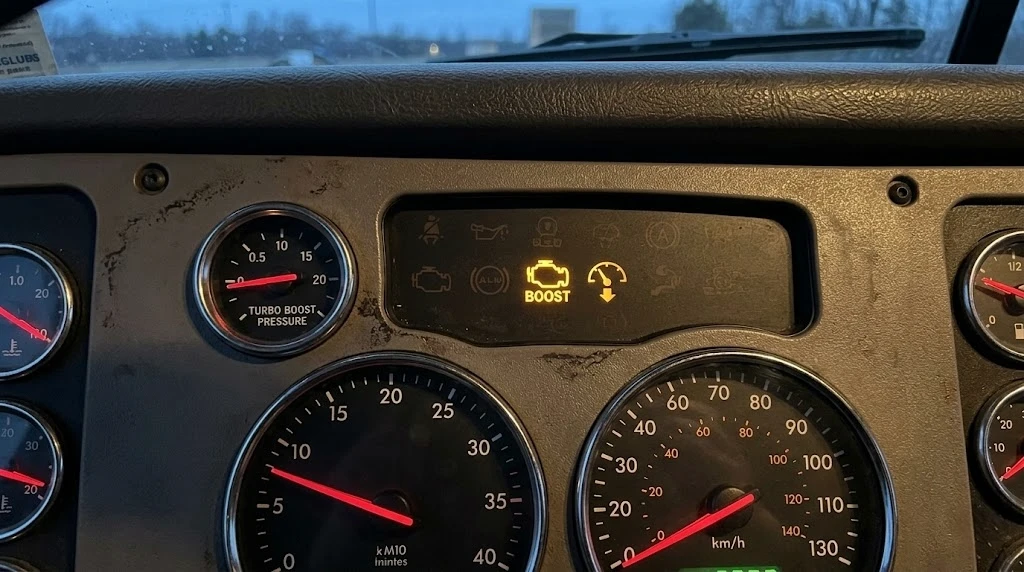
3 Fault Codes P0299 or SPN 102 / FMI 1
P0299 (Turbocharger / Supercharger Underboost) and SPN 102 FMI 1 (Boost Pressure Below Normal) are the two codes most directly tied to a leaking CAC on a Cascadia. The ECM expects a certain boost pressure map based on throttle position, engine speed, and load — if measured boost is consistently below that map, it flags it. Important: these codes don't confirm a bad CAC — a leaking boost pipe, a failing turbo, a cracked intake manifold, or a stuck wastegate will all produce the same codes. You need to do a pressure test to isolate the CAC.
Do not ignore SPN 102 FMI 1 codes on a DD15. Sustained underboost on the Detroit DD15 raises EGT and can trigger DPF regeneration cycles far more frequently, shortening DPF life and potentially damaging the SCR catalyst. Fix the boost leak first before investigating emissions system wear.
4 Increased Fuel Consumption — 5–10% Drop in MPG
Less dense air in the intake means the ECM adds more fuel to try to maintain requested torque. On a long-haul Cascadia doing 200,000 km/year, a 7% fuel economy penalty translates to thousands of dollars in extra diesel annually. If your fuel cost suddenly jumped and you haven't changed routes or loads, put a charge air temperature sensor on both sides of the CAC and compare: a healthy core should show at least a 50°C drop. A plugged core with good fin-to-air contact but restricted airflow will show a smaller drop.
5 Oil-Coated or Wet Boost Boots and Couplers
Walk around the front of the truck with a flashlight and squeeze each silicon boost boot and coupler between the CAC and the turbo, and between the CAC and the intake manifold. They should feel dry and firm. If any of them feel tacky, are visibly oily on the outside, or if you can smell diesel-oil residue around the engine bay intake side, you have a boost system oil leak — and the CAC is usually the collection point. Check the clamp torque on every coupler while you're there: they loosen from engine vibration and a loose coupler is a cheap fix before you pull the CAC.
6 Engine Running Hot / Elevated Intake Air Temperatures
A plugged CAC restricts airflow, which raises intake air temperature (IAT). High IAT forces the ECM to retard timing and reduce fuelling to protect the engine from knock — which compounds the power loss from the restriction itself. If your Cascadia dash is showing elevated IAT readings or the truck is running warmer than usual without a coolant system fault, suspect the CAC fins are plugged with oil film. This is especially common on trucks that have done 600,000+ km without a CAC cleaning.
Rule of thumb: If you have 2 or more of these symptoms together, do the pressure test described in the next section before replacing anything. A cracked boost pipe coupler will produce all 6 symptoms for $40 in parts — a proper diagnosis protects you from replacing a $1,200 CAC unnecessarily.
4-Step Diagnosis: How to Confirm a Bad Cascadia CAC
Step 1 — Visual Inspection of the Core and End Tanks
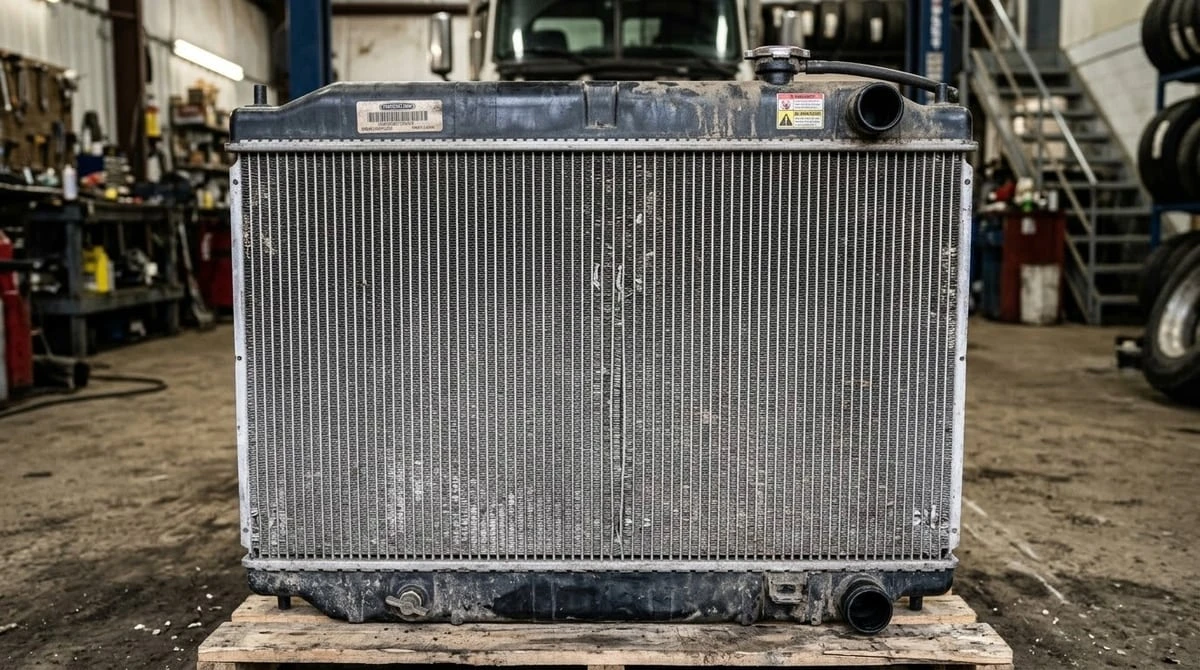
Remove the front fascia or grille access panel (on a Cascadia this is usually 4–6 bolts on the lower fascia). Look at the CAC end tanks — these are the plastic header tanks crimped onto the aluminium core on each side. Run your hand along the crimp joint on both tanks. Cracks here are the #1 failure point on a Cascadia CAC. Also check the fins: if the bottom 30% of the core face is caked with black oil residue and dead insects, airflow is reduced.
Step 2 — Boost Pressure Test (Shop Air Method)
With the engine off and cool, disconnect both boots from the CAC and cap them. Pressurize the CAC to 20–25 psi with shop air through a fitting in one of the end tank openings. Submerge the core in a large trough of water, or spray soapy water across all surfaces while the core is in the truck. Bubbles confirm a leak. Any leak means replacement — CAC cores cannot be reliably welded or brazed once the plastic end tanks are involved.
Do not exceed 30 psi during testing. A Cascadia CAC is designed for 100–120 kPa of continuous operating boost (about 15–17 psi). Testing at 25 psi is above operating pressure, which exposes any weak points, but exceeding 30 psi risks deforming the core fins or cracking a marginal end tank that might have lasted another year otherwise.
Step 3 — Intake Air Temperature Delta Check
With the truck running under load (ideally going uphill or at highway speed), log IAT1 (pre-CAC, after turbo) and IAT2 (post-CAC, at the intake manifold) simultaneously with a diagnostic scanner. A healthy CAC should show a delta of at least 50°C at full load. A delta below 30°C with normal ambient temperature suggests plugged fins. A delta near zero with high boost leak codes confirms a major leak that's bypassing the core entirely.
Step 4 — Inspect Boost Couplers and Pipes First
Before condemning the CAC, squeeze every silicon coupler and check every clamp. On a Cascadia the most common boost leak points are:
- The large lower silicon coupler between the CAC outlet and the intake manifold elbow — it loosens from vibration and often the clamp slides off the bead
- The upper inlet coupler from the turbo outlet — heat-cycles crack the silicon after 5–7 years
- The EGR cooler inlet pipe O-ring on DD13/DD15 — a common oil-into-intake source that looks like a CAC problem
- The MAP sensor O-ring on the intake manifold — a cheap part that causes P0299 codes when it leaks
Shop Cascadia Charge Air Coolers
DD13, DD15, DD16 and Cummins ISX fitments. GTA pickup or Canada-wide shipping.
Why Freightliner Cascadia CACs Fail Early
The Cascadia CAC is not a fragile part — a properly maintained unit should last 800,000–1,200,000 km. But several factors specific to how these trucks are used in Canada cut that life significantly:
Plastic End Tank Fatigue
The Cascadia CAC uses a plastic-crimped-to-aluminium tank design. The plastic tanks flex with each boost pressure cycle. In Canadian winters, the temperature swing from −25 °C overnight to full operating temperature under load creates a thermal stress cycle that the crimp joint accumulates over years. Most Cascadia CAC end-tank cracks appear at the 500,000–700,000 km mark, usually on the driver's side end tank first because it faces the prevailing wind and gets slightly colder.
Road Salt and Fin Corrosion
Southern Ontario roads are heavily salted from November through March. Salt water thrown up from the highway hits the CAC core face constantly. Aluminium fins corrode and become brittle; the solder joints between fins and tubes weaken. On trucks running the 400-series highways around the GTA, we see fin-to-tube separations at the lower core face by 600,000 km — even before an end-tank crack appears.
Oil from Turbo or Rings Plugging the Core
A worn turbo seal lets oil vapour into the pressurized intake circuit. That oil condenses and collects in the CAC, coating the internal fins with a layer of oil that progressively reduces airflow. A truck running a slightly worn turbo for 200,000 km can end up with a CAC that's 40% blocked internally while looking clean externally. If you're replacing a CAC because of oil contamination, also inspect or replace the turbocharger and its seals — otherwise the new CAC will fail in the same way.
Gravel and Rock Strike Damage
The Cascadia CAC sits directly behind the lower grille opening, which makes it the first thing a rock strike hits. A stone that would bounce off a steel bumper can punch through CAC fins and create a pin-leak that's undetectable visually from outside the truck but causes a persistent small boost leak. If you recently drove a gravel road or had a rock strike, that's where to start.
Freightliner Cascadia CAC Replacement Cost in Canada (2026)
The job itself is straightforward — the Cascadia's front-access design means a shop can pull and replace the CAC in 2–3 hours. The variable is the part cost.
| Item | DIY Cost (CAD) | Shop Total (CAD) | Notes |
|---|---|---|---|
| Aftermarket CAC (DD13/DD15) | $480–$680 | $950–$1,250 | Full aluminium bar-and-plate core; includes end tanks; best value for high-km trucks |
| OEM Freightliner CAC | $1,100–$1,600 | $1,700–$2,400 | Direct-fit guaranteed; worth it for trucks under 500,000 km or still under warranty |
| Boost coupler kit (silicon clamps) | $45–$85 | $100–$160 | Replace all couplers and clamps at the same time as the CAC — same labour |
| Labour only (GTA shops) | — | $220–$360 | 2–3 hrs at $110–$120/hr; straightforward access on Cascadia |
| CAC cleaning (oil contamination, no cracks) | $0 (DIY degreaser) | $120–$200 | Only viable if the boost test confirms no leaks; prevents replacing a structurally sound core |
If your truck is still hauling and you're deciding between doing it yourself vs. booking it in: the job requires removing the front fascia lower section, disconnecting the two main boost boots, unbolting 4–6 mounting brackets, and reversing the process. No special tools are needed beyond standard hand tools and a torque wrench. Most experienced Cascadia owner-operators do it in a Saturday morning.
OEM vs. Aftermarket Cascadia CAC: Which One to Choose
This is the question we get asked most often. The short answer: aftermarket is fine for most trucks over 500,000 km; OEM makes sense for newer trucks or if you're under a Freightliner service contract.
When to Choose OEM
- Truck is under 500,000 km and the rest of the cooling system is original and healthy
- You're enrolled in a Freightliner FTL Care or ConnectShield service contract and need to protect warranty coverage
- The truck runs a specific spec with Detroit's HVAC integration system that requires matched inlet/outlet sizing
- You're in a lease/return situation and need identical specs for the truck's documentation
When Aftermarket Is the Right Call
- Truck is over 600,000 km and the CAC is the second or third replacement
- Budget matters — a quality aftermarket CAC at $550 will outlast a $1,400 OEM unit if the root cause (oil from turbo, road salt) isn't addressed regardless
- You're replacing a plastic-tank OEM unit with an all-aluminium aftermarket bar-and-plate core — many of these are structurally superior to OEM plastic-crimp designs
- You need the truck back on the road fast and OEM has a 3–5 day lead time
What we stock: Our charge air cooler inventory includes aftermarket all-aluminium bar-and-plate cores for the DD13, DD15, DD16, and ISX15 Cascadia. Most fitments are in stock for same-day pickup in Vaughan (GTA). We can also source OEM Freightliner units on a 2–3 business day order.
Also worth reading: our guide on charge air cooler symptoms across all makes, and Freightliner Cascadia radiator replacement if your cooling system has more than one issue.
Frequently Asked Questions
Can I drive my Cascadia with a cracked charge air cooler?
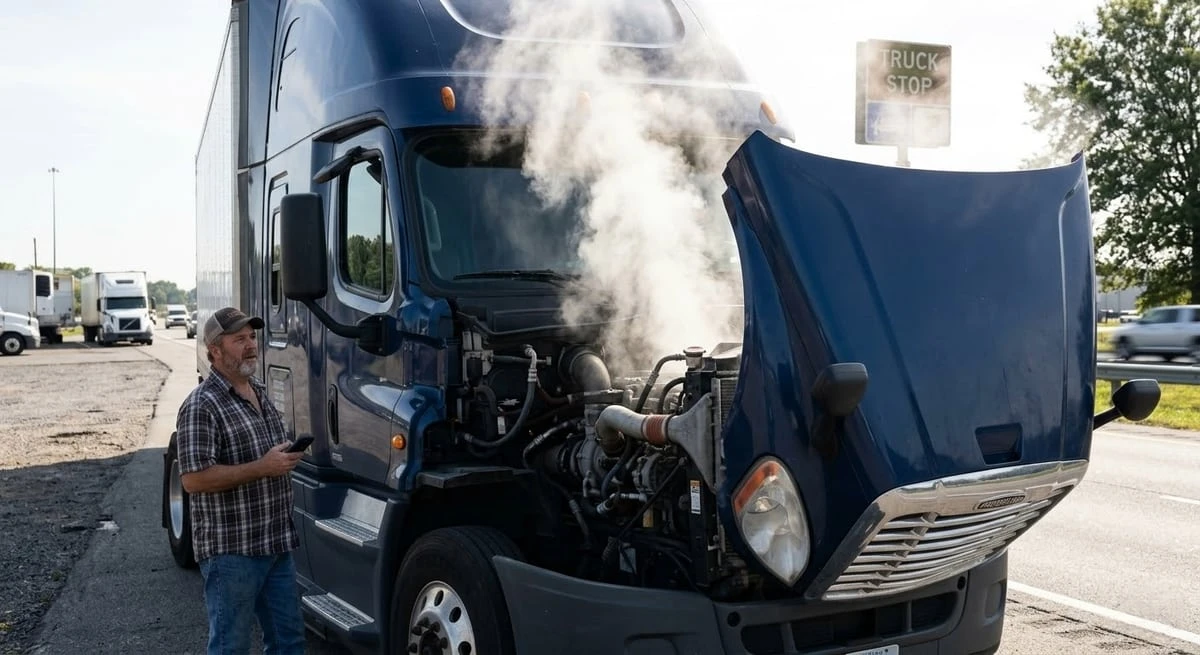
Short term, yes — a small end-tank crack won't strand you immediately. But it will progressively worsen as the plastic fatigues and the crack grows with each heat cycle. More practically: driving with a confirmed boost leak triggers active regeneration cycles more frequently on the Detroit DPF system, which shortens DPF life. If the truck is operating in summer heat, you also risk elevated EGT and potential turbo damage from low-boost over-fuelling. Fix it within the current dispatch cycle; don't defer it through a second season.
How do I know if the problem is the CAC or the turbo?
Do the shop air pressure test at 20–25 psi first. If the CAC holds pressure, pull the CAC inlet boot and inspect the inside with a light — if there's heavy oily residue inside the turbo outlet pipe (not the CAC itself), the turbo shaft seal is bypassing oil into the intake. A CAC that fails visually during a pressure test with oily residue on the inside of the end tanks usually means you have both a worn turbo and a compromised CAC. Fix the turbo first, or both at the same time, or the new CAC will get contaminated again.
What boost pressure should a Cascadia run at highway speed?
A healthy DD15 Cascadia at 100 km/h at full gross weight will typically show 70–90 kPa (10–13 psi) of boost on flat highway, rising to 100–120 kPa (15–17 psi) on a grade at governed RPM. If your scanner shows boost below 60 kPa under a load that should produce more, you have a leak somewhere in the boost circuit. The CAC is the first place to check but not the only one.
How long does a Cascadia CAC replacement take at a shop?
For a shop familiar with the Cascadia, it's a 2–3 hour job. The lower front fascia comes off in about 30 minutes, the CAC unbolts in another 30, and the reinstall and boost test adds another hour. If the shop is doing it for the first time on a Cascadia, budget 4 hours. If you add coupler replacement at the same time, add 30 minutes — it's well worth doing while everything is already apart.
Does a new Cascadia CAC come with new couplers and clamps?
Most aftermarket CACs ship as a bare core only — no couplers, no clamps, no hardware. The OEM Freightliner unit also typically ships without couplers. Always order a silicon coupler kit at the same time. After 600,000 km, the couplers are heat-hardened and will crack during removal anyway. For a job that costs $900–$1,400 in parts and labour, the $65 in new silicon is cheap insurance.
Can I clean an oil-contaminated Cascadia CAC instead of replacing it?
Yes, if and only if the pressure test confirms zero leaks. An oil-contaminated CAC with no structural cracks can be degreased internally using a commercial parts cleaner sprayed through the inlet and outlet ports, soaking for 30 minutes, then flushing with hot water. This restores airflow to close to original. However, if the oil contamination source (turbo seal) isn't fixed, the CAC will re-contaminate within 100,000–150,000 km. Cleaning is a legitimate option for a truck that's otherwise healthy and mid-maintenance cycle; replacement is better if you're already pulling the fascia for another reason.
Need a Cascadia Charge Air Cooler?
DD13, DD15, DD16 and ISX15 fitments in stock. Same-day pickup in Vaughan — Canada-wide shipping.
True Truck Parts
Heavy Duty Cooling & A/C Specialists — GTA, Canada
Our team specializes in cooling and A/C parts for Class 8 semi trucks, serving fleet operators and owner-operators across the Greater Toronto Area and Canada. We stock OEM-fit parts for Freightliner, Kenworth, Peterbilt, Volvo, Mack, Hino, International and Western Star.