CAC stands for charge air cooler. It is the large aluminium heat exchanger at the very front of a semi truck, ahead of the radiator, and its whole job is to cool the air the turbocharger has just compressed — before that air reaches the engine. Every modern Class 8 diesel has one, and almost every driver has looked straight at it without knowing what it was.
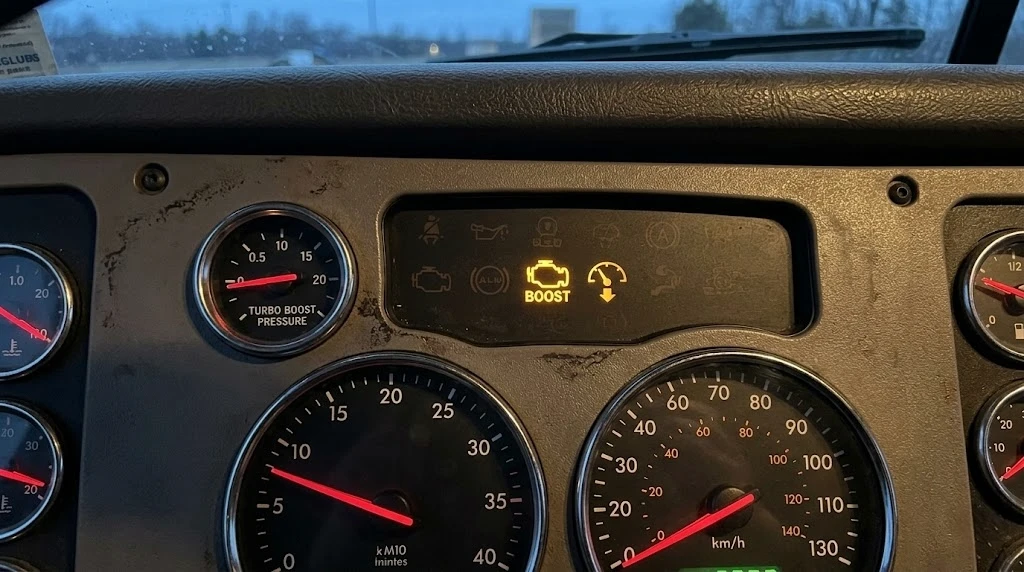
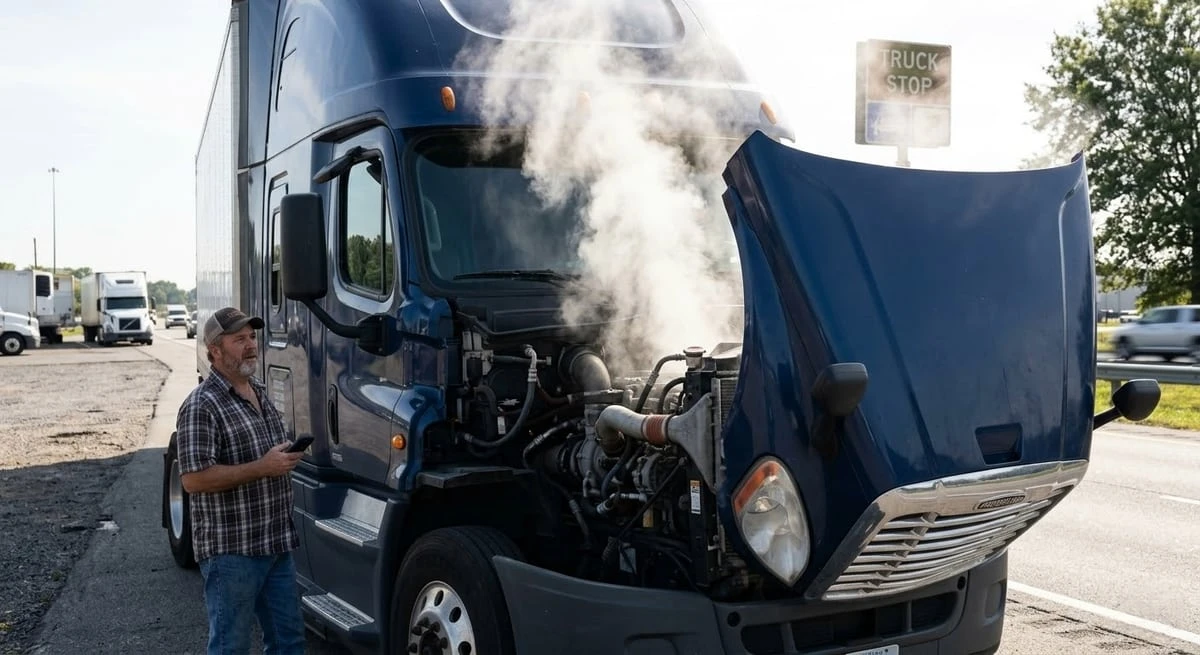
It matters more than its low profile suggests. A turbo that is working properly delivers air at 150–200 °C, and air that hot is so thin it undoes most of what the turbo just achieved. The charge air cooler is what turns boost into usable power. When it starts leaking, the truck loses power on grades, smokes under load, and logs boost faults — and the cooler itself often looks perfectly fine from the outside.
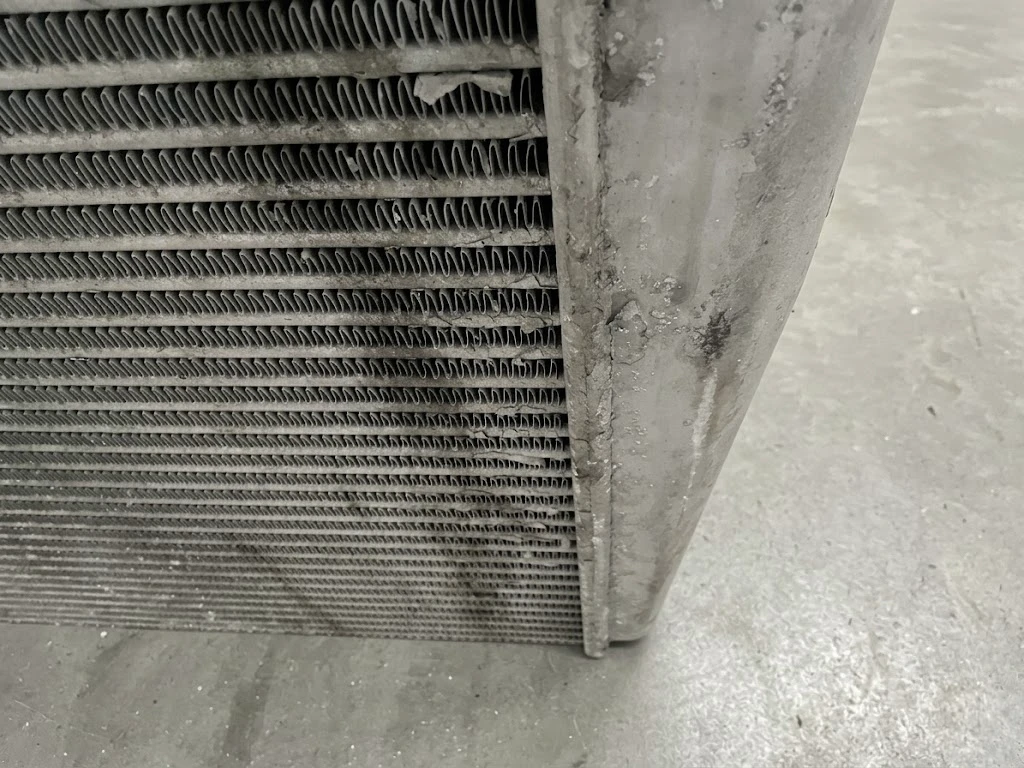
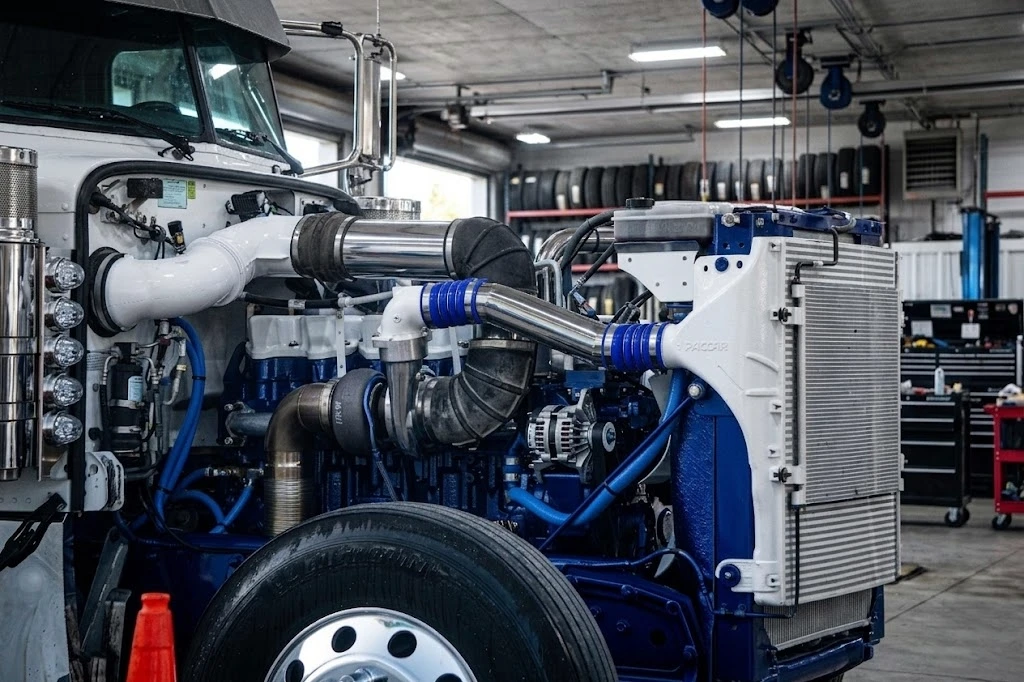
The fin pack is the working surface of a charge air cooler. Because it sits at the very front of the truck, it is also the first thing to collect bugs, road salt and stone damage — all of which reduce how much heat it can shed.
In this article
- What a Charge Air Cooler Is
- How It Works, and Why Hot Air Is a Problem
- CAC, Intercooler, Aftercooler: The Same Part?
- What the CAC Actually Buys You
- Where It Sits and What It Looks Like
- How to Read a CAC Spec Sheet
- How to Tell Yours Is Failing
- Notes by Truck Make
- What a Charge Air Cooler Costs
- Frequently Asked Questions
What a Charge Air Cooler Is
A charge air cooler is a radiator for air rather than for coolant. "Charge air" is the air the turbocharger has compressed and is about to push into the cylinders — the engine's charge. The cooler sits in the pipework between the turbo outlet and the intake manifold, and it removes heat from that air on the way through.
On a Class 8 truck it is an air-to-air cooler: the charge air runs through the tubes, and ordinary outside air passing through the grille at road speed carries the heat away. There is no coolant in it. That is why it lives at the front of the truck where the air is, and why it is roughly the size of the radiator sitting behind it.
You will see the same component called a CAC in a parts book, an intercooler in conversation, and an aftercooler in an engineering manual. On a truck those almost always mean the same physical part — more on that below.
How It Works, and Why Hot Air Is a Problem
Compressing a gas heats it. That is not a side effect of a turbo being inefficient; it is unavoidable physics. Squeeze air into a smaller volume and its temperature rises. On a loaded Class 8 engine pulling 25–40 psi of boost, air entering the turbo at 20 °C typically leaves the compressor at 150–200 °C.
The problem is that a diesel does not care about the volume of air it receives. It cares about the mass of oxygen it can fit in the cylinder, because that is what limits how much fuel can be burned completely. And hot air is thin. Air density falls in direct proportion to absolute temperature, so:
- Air at 20 °C is 293 kelvin. Air at 200 °C is 473 kelvin.
- 293 ÷ 473 ≈ 0.62 — the hot charge is only about 62% as dense.
- So without cooling, a large part of what the turbo just delivered is given straight back.
The charge air cooler recovers it. A healthy air-to-air CAC brings the charge back down to within roughly 10–20 °C of the outside air before it reaches the intake manifold. The same relationship works in your favour on the way down: near normal operating temperatures, every 3 °C of cooling is worth about 1% more air density, which is about 1% more oxygen in the cylinder for the same boost pressure.
The short version: the turbocharger supplies pressure, and the charge air cooler is what converts that pressure into density. Boost without charge cooling is mostly heat.
CAC, Intercooler, Aftercooler: Are They the Same Part?
On a truck, in practice, yes. The three words have distinct technical meanings, but the industry does not use them that way, and it causes real confusion when someone is trying to order a part.
- Intercooler — strictly, a cooler placed between two stages of compression.
- Aftercooler — strictly, a cooler placed after the final stage of compression.
- Charge air cooler — the general term for either, and the one used in almost every heavy truck parts catalogue.
A single-turbo diesel has one compression stage, so what it actually has is an aftercooler. Nearly everyone still calls it an intercooler, and the parts book calls it a charge air cooler. All three refer to the same aluminium cooler at the front of the truck.
The practical advice: search whichever term you know, then confirm by part number and by the position of the inlet and outlet. That is what determines fitment — not which of the three words the listing happens to use.
What the CAC Actually Buys You
Charge cooling is not a performance add-on. On an emissions-era engine it is load-bearing, and the ECM is watching it.
- Power under load. More oxygen mass per cylinder fill means more fuel can be burned completely. A leaking CAC shows up first as a truck that will not hold speed on a grade.
- Fuel economy. An engine making less power per litre of fuel burned has to burn more of it to do the same work.
- Exhaust gas temperature. Cooler intake air means cooler combustion, which means lower EGT. Sustained high EGT is what shortens turbo life, stresses exhaust valves and cooks aftertreatment components.
- Emissions compliance. NOx forms in proportion to peak combustion temperature. Charge cooling is one of the levers that lets a modern diesel meet its limits, which is exactly why the ECM monitors intake manifold temperature and boost pressure — and why it will derate the engine when they drift out of range.
- Engine life. Every item above compounds. A truck run for months with a boost leak is not just slower; it has been running hotter than designed the whole time.
Where It Sits and What It Looks Like
Open the hood on a Class 8 tractor and the charge air cooler is the front-most element of the cooling stack: CAC first, radiator directly behind it, and on many trucks the A/C condenser mounted alongside or in front. Everything in that stack shares the same airflow, which is why a grille packed with bugs or a bent CAC fin pack raises coolant temperature as well as charge temperature.
Physically you are looking for a wide aluminium core — commonly 900–1,100 mm across on a Class 8 — with a tank at each end and two large connections, typically 75–100 mm in diameter. One carries hot air in from the turbo, the other carries cooled air out to the intake manifold. Both are joined with silicone boots and constant-torque clamps rather than being bolted directly, because the cooler and the engine move relative to each other.
Its position is also its main hazard. Sitting ahead of everything else, it takes the stone strikes, the road salt and the full bug load, and it is the first component starved of air when the grille blocks up.
How to Read a CAC Spec Sheet
Most wrong-part returns on charge air coolers come from matching the core and ignoring everything else. A listing worth trusting gives you all of the following:
- Core dimensions — height × width × depth. Depth is the thickness of the fin pack, and it is the one people skip.
- Overall dimensions — including the end tanks, which is what actually has to fit the opening.
- Inlet and outlet diameter, position and orientation. This is the specification that most often decides whether a cooler bolts up. Two coolers with an identical core can be completely different parts.
- Core construction — bar-and-plate is heavier and more robust; tube-and-fin is lighter and more common as original equipment.
- End tank type — welded aluminium, or plastic crimped on over a gasket. Crimped seams are the classic leak point, and knowing which you have tells you where to look first.
- Mounting — bracket positions and isolator locations.
Every charge air cooler listed on our charge air coolers page carries its core dimensions and the OEM numbers it cross-references, so a part can be matched on specification rather than on a photograph.
How to Tell Yours Is Failing
A charge air cooler almost never fails suddenly. It develops a leak, and boost escapes through it. The symptoms are consistent:
- Power loss under load, most obvious on a grade or when pulling away heavy
- Black smoke under acceleration — fuel without enough air to burn it
- Boost pressure fault codes, commonly SPN 102 or P0299 (turbocharger underboost)
- Rising exhaust gas temperature at the same workload
- Oil film inside the cooler or the boots, which points at turbo seals rather than the cooler itself
- Visible damage: a split along a crimped end tank seam, or eroded and flattened fins
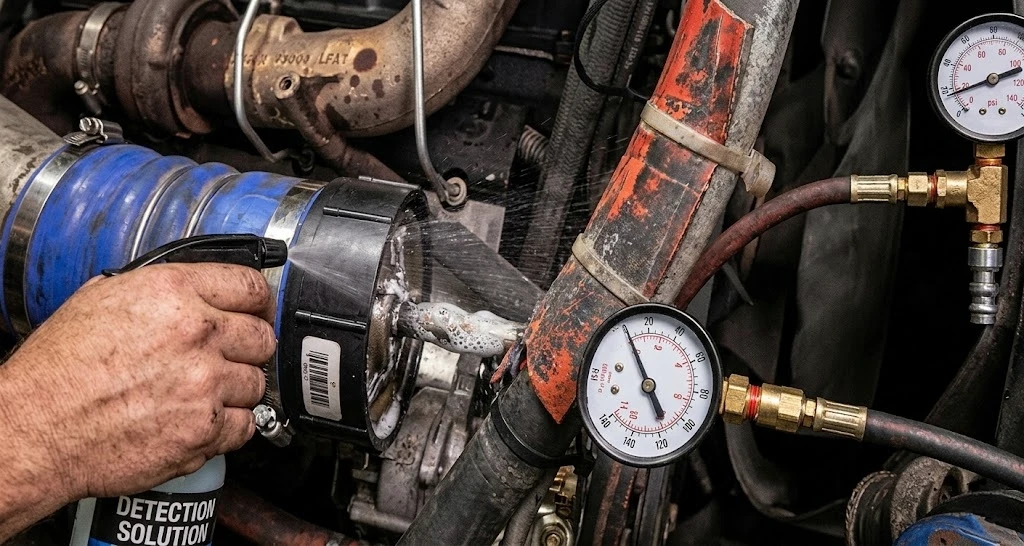
The reliable test is a pressure test. Block the outlet, apply shop air to the charge side at around 30 psi, and listen — then spray the seams and boot joints with soapy water. A leak that is invisible cold and silent at idle is usually obvious under pressure.
Check the clamps before condemning the cooler. A loose boot or a failed clamp produces the same symptoms as a cracked cooler and costs a fraction as much to fix. Pressure-test first, then decide. Our charge air cooler symptoms guide walks through the full diagnosis.
Notes by Truck Make
The principle is identical across makes; what changes is the fitment and the engine the cooler is matched to.
Freightliner Cascadia
Detroit DD13, DD15 and DD16 engines. The most common charge air cooler we supply by volume. See Cascadia charge air cooler problems for the failure patterns specific to this truck.
Peterbilt 579 and 389
PACCAR MX-13 and Cummins X15. Searches for "Peterbilt 579 CAC" are common precisely because the 579's cooler is a high-wear item on long-haul duty. The Peterbilt 379 and 389 guide covers the older chassis.
Kenworth T680 and T880
PACCAR MX-13 and Cummins X15, sharing much of the 579's driveline. See Kenworth cooling and A/C problems.
Volvo VNL
Volvo D11 and D13. Fitment is tightly tied to model year, so the inlet and outlet positions matter more here than the core size.
Mack Anthem and Granite
Mack MP7 and MP8. Vocational Granite units live a harder life than highway tractors and tend to fail earlier from vibration. See Mack charge air cooler problems.
International LT and ProStar
A26, N13 and the earlier MaxxForce engines. International is our single largest charge air cooler category by part count.
What a Charge Air Cooler Costs
Charge air coolers are large aluminium assemblies, and they are priced accordingly. Rather than quote a general industry figure, here is what our own catalogue actually shows across the 96 charge air coolers we currently publish a price for:
- Typical range: roughly $700 to $2,100 CAD
- Median: a little under $1,100 CAD
- Middle half of the catalogue: about $1,000 to $1,200 CAD
Where a particular cooler sits in that range is driven by core size and construction more than by the badge on the truck. Labour is on top, and varies with how much of the front end has to come apart.
Set against that, the cost of leaving a boost leak alone is not the cooler — it is months of elevated exhaust gas temperature and extra fuel, followed eventually by a turbo.
Frequently Asked Questions
What does CAC stand for on a truck?
Charge air cooler. It is the heat exchanger that cools the compressed air leaving the turbocharger before that air enters the engine's intake manifold. On a Class 8 truck it sits at the very front, ahead of the radiator.
Is a charge air cooler the same as an intercooler?
On a truck, effectively yes. Strictly, an intercooler sits between two stages of compression and an aftercooler sits after the final stage, so a single-turbo diesel technically has an aftercooler. In practice all three terms are used for the same part, and heavy truck parts catalogues standardise on "charge air cooler". Match by part number and by inlet and outlet position rather than by the name used in the listing.
What happens if the charge air cooler fails?
Boost escapes through the leak, so less air reaches the cylinders. The truck loses power under load, smokes black under acceleration, runs higher exhaust gas temperatures and usually sets a boost pressure fault such as SPN 102 or P0299. The engine may derate.
Can you drive with a leaking charge air cooler?
The truck will usually still move, which is what makes this failure easy to postpone. It is not advisable. You are running hotter than the engine was designed for and burning extra fuel the whole time, and a derate can happen at an inconvenient moment. Treat it as a repair to schedule promptly, not an emergency stop.
How long does a semi truck charge air cooler last?
There is no fixed interval. Most fail through damage or fatigue rather than wear: stone strikes to the fin pack, road salt corrosion, and vibration fatigue at crimped end tank seams. Highway tractors often go the life of the truck; vocational and off-road duty is much harder on them.
Can a charge air cooler be repaired instead of replaced?
Sometimes, for a welded aluminium tank with a single accessible crack. It is rarely worth it on a crimped plastic end tank, and a repair does nothing about a fin pack that has already lost cooling capacity. Pressure-test first so you know what you are actually dealing with.
Does a dirty charge air cooler cause overheating?
It can contribute. The CAC sits in front of the radiator and shares its airflow, so a fin pack packed with bugs and debris reduces the air reaching the radiator as well as its own cooling. Coolant temperature and charge temperature tend to climb together. See semi truck overheating causes.
Where can I get a charge air cooler in the GTA?
True Truck Parts stocks 177 charge air coolers for Freightliner, International, Kenworth, Peterbilt, Mack, Volvo, Western Star, Sterling and Hino, with core dimensions and OEM cross-references listed on every part. Contact us with your make, model year and the number off the old cooler and we will confirm fitment. Same-day pickup in Vaughan, shipping Canada-wide.