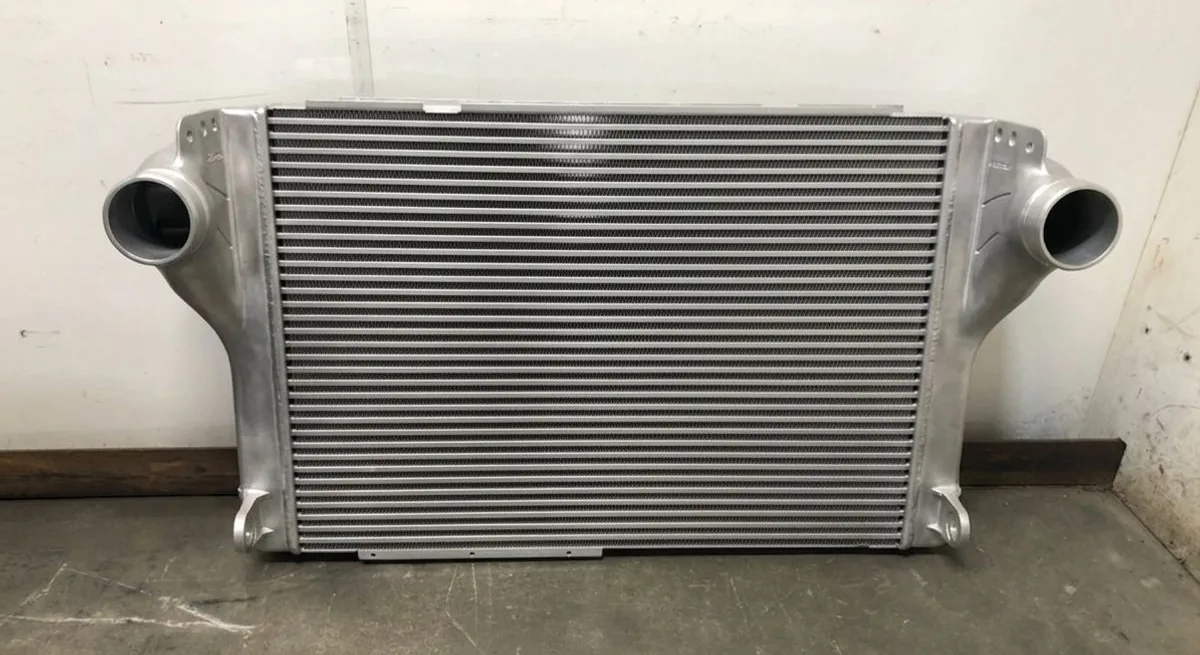
On a Kenworth the charge air cooler fails more often than the radiator, and the symptoms are easy to mistake for an engine fault.
In this article
- Why Kenworth cooling and A/C systems fail
- The air-to-air: the part that fails first
- One badge, many coolers: why fitment is hard
- Six common Kenworth cooling and A/C faults
- Problems by model: T680, T880, W900, T800, T660
- Diagnosing overheating and weak A/C
- Kenworth parts we stock in the GTA
- Frequently asked questions
Why Kenworth Cooling and A/C Systems Fail
A Class 8 Kenworth carries two separate heat problems in the same nose. The cooling system keeps the engine block in range. The charge air cooler — the air-to-air, as most drivers call it — drops intake charge temperature after the turbo. They sit in the same module, they share the same airflow, and when the front of the truck is packed with road film both degrade together.
That shared airflow is why diagnosis goes wrong. A truck that makes less power, blows black smoke under load and runs hot on a grade reads like an engine problem. Often it is a leaking air-to-air, and the engine is simply responding to hot, thin charge air. The third system, the cab A/C, is separate in function but shares the same stack of coolers at the front and the same debris.
Kenworth's own range spans a very wide duty cycle, and that changes what fails. A W900 in linehaul and a T880 on a dump body do not wear the same parts at the same rate, and the cooling package differs between them.
The Air-to-Air: The Part That Fails First
On a modern Kenworth the charge air cooler is the component most likely to strand you, and it is the one people search for most. It lives ahead of the radiator, takes the full force of everything the road throws up, and flexes constantly as boost pressure cycles.
Three failure points account for most of it:
- Tube-to-header joints. The junction where the tubes meet the end tank sees the most movement. A leak here bleeds boost, and the first sign is usually reduced power rather than a warning light.
- Fin damage and packing. Stone strikes flatten fins; road film, oil mist and insects fill the gaps. Both reduce the cooler's ability to shed heat long before anything leaks.
- Oil in the core. Turbo seal wear puts oil through the cooler. It coats the internal surface, insulates it, and no amount of external cleaning recovers the loss.
A boost-leak test is the only reliable check. Pressurise the intake tract to around 25–30 psi with the engine off and listen. A cooler that holds pressure is fine; one that bleeds down has a seam or joint open. The symptoms of a failing charge air cooler covers the full test procedure.
One Badge, Many Coolers: Why Air-to-Air Fitment Is Hard
The single most common ordering mistake on a Kenworth is assuming the model name identifies the part. It does not. We stock 20 different charge air coolers that fit Kenworth trucks, spanning 1982 to 2026, and 10 of them list the T800. Core heights across the range run from 24.5″ to 46.375″. A "T800 charge air cooler" is not one part.
| Part | Fits | Years | Core in. H×W×D | Price |
|---|---|---|---|---|
| TKC0003 | 579, T680 | 2022–2024 | 32.625× |
$1,789.16 |
| TKC0004 | 579, T680 | 2018–2022 | 37.125× |
$1,249.17 |
| TKC0001 | T660, T700, T800, T880, W900 | 2008–2016 | 37.25× |
$1,109.17 |
| TKC0007 | T660, T680, W900 | 2008–2017 | 29× |
$1,039.17 |
| TKC0008 | T800H, W900B | 2008–2011 | 34.875× |
$2,089.17 |
| TKC0019 | — | 2008–2026 | 26.4375× |
$1,309.17 |
| TKC0011 | T800 | 2007 | 46.375× |
$1,898.17 |
| TKC0014 | T600, T800 | 2005–2007 | 30.875× |
$1,209.17 |
| TKC0010 | 330, T300, T800 | 2003–2007 | 32.375× |
$969.17 |
| TKC0013 | T2000, T800 | 1997–2007 | 40× |
$1,309.17 |
| TKC0015 | T800 | 1996–2007 | 44.125× |
$1,498.17 |
| TKC0012 | C500, T2000, T800, W900B | 1995–2012 | 34.875× |
$1,209.17 |
| TKC0005 | C500, T600, T800, W900 | 1989–2005 | 28.25× |
$849.17 |
| TKC0006 | T300, T400, T600A, T800, W900 | 1982–2010 | 28.25× |
$896.59 |
Kenworth charge air coolers by year and core size — 20 in total. The year narrows the field; the three core dimensions decide it.
So the order of operations is: model year narrows the candidates, then measure the core you are removing — height, width and depth — and match all three. Inlet and outlet position matters too. If the truck has had a cooler replaced before, what is fitted may not match the original build year at all, which is why measuring beats looking up.
T680 owners have the easiest job, because the run is short and well documented — our Kenworth T680 charge air cooler page lists the coolers for that model with fitment notes and pricing. For every other model, the table above is the starting point and the tape measure settles it.
Not sure which one you need?
Send us the VIN and we will confirm the exact charge air cooler, radiator or A/C part for your build. Same-day quotes, pickup in Vaughan.
Get a fitment checkSix Common Kenworth Cooling and A/C Faults
1 Charge air cooler leak
Power loss under load, black smoke, rising exhaust temperature and worse fuel economy. Because none of those point obviously at the cooler, trucks are often diagnosed for turbo or injector faults first. Boost-test before replacing anything upstream.
2 Radiator leaks and core blockage
Aluminium core with plastic end tanks on most of the modern range. The tank-to-core crimp is the usual leak point, and it tends to weep rather than burst — a slow loss that shows as a dropping reservoir level long before the gauge moves. Internally, scale from neglected coolant restricts flow through the tubes.
3 Coolant reservoir cracks
The surge tank is pressurised plastic that heat-cycles thousands of times. Cracks start at moulding seams and around the neck. A tank that needs topping up weekly with no visible puddle is usually cracked at a seam that only opens when hot and pressurised.
4 A/C compressor failure
Warm air, a clutch that will not engage, or a noise that changes with engine speed. Compressors rarely fail in isolation — low refrigerant from an untraced leak starves the compressor of oil and destroys it. Replacing the compressor without finding the leak buys a few months at most.
5 Receiver drier saturation
The drier holds a desiccant that absorbs moisture. Once the system has been open to atmosphere — any repair, any leak — it is saturated and must be replaced. Skipping it is the most common reason a fresh A/C repair fails again within a season, because the moisture left behind forms acid and attacks the new compressor.
6 O-ring and line leaks
The cheapest failure and the most frequently searched. Every joint in an A/C system is sealed by an o-ring, they harden with age and heat, and a hardened one leaks slowly enough that the system just gets gradually less cold. Replace every o-ring you disturb, use the correct compound for the refrigerant in the system, and lubricate with the right A/C oil rather than anything to hand.
Problems by Kenworth Model
T680 (2013–present)
The aerodynamic flagship, PACCAR MX-13 or Cummins ISX15. Its tight aero nose means a densely packed cooling module: the charge air cooler, radiator and A/C condenser sit close together with less room for debris to clear. Cleaning between the stack matters more here than on an older truck. Three charge air coolers cover the run — see the table above.
T880 (2014–present)
The vocational counterpart to the T680, sharing much of the cab and driveline. Dump, mixer and heavy-haul duty means constant low-speed, high-load operation — the worst case for any cooling package, because there is little ram air and the fan does all the work. Fan clutch condition is worth checking first on a T880 that runs hot in the yard but not on the highway.
W900 (long hood)
The classic. A long hood gives a large frontal area and generally generous cooling capacity, which is why a W900 that overheats usually has a specific fault rather than a marginal system. Look for blockage and coolant condition before suspecting the radiator itself.
T800 (1986–2021)
The long-running vocational workhorse, in service across an enormous range of years and specifications. Because the same badge covers three and a half decades, year alone is a poor guide to fitment — the core dimensions and inlet and outlet positions decide it.
T660 and T600
The aero generation the T680 replaced. Both are now old enough that original radiators and coolers are reaching the end of their service life, and both are well represented in the aftermarket.
Diagnosing Overheating and Weak A/C — Step by Step
- Look at the front of the truck first. Most heat complaints on any Class 8 truck are airflow, not components. Check the whole stack — condenser, charge air cooler, radiator — for packing.
- Check coolant level and condition. A dropping level with no puddle points at the surge tank or a weeping tank crimp. Brown or oily coolant is a separate and more serious problem.
- Note when it happens. Hot at low speed but fine on the highway points at the fan or fan clutch. Hot at highway speed points at flow or capacity: a blocked core, a failing water pump, or a thermostat.
- Boost-test the air-to-air if there is any power complaint at all, before touching the turbo.
- For weak A/C, measure both pressures. High side and low side together tell you whether you have a charge problem, a restriction or a failing compressor. A single gauge reading tells you almost nothing.
- Find the leak before replacing the compressor. Dye or an electronic sniffer. A compressor fitted into a leaking system fails again.
Need the part today?
We stock 96 Kenworth cooling and A/C parts with same-day pickup in Vaughan and delivery across the GTA.
Browse Kenworth partsKenworth Cooling and A/C Parts in the GTA
We carry 96 parts that fit Kenworth trucks, covering the cooling system and the complete air conditioning loop. Every listing carries the OE cross-reference numbers, so you can match against the number stamped on the part you are replacing rather than guessing from the model year.
| Part | Fits | Years | Core in. H×W×D | Price |
|---|---|---|---|---|
| TKR0006 | T170, T270, T300, T370, T400, W900 | 2011–2014 | 25.75× |
quote |
| TKR0007 | T370, T600, T660, W900 | 2008–2016 | 43× |
$909.17 |
| TPR0003 | 367, 387, 567, 579, 587 | 2008–2016 | 34× |
quote |
| TPR0004 | 365, 367, 379, 387, 388, 389, 567 | 2008–2018 | 42.875× |
quote |
| TKR0008 | T600, T660, W900 | 2007–2016 | 40.5× |
quote |
| TKR0011 | C500 | 2007–2026 | 44.125× |
quote |
| TKR0004 | T600, T660, T800 | 2006–2008 | 40× |
quote |
| TKR0010 | T800 | 2003–2007 | 37.75× |
quote |
| TPR0009 | 330, 335, 340 | 2003–2007 | 34.625× |
$753.67 |
| TKR0003 | T2000, T800, W900 | 1997–2007 | 38× |
quote |
| TKR0012 | T800 | 1995–2007 | 45.75× |
$3,498.17 |
| TKR0014 | W900 | 1995–2007 | 40× |
quote |
A selection of the 24 Kenworth radiators we stock. Core dimensions decide fitment where the model year does not.
What We Stock for Kenworth
- Kenworth radiators — 24 for Kenworth, covering T680, T880, W900, T800, T660, T600 and C500
- Charge air coolers — 20 air-to-air units, including all three T680 variants
- A/C condensers — 11 listings
- A/C compressors — 8 listings
- Receiver driers — 8 listings; replace at every A/C repair
- Evaporators — 6 listings
- Expansion valves — 7 listings
- Coolant tanks and surge tanks — 6 listings
- Pressure switches — 6 listings
- A/C o-rings and seals — replace every one you disturb
For a same-day quote, contact us with your Kenworth model and VIN, or the part number off the old unit. We will confirm fitment before you commit. Pickup is in Vaughan, with delivery across Brampton, Mississauga, North York, Oshawa and the rest of the GTA.
Frequently Asked Questions
How do I know which charge air cooler fits my Kenworth?
Model and year narrow it; core dimensions decide it. We stock 20 coolers fitting Kenworth trucks and 10 of them list the T800 alone, so the badge on the hood is not enough. Measure the height, width and depth of the core you are removing and match all three, and check the inlet and outlet positions. For a T680 specifically, our T680 charge air cooler page narrows it down by build year.
What does "air to air" mean on a Kenworth?
It is the charge air cooler, also called an intercooler. Air-to-air describes how it works: hot compressed air from the turbocharger is cooled by ambient air passing through the core, rather than by coolant. On a Kenworth it sits ahead of the radiator in the same cooling module.
Why does my Kenworth run hot in traffic but fine on the highway?
Almost always the fan or fan clutch. At highway speed ram air does most of the cooling; at low speed the fan has to do it all. If the clutch is not engaging or is slipping, the truck cools fine when moving and heats up as soon as it slows. A packed radiator face produces the same pattern, so check airflow first — it costs nothing.
Do I need to replace the receiver drier when I replace the A/C compressor?
Yes. The drier's desiccant saturates as soon as the system is opened to atmosphere, and the moisture it releases back into a repaired system forms acid that attacks the new compressor. It is the cheapest part in the repair and skipping it is the most common reason an A/C job fails within a season.
What A/C oil does a Kenworth use?
It depends on the compressor and refrigerant, not the truck. Check the label on the compressor or the underhood A/C decal for the specified oil type and charge quantity, and match it exactly — mixing oil types causes the lubricant to separate and the compressor to run dry. If the label is missing or unreadable, send us the compressor part number and we will confirm.
Can I get Kenworth cooling and A/C parts in Vaughan or Brampton?
Yes. We hold 96 Kenworth parts — radiators, charge air coolers, condensers, compressors, driers, expansion valves, coolant tanks, switches and o-rings — with same-day pickup in Vaughan and delivery across Brampton, Mississauga, North York and Oshawa. Send the VIN or the old part number and we will confirm fitment first.
How long should a Kenworth radiator last?
Coolant maintenance matters far more than mileage. A system flushed on schedule with the correct coolant will usually outlast one that is topped up with whatever is to hand by a wide margin, because it is scale and corrosion — not wear — that ends most radiators. Damage from road debris is the other common cause, and that has nothing to do with age.