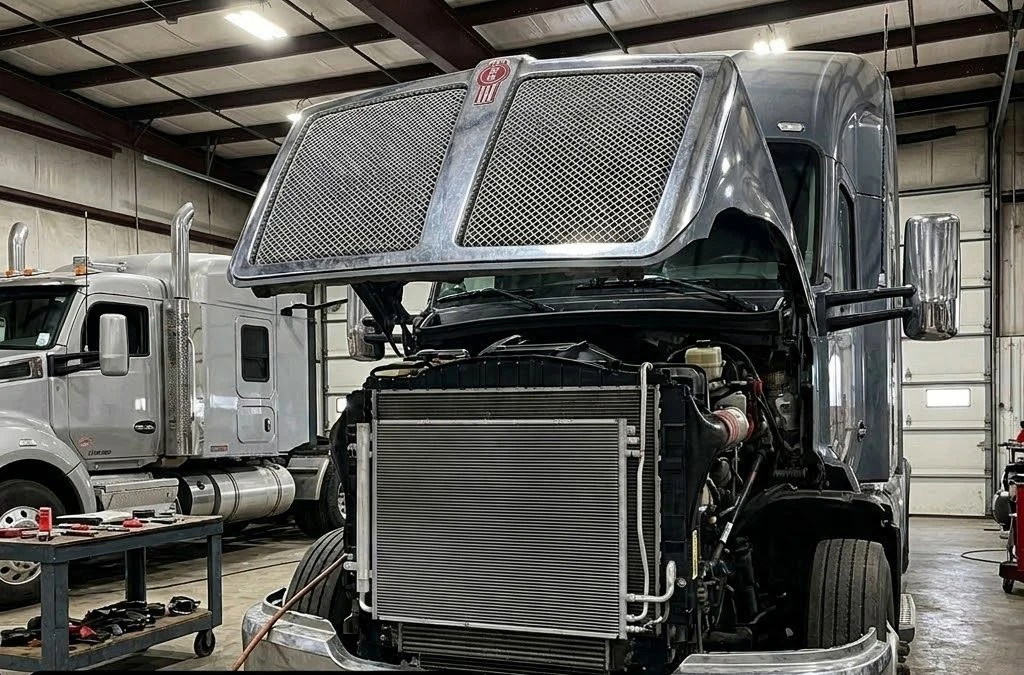
The receiver drier is the most overlooked part in a semi truck A/C repair — and skipping it is the single most common reason a new compressor fails within a season. It costs less than $80. A replacement compressor costs $600–$1,200. The math is straightforward, yet shops and owner-operators skip it every day.
This guide covers what a receiver drier does, the 5 symptoms that mean it's already failed, the exact rule for when to replace it, and what else to change at the same time to protect your A/C investment.
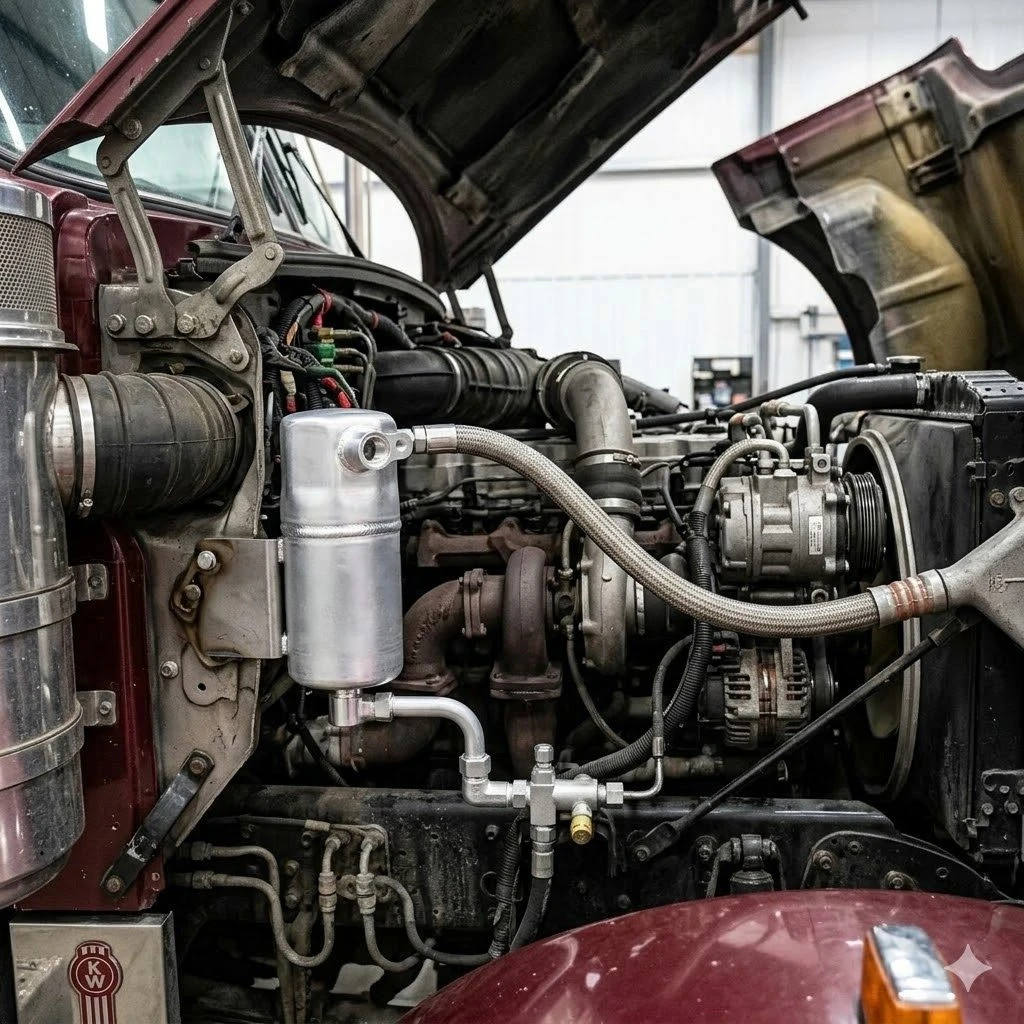
The receiver drier sits between the condenser and the expansion valve. Its job is to filter moisture and contaminants from the refrigerant — a job it can only do for so long before it becomes a liability.
In this article
What a Receiver Drier Does — and Why It Matters
The receiver drier is a sealed aluminium canister installed in the high-pressure side of the A/C system, between the condenser and the expansion valve (or TXV). It performs three jobs simultaneously:
- Moisture removal: The desiccant inside — typically silica gel or molecular sieve — absorbs water vapour that enters the system any time it is opened for service or through micro-leaks.
- Refrigerant storage: It acts as a reservoir that supplies liquid refrigerant to the expansion valve on demand, smoothing out demand fluctuations from the compressor.
- Filtration: A mesh filter screens out particulate — debris from hose degradation, compressor wear particles, and scale from corroding metal components.
The desiccant inside the drier has a finite capacity. Once it is saturated — whether from age, system exposure, or a moisture ingress event — it stops absorbing moisture. Worse, a fully saturated drier can release moisture back into the refrigerant under high heat, circulating water through the entire A/C system. Water and refrigerant oil combine to form an acid that corrodes compressor internals, expansion valves, and hose fittings from the inside.
The core problem: You cannot see, measure, or test desiccant saturation from outside the drier. There is no warning light. The only reliable way to know the drier is good is to replace it on schedule.
5 Symptoms of a Failed Receiver Drier
1 A/C Blows Warm Despite Full Refrigerant Charge
If the system holds the correct refrigerant charge but the cab still doesn't cool down, a clogged receiver drier is a leading suspect. The drier's internal filter can become blocked with debris — especially after a compressor failure that sent metal particles through the system — restricting refrigerant flow to the expansion valve. The compressor runs, pressures look normal on the gauges, but the flow rate is reduced enough that the evaporator can't transfer heat effectively.
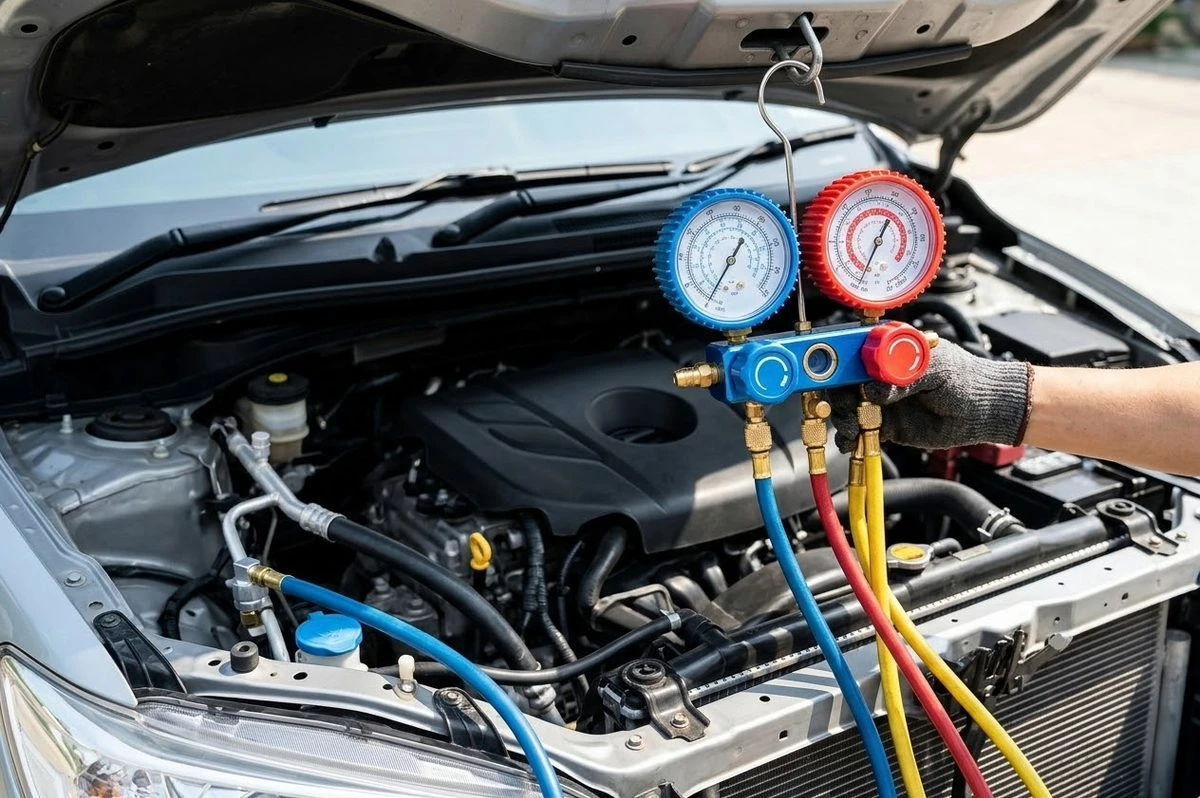
A restricted receiver drier shows up on the gauge set as a high-side pressure drop across the drier — the outlet is noticeably cooler than the inlet, indicating a restriction to flow.
2 Temperature Difference Across the Drier Body
A restricted drier causes a measurable temperature drop between the inlet and outlet of the canister. Under normal operation, the inlet and outlet should be close in temperature. If you feel a significant cold spot at the outlet or measure a 10°C+ difference with an infrared thermometer, the drier is restricted and needs replacement. This is one of the fastest field diagnoses available without pulling the system apart.
3 Frost or Ice on the Drier Body
Ice forming on the exterior of the receiver drier is a clear sign of a restriction. When refrigerant flow is restricted, there is a pressure drop across the restriction — and pressure drop causes temperature drop, sometimes enough to freeze ambient moisture on the canister surface. If you see frost on the drier body while the system is running, it needs replacement immediately.
4 Repeated Compressor Failures
This is the most expensive symptom. If you have replaced an A/C compressor and the new one has failed within a season — or within a year — the most likely cause is a contaminated system that was never properly flushed and a drier that was never replaced. Acid from moisture-contaminated refrigerant oil attacks the compressor's internal surfaces, bearing surfaces, and reed valves. A new compressor in a contaminated system is on borrowed time from day one.
If you have had two compressors fail in the same truck: the system needs a complete flush, new expansion valve, new receiver drier, new hose inspection, and a fresh refrigerant and oil charge — not just another compressor.
5 Sight Glass Shows Bubbles or Cloudiness
Many semi truck A/C systems have a sight glass on the receiver drier or in the liquid line. A properly charged, healthy system shows clear liquid refrigerant at the sight glass. Persistent bubbles (even with a full charge) suggest a restriction downstream of the drier — often the drier itself. Cloudy or milky refrigerant visible at the sight glass indicates moisture contamination: the drier is saturated and must be replaced along with a full system evacuation and recharge.
Need a replacement receiver drier?
OEM-fit A/C dryers for Freightliner, Kenworth, Peterbilt, Hino, Volvo & Mack. Same-day quotes.
The Rule: When You Must Replace the Receiver Drier
The industry rule — followed by every OEM and A/C system manufacturer — is straightforward:
Replace the receiver drier whenever:
- Any A/C system component is replaced (compressor, condenser, expansion valve, evaporator)
- Any A/C hose or fitting is disconnected — even briefly
- The system has been open to atmosphere for more than 10 minutes
- A compressor failure has sent debris through the system
- The drier is more than 2 years old and the system has been opened since installation
- Refrigerant has been recovered and the system evacuated for any reason
The reasoning is simple: every time the A/C system is opened, ambient air — which contains moisture — enters the lines, the condenser, and the evaporator. The receiver drier is the only component designed to capture that moisture. Once the system is opened, the drier's remaining desiccant capacity starts being consumed. If the drier is already old, it may be saturated before the job is even finished.
Some fleets operate on a fixed replacement interval regardless of service events: every 2 years or every second A/C recharge, whichever comes first. On trucks that are recharged annually, this means replacing the drier every other recharge season — a minor cost compared to the compressor warranty implications of skipping it.
What to Replace at the Same Time
Replacing the receiver drier in isolation — without addressing the rest of the A/C system — is only half the job when the reason for replacement is a compressor failure or system contamination. Here is the full list of what should be addressed:
Always replace with the receiver drier:
- Expansion valve (TXV) — the orifice and screen in the expansion valve trap debris and moisture just as readily as the drier. After a compressor failure, debris in the expansion valve is nearly guaranteed. A new drier with a contaminated expansion valve will fail again.
- Refrigerant oil — drain and replace with the correct viscosity and type for your compressor. Old oil carries acid and moisture products from the contaminated system.
Inspect and replace as needed:
- A/C hoses and lines — the rubber inner lining of older hoses degrades and sheds particles into the refrigerant. If hoses are original on a high-mileage truck, replace them at the same time to prevent re-contamination.
- Compressor — if the drier was run to failure, inspect the compressor for debris damage. A compressor that has run contaminated refrigerant may have scored internals that will generate debris even after the system is flushed.
- O-rings at all disturbed connections — always replace O-rings at any fitting that was opened. Reused O-rings are the most common source of slow leaks after an A/C service.
Flush the system if:
- A compressor failure was catastrophic (seized, broken reed valves, or bearing failure)
- There is visible black sludge or metallic particles in the refrigerant oil drained from the system
- The sight glass showed milky or cloudy refrigerant
Flushing note: The condenser and evaporator can be flushed with A/C flush solvent. The compressor cannot be flushed — it must be replaced if contaminated. The receiver drier and expansion valve are replaced, not flushed. The TXV screen is too fine to clean reliably after a contamination event.
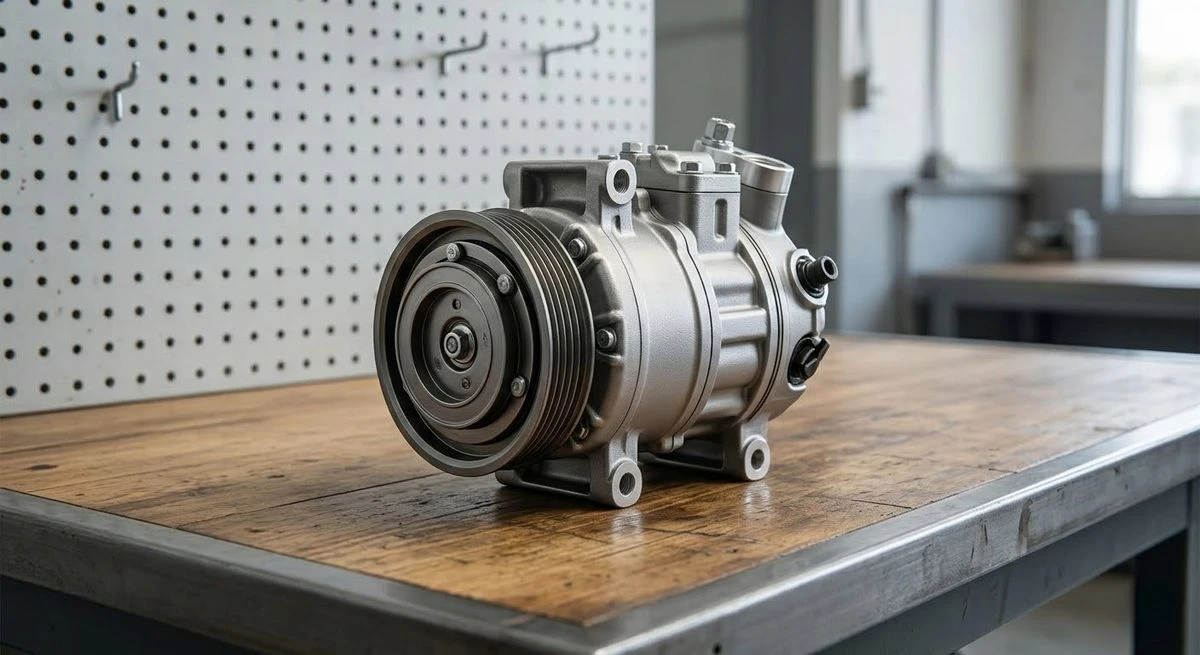
When replacing the compressor, the receiver drier and expansion valve should always come out at the same time. The cost difference is minor; the protection it provides is significant.
Replacing your compressor?
We'll quote you the compressor, receiver drier, and expansion valve together — one order, correct fitment. GTA pickup or ships Canada-wide.
Notes by Truck Make
Freightliner Cascadia
The Cascadia uses a Sanden compressor on most configurations. The receiver drier is mounted near the condenser in the front of the cab. Access is straightforward with the hood up. Sanden compressors are sensitive to moisture contamination — replace the drier without exception on every A/C service that opens the system.
Kenworth T680 / Peterbilt 579
Both share similar A/C architecture. The receiver drier is typically mounted in the engine compartment near the firewall. On trucks spec'd with Thermo King or Carrier APU units, the cab A/C and the APU A/C are separate systems — confirm which system you are servicing before ordering the drier. The two systems take different drier part numbers.
Volvo VNL
Volvo uses a combined receiver-drier/sight glass assembly on many VNL configurations. The sight glass is integrated into the top of the drier canister — use it to assess system condition before and after recharge. If the sight glass shows bubbles or cloudiness, do not skip the drier replacement.
Mack Anthem / Pinnacle
Similar to Volvo (same parent company), Mack trucks often feature an integrated sight glass on the drier. The drier mounting bracket on the Anthem can corrode in northern climates — inspect the bracket when replacing the drier and replace it if there is significant rust. A drier that vibrates loose from a corroded bracket can damage the adjacent condenser lines.
Hino 268 / 338
Hino uses a compact receiver drier suited to the J05E and J08E engine bays. On urban delivery routes with high A/C cycle frequency, Hino driers should be replaced at every second seasonal recharge — the high cycle count accelerates desiccant fatigue faster than on long-haul trucks. We stock direct-fit Hino receiver driers for same-day pickup in the GTA.
Frequently Asked Questions
How often should I replace the receiver drier on a semi truck?
Replace it every time the A/C system is opened for any reason — compressor replacement, hose repair, leak repair, or recharge that requires breaking a fitting. As a time-based maximum, replace it every 2 years regardless of service history on trucks in active use.
Can I recharge the A/C without replacing the receiver drier?
If you are doing a top-up recharge through the service ports without opening any fittings, you do not need to replace the drier. But if any fitting has been disconnected, or if the system was evacuated, the drier should be replaced before recharging.
What happens if I skip the receiver drier when replacing the compressor?
The old desiccant will not protect the new compressor from the moisture that entered the system during the repair. Moisture combines with refrigerant oil to form acid, which corrodes the new compressor's internal surfaces — often within one season. Most compressor warranty claims are voided when the receiver drier was not replaced at the same time.
How do I know if my receiver drier is clogged vs. just saturated?
A clogged drier shows as a temperature drop (or frost) between its inlet and outlet while the system is running — the restriction causes a pressure drop and corresponding temperature drop. A saturated-but-not-yet-clogged drier won't show this symptom but will still allow moisture to contaminate the system. Both conditions require replacement — you can't clean or regenerate a used receiver drier.
Is a receiver drier the same as an accumulator?
No — they serve similar purposes but are in different locations. A receiver drier is used in systems with a TXV (thermal expansion valve) and sits on the high-pressure (liquid) side. An accumulator is used in systems with an orifice tube and sits on the low-pressure (suction) side. Most Class 8 semi truck A/C systems use a TXV and receiver drier. Check your system type before ordering.
What does a receiver drier cost for a semi truck?
Typically $50–$120 CAD for an OEM-fit receiver drier depending on the truck make and model. Labour to replace it is minimal — 30–60 minutes — since the system needs to be opened anyway for whatever A/C work is being done. There is no meaningful reason to skip it at this price point.