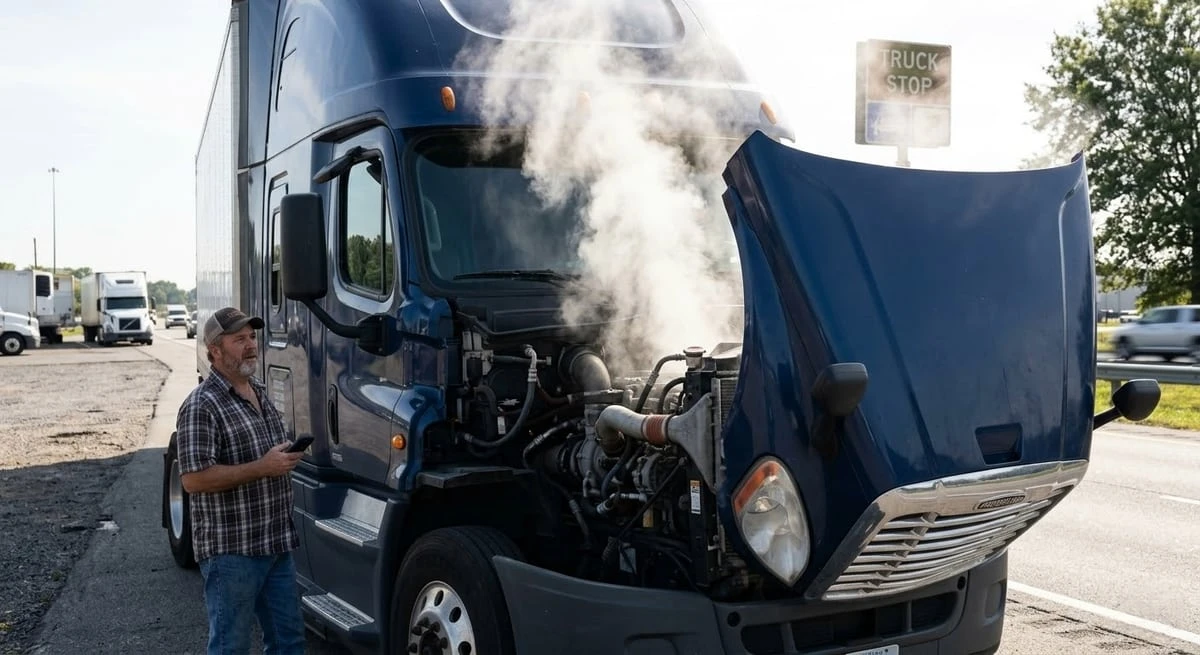
When your semi truck A/C is blowing warm air and the compressor checks out fine, the condenser is almost always the next part to look at. The condenser sits at the front of the truck — right in the path of rocks, road debris, and insects — and it takes a beating every kilometre of highway driving.
A semi truck A/C condenser typically lasts 400,000 to 700,000 km, but physical damage, bent fins, and refrigerant leaks can cut that lifespan in half. The good news: condenser replacement is one of the more straightforward A/C jobs on a Class 8 truck, and the parts are significantly cheaper than a compressor.
This guide covers the 5 warning signs of a failing condenser, how to confirm the diagnosis with a gauge set, the step-by-step replacement process, and what to budget for the job in Canada.
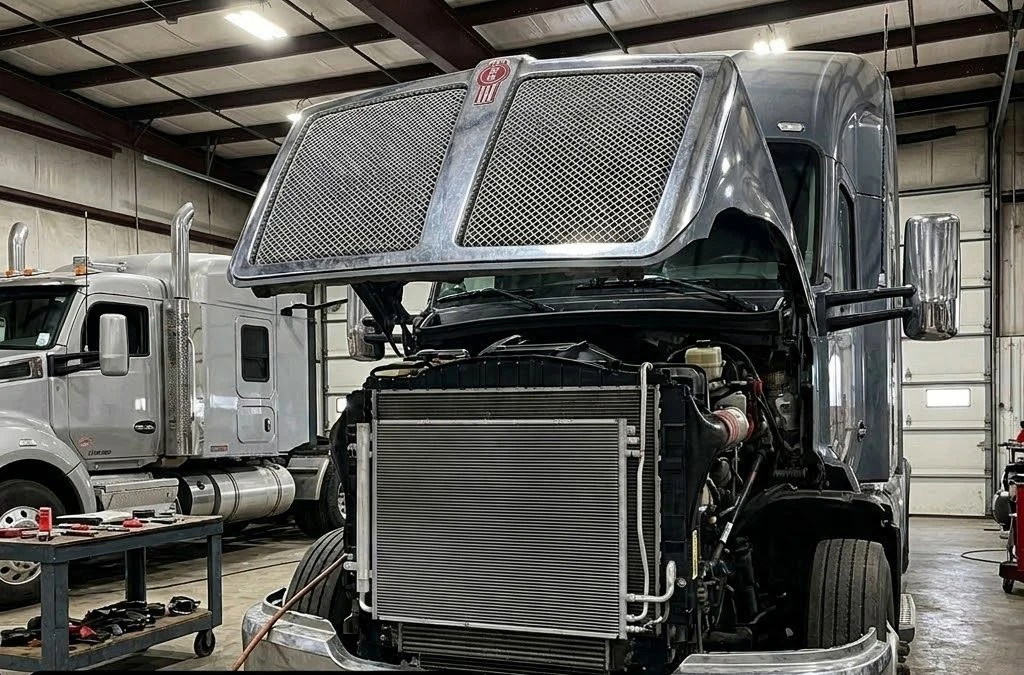
The A/C condenser is mounted directly in front of the radiator. Its aluminium fins dissipate heat from the hot refrigerant gas arriving from the compressor. Bent fins and external leaks are the two most common failure modes.
In this article
What the Condenser Does 5 Signs Your Condenser Is Failing How to Diagnose with a Gauge Set Step-by-Step Replacement Guide What to Replace at the Same Time Replacement Cost in Canada Condenser Life by Make Frequently Asked QuestionsWhat the A/C Condenser Does
Think of the condenser as a radiator for refrigerant. After the compressor pressurizes the refrigerant gas to roughly 200–250 psi, that hot, high-pressure gas travels to the condenser at the front of the truck. Air rushing through the condenser's fins pulls the heat out of the refrigerant, causing it to condense from a gas into a liquid.
That liquid refrigerant then moves through the receiver-drier, through the expansion valve, and into the evaporator inside the cab — where it evaporates and absorbs heat from the cabin air, producing the cold air you feel.
If the condenser can't release heat efficiently — because of bent fins, a clogged core, or an internal leak — the refrigerant stays too hot, system pressures spike, and the A/C either blows warm or the high-pressure switch shuts the compressor off entirely to prevent damage.
Key distinction: The condenser is on the high-pressure side of the A/C system. A condenser leak will show as high-side pressure loss. Don't confuse it with a low-side leak from the evaporator or suction hose — the gauge set reading tells you which side is losing pressure.
5 Signs Your Semi Truck A/C Condenser Is Failing
1. A/C Blows Warm or Barely Cool
The most common symptom and the same as a failing compressor — which is why diagnosis matters. If the compressor clutch engages, the compressor is pumping, and gauge pressures are in range but the air is still warm, suspect the condenser first. A clogged or damaged condenser can't reject enough heat, so the refrigerant never fully condenses and the system loses cooling capacity.
2. High-Side Pressure Consistently Over 350 psi
Normal high-side pressure on a Class 8 truck is roughly 200–275 psi at highway idle in warm weather. If your gauge set shows high-side pressure pushing 350 psi or higher while the low side is normal or slightly high, the condenser is the likely culprit — it's not releasing heat fast enough, so pressure builds up on the high side.
3. Visible Bent or Crushed Fins
Do a visual inspection. The condenser sits in front of the radiator, exposed to everything on the road. Bent fins reduce airflow through the core. A condenser with more than 20–25% of its fin area blocked or bent flat will have measurably reduced heat rejection capacity. This is the most common physical cause of condenser failure on highway trucks.
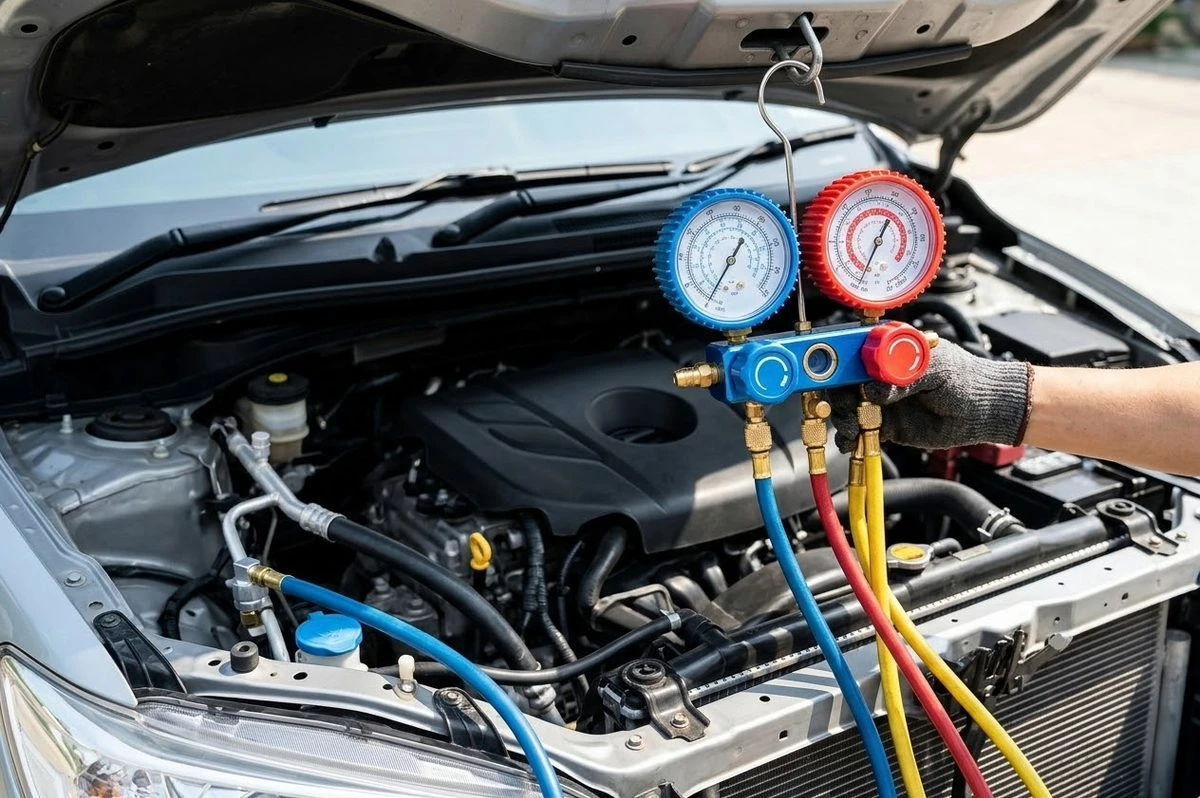
A manifold gauge set is the only reliable way to separate a condenser problem from a compressor problem. High-side over 350 psi with normal low-side = condenser. Low pressures on both sides = refrigerant leak or compressor issue.
4. Oil Staining or Residue Near the Condenser
Refrigerant carries compressor oil with it through the system. When a condenser develops a pinhole leak or seam crack — common after years of vibration and temperature cycling — refrigerant escapes slowly, leaving an oily residue on the condenser surface or on the frame rails below it. This residue is a reliable sign of a refrigerant leak at the condenser.
5. A/C Compressor Cycling Rapidly (Short Cycling)
The high-pressure cut-out switch shuts the compressor off when system pressure exceeds a safe threshold — typically around 400 psi. If the condenser can't reject heat fast enough, the high side climbs to that threshold quickly, the switch trips, the compressor shuts off, pressure drops, the switch resets, and the compressor kicks back on. This rapid on-off cycling — often every 10–20 seconds — points directly at a condenser that can't keep up.
| Symptom | What It Indicates | Urgency |
|---|---|---|
| Warm air, compressor OK | Clogged or damaged condenser core | Replace soon |
| High-side >350 psi | Condenser not rejecting heat | Replace soon |
| Bent / crushed fins (>20%) | Reduced airflow through core | Replace or straighten |
| Oily residue on condenser | Refrigerant leak — losing charge | Replace now |
| Compressor short cycling | High-pressure switch tripping repeatedly | Replace now |
Need a replacement condenser?
We stock OEM-fit A/C condensers for Freightliner, Kenworth, Peterbilt, Volvo, Mack and more.
How to Diagnose a Failing Condenser with a Gauge Set
Before pulling the condenser, confirm it's the problem — not the compressor or a refrigerant leak elsewhere. You need a manifold gauge set and about 15 minutes.
1Connect the gauge set — blue hose to the low-side port (suction line), red hose to the high-side port (discharge line). Engine off.
2Start the engine and turn A/C on max — let the system run for 5 minutes to stabilize.
3Read high-side pressure — normal range is 200–275 psi in 20–25°C ambient temperature. Above 300 psi is borderline; above 350 psi consistently points to condenser restriction or damage.
4Read low-side pressure — normal range is 25–40 psi. If the low side is also high (above 50 psi), the problem may be the expansion valve, not the condenser.
5Check ambient temperature correction — high-side pressure rises with ambient temperature. Add roughly 5–7 psi per degree Celsius above 20°C. Adjust your expected range accordingly.
6Inspect for leaks — with the system running, use a UV leak detection kit or electronic refrigerant leak detector around all condenser fittings, seams, and along the core face. Any reading confirms a refrigerant leak at the condenser.
Pro tip: If you suspect bent fins are the issue, try spraying the condenser with water while it's running. If high-side pressure drops noticeably and the air gets colder, the condenser fins are restricting airflow — fin damage or blockage confirmed.
Step-by-Step A/C Condenser Replacement Guide
Condenser replacement on most Class 8 trucks is a 2–3 hour job. The biggest time variable is accessing the mounting hardware — on some Freightliner Cascadias and Kenworth T680s, the hood or bumper fascia needs to come forward for full access.
1Recover the refrigerant — this is not optional and is legally required in Canada. Use a refrigerant recovery machine to capture the entire charge before opening any fittings. Releasing refrigerant to atmosphere is an environmental offence.
2Disconnect the battery negative — the A/C system is electrically controlled; disconnect battery before working near any connectors or pressure switches.
3Remove the grille or bumper fascia if needed — on most trucks you'll need to remove the front grille for unobstructed condenser access. On Freightliner Cascadia, this means removing the hood latch and top grille panel.
4Disconnect the refrigerant lines — use A/C line wrenches to avoid rounding the fittings. Cap both lines immediately after disconnecting to prevent moisture entry into the system. Moisture + refrigerant = acid contamination.
5Remove mounting hardware — most condensers are held by 4–6 bolts or brackets. Note the orientation and any rubber isolator mounts — replace those if worn.
6Install the new condenser — transfer any pressure switches or sensor ports from the old condenser to the new one. Torque the line fittings to spec (typically 14–18 ft-lb) — over-tightening cracks aluminium fittings.
7Replace the receiver-drier — this is mandatory any time the system is opened (see below).
8Pull a vacuum — connect the manifold gauge set to a vacuum pump. Pull the system down to 500 microns (29.9 in/Hg) and hold for at least 30 minutes. If vacuum doesn't hold, there's still a leak — find it before charging.
9Charge with the correct refrigerant — most Class 8 trucks use R-134a. Charge to manufacturer spec (typically 1.0–1.8 kg). Do not overcharge — overfilling causes the same high-side pressure problem you just fixed.
10Verify operation — run the A/C for 10 minutes, check vent temperature (target: 4–8°C at the dash vents in normal ambient conditions), verify gauge pressures are in range.
What to Replace at the Same Time
Every time the A/C system is opened — for any reason — the receiver-drier must be replaced. This is not optional.
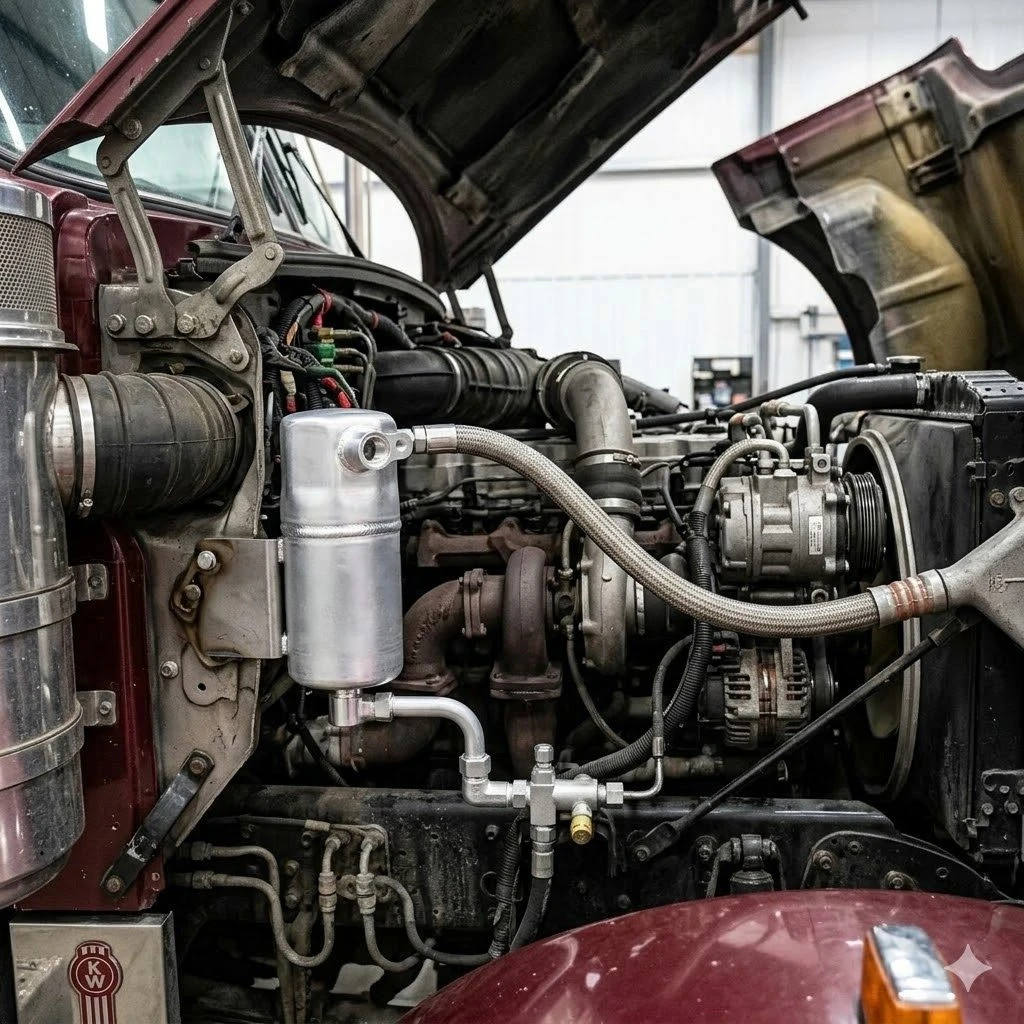
The receiver-drier contains desiccant that absorbs moisture from the refrigerant. Once the system is opened to air, the desiccant saturates quickly. Always replace it when replacing the condenser — skipping this step can contaminate the new condenser within a season.
Parts to Replace During Condenser Job
Browse our A/C dryers and receiver-driers and refrigerant O-rings — we stock the fitments for all major Class 8 makes.
A/C Condenser Replacement Cost in Canada
Condenser replacement is one of the more affordable A/C repairs on a Class 8 truck. The condenser itself costs significantly less than a compressor, and the labour time is shorter.
| Item | DIY Cost (CAD) | Shop Cost (CAD) |
|---|---|---|
| A/C condenser (aftermarket OEM-fit) | $300–$600 | $300–$600 |
| Receiver-drier | $60–$120 | $60–$120 |
| O-ring kit | $15–$30 | $15–$30 |
| R-134a refrigerant (1–1.8 kg) | $80–$150 | $80–$150 |
| Refrigerant recovery & recharge (shop) | N/A | $100–$200 |
| Labour (2–3 hrs @ $120–$180/hr) | N/A | $240–$540 |
| Total estimate | $455–$900 | $800–$1,640 |
Note: Refrigerant recovery and recharge requires certified equipment. In Canada, technicians handling refrigerants must be certified under the Environmental Protection Act. Most owner-operators hire a shop for recovery/recharge and handle the mechanical condenser swap themselves — the legal combination that cuts cost without cutting corners.
A/C Condenser Life by Truck Make
Condenser lifespan varies by make due to differences in front-end design, airflow, and vibration exposure. Trucks with more aggressive grille openings run cooler condensers but expose them to more debris.
| Make | Typical Condenser Lifespan | Common Failure Mode |
|---|---|---|
| Freightliner Cascadia | 500,000–750,000 km | Fin damage from debris; fitting corrosion |
| Kenworth T680 / T880 | 600,000–800,000 km | Seam cracks from vibration; pin-hole leaks |
| Peterbilt 579 / 389 | 600,000–800,000 km | Seam cracks; inlet fitting leaks |
| Volvo VNL | 500,000–700,000 km | Fin blockage from road film; bracket corrosion |
| Mack Anthem / Pinnacle | 450,000–650,000 km | Debris damage; shorter lifespan in urban routes |
| International LT / RH | 500,000–700,000 km | Fitting corrosion; fin damage |
| Western Star 49X / 57X | 500,000–700,000 km | Seam cracks; aggressive vibration exposure |
Shop A/C condensers by make
OEM-fit condensers for Freightliner, Kenworth, Peterbilt, Volvo, Mack, International and Western Star. GTA, Canada.
Frequently Asked Questions
Can I drive with a leaking A/C condenser?
You can drive, but you'll lose your refrigerant charge over time, which eventually causes the A/C to stop working entirely. More importantly, a low-charge system forces the compressor to run under abnormal conditions — this can damage the compressor, turning a $400 condenser replacement into a $1,200+ job. Fix the condenser as soon as possible.
Can I straighten bent condenser fins instead of replacing the condenser?
If the fins are only lightly bent and the core isn't leaking, a fin comb can restore airflow and buy more life from the condenser. This is worth doing during routine maintenance. However, if more than 30% of the fins are crushed flat, or if there's any leak or corrosion, replacement is the right call — a fin-combed condenser at 60% efficiency is still a condenser problem.
How long does a semi truck A/C condenser replacement take?
A shop doing a complete condenser replacement — including refrigerant recovery, condenser swap, drier replacement, vacuum pull, and recharge — typically takes 2.5 to 4 hours total. The mechanical swap itself is 1.5–2 hours; the rest is recovery and recharge time.
Do I have to replace the receiver-drier every time I open the A/C system?
Yes, every time. The desiccant inside the drier absorbs moisture from ambient air the moment the system is opened. Once saturated, it stops working — and moisture in the refrigerant creates acid that corrodes the compressor, condenser, and expansion valve. A $60–$120 drier is cheap insurance against a $1,500+ system failure.
What refrigerant does a Class 8 semi truck use?
The vast majority of Class 8 trucks manufactured after 1995 use R-134a refrigerant. Some 2021+ model year trucks are transitioning to R-1234yf (lower global warming potential), but R-134a is still standard for the Freightliner Cascadia, Kenworth T680, Peterbilt 579, and Volvo VNL currently in fleet service. Always check the refrigerant label under the hood before charging.
How much refrigerant does a semi truck A/C system hold?
Most Class 8 trucks hold between 1.0 and 1.8 kg of R-134a. The exact amount is on a label near the compressor or in the service manual. Always charge to the specified amount — overcharging produces the same high-side pressure symptoms as a blocked condenser and can damage the compressor.