Not sure what the charge air cooler does? See what a charge air cooler is and how it works first.
In this article
What the Charge Air Cooler Does on a Peterbilt 379/389
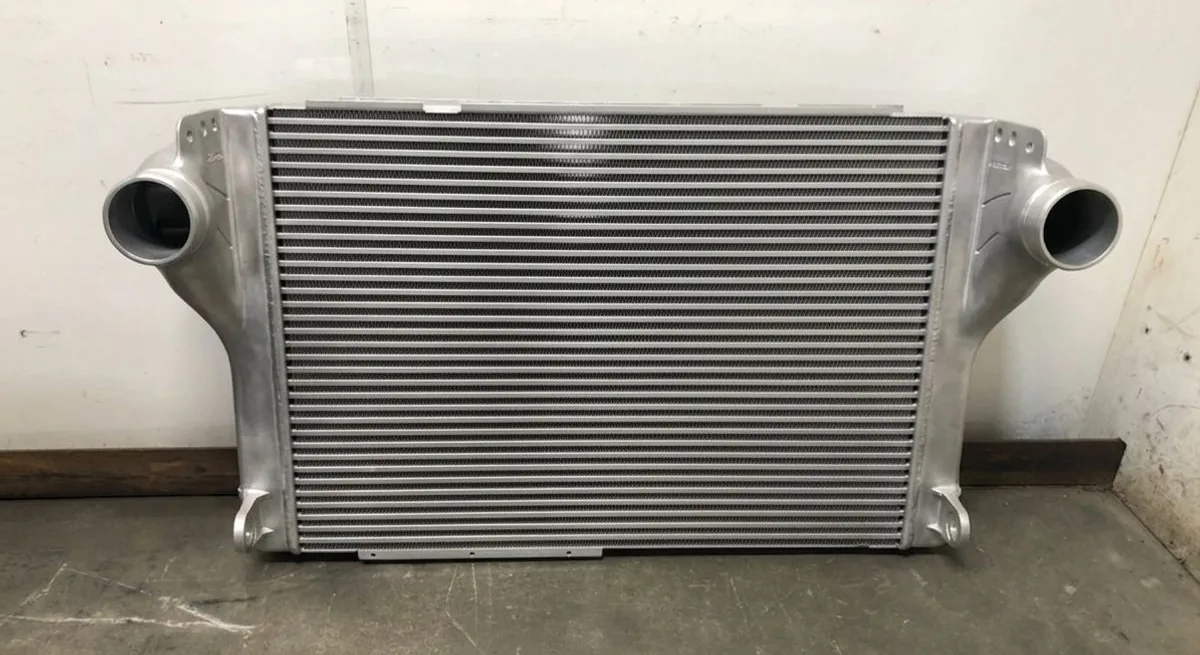
The 379 (built 1987–2007) and its successor the 389 (2007–2022) are the trucks most people picture when they picture a semi — long hood, upright chrome grille, classic proportions. Both are highway conventionals that have almost always shipped with a turbocharged diesel, and on a turbo diesel the charge air cooler (CAC) is what makes the boost usable. The turbo compresses intake air and heats it well past 150 °C in the process; the CAC — mounted in front of the radiator behind that classic grille — pulls 50–80 °C back out before the air reaches the intake manifold. Denser, cooler air means more oxygen per stroke, which is what lets these engines make their rated power without melting themselves down.
The difference between a 379/389 and a modern aero truck like a T680 or Cascadia isn't the job the CAC does — it's where the CAC sits and what hits it. More on that in the "why they fail differently" section below.
Engine & Fitment by Model Year
These two trucks span 35 years and half a dozen engine platforms, so fitment is the first thing to confirm before ordering any CAC.
| Model / Years | Common Engines | Notes |
|---|---|---|
| 379 (1987–2002) | CAT 3406, Cummins N14, Detroit Series 60 | Pre-emissions or early-EGR; boost circuits are simpler, fewer sensors in the charge air path — a leak shows up as pure power/economy loss with no code |
| 379 (2003–2007) | CAT C15, Cummins ISX, Detroit Series 60 | Later 379s picked up EGR; a boost leak here can start pushing exhaust temps and coking the EGR cooler in addition to the power loss |
| 389 (2007–2016) | Cummins ISX, CAT C15 (early), Paccar MX-13 (later) | Full EGR/DPF emissions systems; boost leaks accelerate regen frequency exactly like on modern trucks |
| 389 (2016–2022) | Paccar MX-13, Cummins X15 | Same core dimensions as late Kenworth T880/W900 on the MX-13 platform, but confirm bracket and hose orientation before cross-shopping |
Because so many 379s on the road today are glider kits or engine swaps, always confirm the actual engine under the hood rather than assuming it matches the original factory spec for that model year — CAC dimensions follow the engine, not the VIN.
5 Signs Your Peterbilt CAC Is Failing
1 Power Loss That Shows Up Gradually, Then Suddenly
Owner-operators who know their trucks well often describe this as the engine "not pulling like it used to." A boost leak vents compressed air before it reaches the manifold; the ECM (or, on pre-electronic engines, simple physics) delivers less oxygen than the fuel setting expects, and power drops. On mechanical engines (early 379s with in-line pumps), this can feel gradual because there's no computer cutting fuel to compensate — you just have a flat-feeling motor. On electronic engines (ISX, MX-13, later C15), the ECM actively reduces fuelling in response to low boost, so the drop can feel more sudden and pronounced.
2 Black or Grey Smoke Under Acceleration
Less air for the same fuel charge means incomplete combustion — visible as black smoke pulling away from a stop or climbing a grade. On EGR/DPF-equipped 389s and late 379s, this also raises exhaust temperature and triggers more frequent active regens. On earlier mechanical 379s without aftertreatment, the smoke itself is the main symptom — there's no DPF to load up, but the smoke is also more visible and more likely to draw a roadside inspection.
3 Fault Codes on Electronic Engines (ISX, MX-13, Late C15)
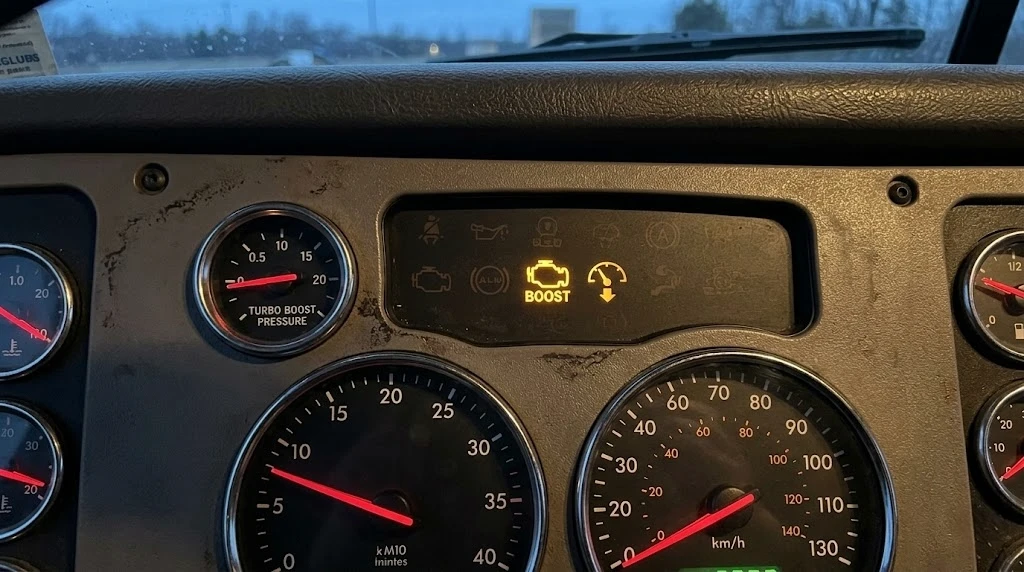
If your 379 or 389 runs a Cummins ISX or Paccar MX-13, a boost leak typically throws a low manifold pressure / underboost code — SPN 102 on the J1939 bus, sometimes paired with a turbo-related code depending on the ECM's interpretation. As with any make, these codes point at the boost circuit broadly, not the CAC specifically — a cracked charge pipe or a bad wastegate actuator produces the same symptom. Pre-electronic 379s (mechanical CAT 3406, early N14) won't throw a code at all — smoke and power loss are your only signals, which is exactly why the pressure test below matters more on older trucks, not less.
4 Fuel Economy Drift
A CAC that's leaking or fouled forces the engine to burn more fuel for the same output. On a truck doing real highway miles, even a 5–7% fuel penalty adds up fast. This is often the first sign an owner-operator notices, since it hits the wallet directly — before the power loss becomes obvious enough to complain about.
5 Rock Chips, Bent Fins, or Oily Residue on the Core Face
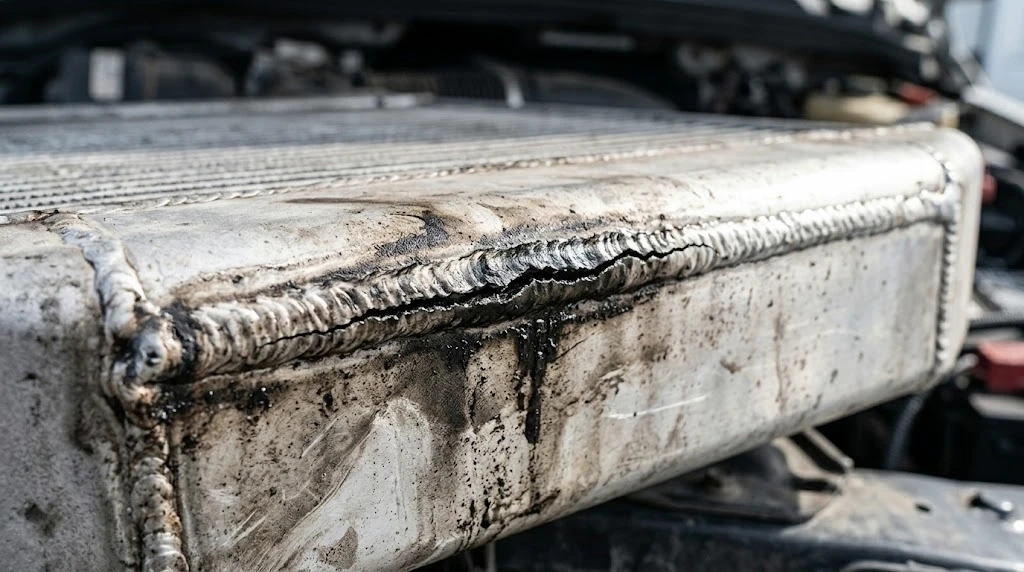
Pop the hood — on a 379/389 this is a genuine hood tilt, not a fascia panel, so the CAC is easy to inspect directly. Look for bent or crushed fins from debris passing through the tall, upright grille, and run a hand along the plastic end tanks feeling for cracks at the crimp joint. Oily residue on the core or the boost couplers points to a turbo seal starting to pass oil into the charge circuit — that oil coats the internal fins and reduces cooling even before a structural leak develops.
Rule of thumb: two or more of these together — especially power loss plus visible core damage — means pressure-test before you order a core. A squeezed coupler clamp costs nothing to fix; a new CAC does.
How to Diagnose a Boost Leak on a 379/389
Step 1 — Visual Inspection During a Hood Tilt
Since the 379/389 hood tilts forward for engine access, you get a much more direct view of the CAC than on a fascia-panel aero truck. Inspect both end tanks for cracking at the crimp joint, check every boost coupler and hose clamp, and look at the core face for bent fins or impact damage from road debris passing through the grille.
Step 2 — Shop Air Pressure Test
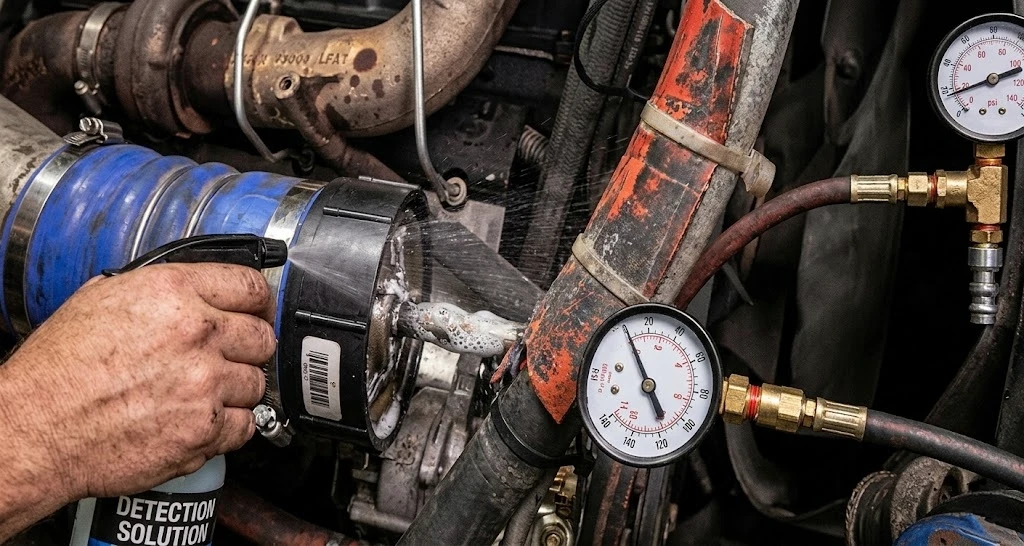
Remove both boost boots, plug one side, and feed shop air into the other through a regulator with a gauge, pressurizing to 20–25 psi. Spray soapy water over the whole core and both end tanks — bubbles confirm the leak location. This works identically whether you're testing a 1990 mechanical 379 or a 2020 MX-13-powered 389; the CAC itself doesn't care what engine feeds it.
Stay at or below 30 psi. Typical in-service boost on these trucks runs 15–28 psi depending on engine and load. Testing at 20–25 psi exposes real leaks without risking damage to a core that's otherwise sound.
Step 3 — On Electronic Engines, Pull the Fault Codes First
If you're running ISX, MX-13, or a late electronic C15, scan for codes before you start pulling parts. An underboost code narrows things down immediately and can save you from testing components that aren't involved.
Step 4 — Check the Cheap Stuff Before Condemning the Core
- Boost coupler clamps — road vibration on a long-hood conventional walks clamps loose over time just like on any truck
- Silicon couplers themselves — heat-hardened and cracking after 6–10 years is common on higher-mileage trucks
- Charge pipe welds, especially on trucks that have had frame or engine work done — a pipe reroute during a glider build or engine swap is a common source of a new leak
- Turbo boot and elbow connections near the manifold
Shop Peterbilt Charge Air Coolers
379 and 389 fitments across CAT, Cummins and Paccar MX-13. GTA pickup or Canada-wide shipping.
Why the 379/389 Fails Differently Than Aero Trucks
The Classic Grille Changes the Debris Path
A T680 or Cascadia tucks its CAC behind a low, angled aero fascia that deflects a lot of road spray and small debris around the truck. The 379/389's tall, upright chrome grille does the opposite — it's designed to move maximum air straight through to the radiator and CAC for cooling capacity, which also means rocks, gravel, and road debris hit the core more directly. Owner-operators running gravel roads or winter conditions see more physical core damage on these trucks than on aero-nosed equivalents.
Age Is a Bigger Factor Than Duty Cycle
A huge share of 379s on the road today are 15–35 years old, often several owners deep, sometimes glider-kitted with a newer engine in an old frame. At that age, the CAC's aluminium fins and plastic-to-metal joints degrade from decades of heat cycling and road salt exposure regardless of how gently the truck has been driven. Where a modern MX-13 or ISX truck's CAC failure is usually about vibration and emissions duty cycle, an older 379's failure is just as often simple material fatigue from age.
Glider Kits and Engine Swaps Complicate Fitment
Because the 379 has been such a popular glider kit platform, it's common to find a truck with a different engine than its model year originally shipped with. Always match the CAC to the actual engine and charge pipe routing in the truck, not to the frame's model year — mismatched fitment on a glider is one of the most common return reasons we see.
Chrome Culture Means More Aftermarket Modification Near the CAC
Custom grille inserts, bug screens, and chrome accessories are common on show-quality 379s and 389s. Some of these reduce airflow to the CAC more than owners realize, which can show up as reduced cooling efficiency even on a structurally sound core. If you've added a bug screen or custom grille insert and started noticing power loss on hot days, airflow restriction is worth ruling out before assuming the CAC itself has failed.
Peterbilt 379/389 CAC Replacement Cost in Canada (2026)
The hood-tilt design actually makes CAC replacement more straightforward on a 379/389 than on a fascia-panel aero truck — no bumper trim to remove, direct access once the hood is up. Budget 2–3 hours labour at a competent heavy-duty shop for either model.
| Item | DIY Cost (CAD) | Shop Total (CAD) | Notes |
|---|---|---|---|
| Aftermarket CAC (389, MX-13/ISX) | $500–$750 | $950–$1,350 | All-aluminium bar-and-plate cores widely available for the modern engine platforms |
| Aftermarket CAC (379, CAT/N14/Series 60) | $450–$700 | $900–$1,300 | Older engine fitments — availability varies more; confirm core dimensions carefully, especially on glider-kit trucks |
| OEM Peterbilt/Paccar CAC | $1,200–$1,900 | $1,900–$2,800 | Best for late-model 389s still under warranty; longer lead time for 379-era parts |
| Silicon coupler kit | $55–$95 | $120–$180 | Replace while the hood's already up — old couplers on higher-mileage trucks crack during removal anyway |
| Labour only (GTA) | — | $190–$340 | 2–3 hrs at $95–$130/hr; hood-tilt access keeps this on the shorter end compared to aero trucks |
OEM vs. Aftermarket vs. Duralite
You'll see "Duralite" come up a lot when searching for 379 charge air coolers — it's one of the established aftermarket brands with wide coverage for the 379's various engine platforms, and a reasonable reference point for quality when comparing options.
When OEM Makes Sense
- Late-model 389 still under Peterbilt/Paccar warranty
- You need exact factory documentation for a fleet or resale record
When Aftermarket Is the Better Call
- Any 379, given its age — an all-aluminium aftermarket core has no plastic end-tank fatigue point to worry about long-term
- A 389 over 500,000 km — same logic as any high-mileage truck, the OEM plastic tanks will eventually crack again
- Glider kits and engine swaps — aftermarket suppliers often stock a wider range of fitments matched to engine rather than chassis year
- Budget matters and downtime matters — aftermarket cores are typically in stock; OEM parts for a 20+ year old 379 may need to be sourced
What we stock: our charge air cooler inventory covers Peterbilt 379 and 389 fitments across CAT, Cummins and Paccar MX-13 engine platforms, plus our dedicated Peterbilt 579 CAC page if you're running the current-generation aero model. Most fitments ship same-day from Vaughan or Canada-wide.
Running other makes in your fleet? See our guides for the Kenworth Cooling & A/C, Mack MP7/MP8, and Freightliner Cascadia charge air coolers, or the make-agnostic CAC symptoms guide.
Frequently Asked Questions
Can I run my 379 or 389 with a small CAC leak for a while?
A minor leak won't strand you, but it worsens with every heat cycle. On EGR/DPF-equipped 389s and late 379s, ignoring it means more frequent regens and accelerated aftertreatment wear. On mechanical pre-emissions 379s, the main cost of waiting is fuel economy and power — less urgent, but not free either. Fix it within the next service interval rather than waiting for it to fail completely.
Will a Peterbilt 389 CAC fit a 379, or vice versa?
Not reliably. Even where engine platforms overlap (late 379s and early 389s both ran CAT C15 and Cummins ISX), hood geometry, mounting brackets, and charge pipe routing differ between the two chassis. Match by engine and confirm bracket/port orientation — don't assume cross-compatibility from chassis similarity alone.
My 379 is a glider kit — how do I know which CAC to order?
Order based on the actual engine installed, not the frame's original model year. Get the engine make, model, and displacement (e.g., "Cummins ISX15" or "CAT C15 Acert") and use that to match CAC dimensions — the glider builder's paperwork or the engine's own dataplate is more reliable than the truck's VIN for this purpose.
Does a bug screen or custom grille insert affect the CAC?
It can. Anything that restricts airflow through the grille reduces how much cooling the CAC (and radiator behind it) can do, which shows up as reduced power or higher operating temps on hot days — even with a perfectly healthy core. If you've added one and started noticing heat-related performance issues, that's worth checking before assuming the CAC itself needs replacing.
What boost pressure should a healthy 379/389 show?
It varies significantly by engine — a mechanical CAT 3406 runs different boost than an electronic MX-13. As a general range, expect roughly 15–28 psi at full load across these platforms. If you have access to factory service data for your specific engine, use that as the reference; otherwise a temperature-delta test (50°C+ drop across the CAC) is a reliable engine-agnostic check.
Need a Peterbilt 379 or 389 Charge Air Cooler?
CAT, Cummins and Paccar MX-13 fitments in stock. Same-day pickup in Vaughan (GTA) — Canada-wide shipping available.
True Truck Parts
Heavy Duty Cooling & A/C Specialists — GTA, Canada
Our team specializes in cooling and A/C parts for Class 8 semi trucks, serving fleet operators and owner-operators across the Greater Toronto Area and Canada. We stock OEM-fit parts for Freightliner, Kenworth, Peterbilt, Volvo, Mack, Hino, International and Western Star.