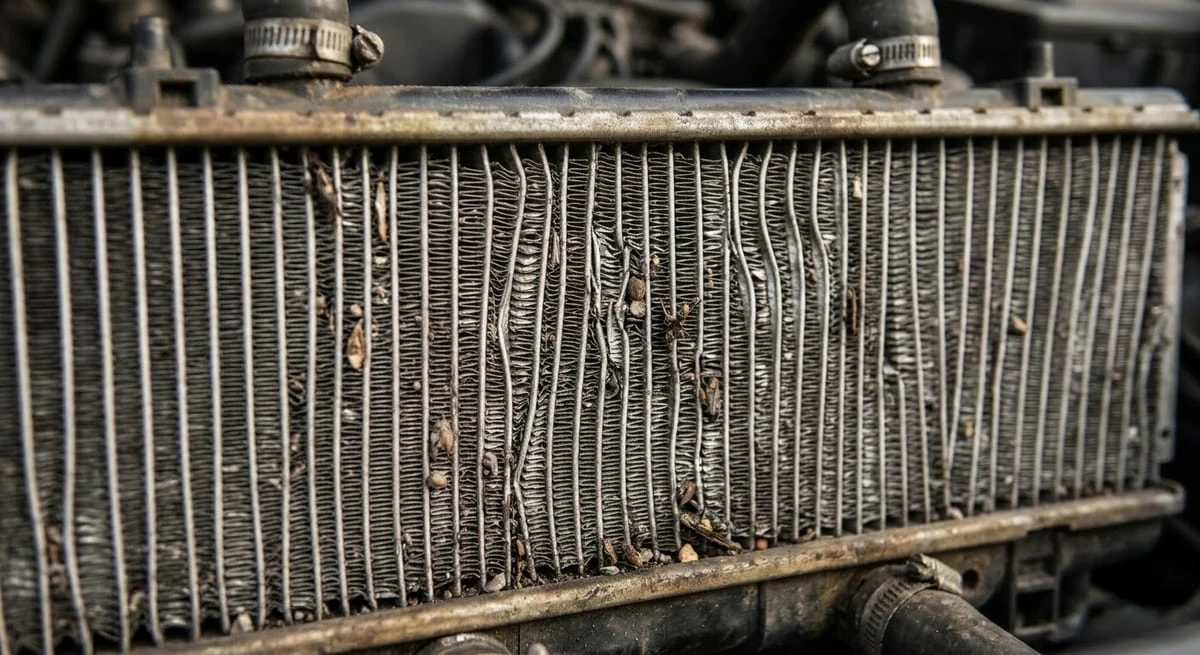
Airflow, not components, causes most Peterbilt heat complaints — and a packed core looks fine from the driver's seat.
In this article
- Classic or aero: two different cooling problems
- Why the 379 radiator is the hard one
- Six common Peterbilt cooling and A/C faults
- Coolant: what actually decides radiator life
- Problems by model: 379, 389, 567, 579, 387
- Doing the A/C job once
- Diagnosing overheating and weak A/C
- Peterbilt parts we stock in the GTA
- Frequently asked questions
Classic or Aero: Two Different Cooling Problems
Peterbilt is really two trucks wearing one badge, and they do not fail the same way. The long-hood classics — the 379 and the 389 that replaced it — carry a large frontal area, a deep engine bay and generous airflow. The aero tractors, the 579 and the vocational 567, pack the same cooling job into a tighter, shaped nose where the charge air cooler, radiator and A/C condenser sit close together.
That difference decides what goes wrong. On a classic, cooling capacity is rarely the constraint, so a 379 that runs hot almost always has a specific fault: a blocked core, a tired water pump, a fan clutch that is not locking up. On an aero truck the stack is denser, less forgiving of road film, and cleaning between the coolers matters far more than it does on a long hood.
The A/C side is common to both and is where most of the day-to-day complaints live — a cab that will not cool costs a driver sleep, and on a truck that is a safety problem before it is a comfort one.
Why the 379 Radiator Is the Hard One
If one part causes more wrong orders on a Peterbilt than any other, it is the radiator. We stock 35 radiators that fit Peterbilt trucks, spanning 1979 to 2018, with core heights from 22.1875″ to 42.9375″ — and 18 of them list the 379. A "379 radiator" is not one part, and the year alone will not get you to the right one.
| Part | Fits | Years | Core in. H×W×D | Price |
|---|---|---|---|---|
| TPR0003 | 367, 387, 567, 579, 587 | 2008–2016 | 34× |
quote |
| TPR0004 | 365, 367, 379, 387, 388, 389, 567 | 2008–2018 | 42.875× |
quote |
| TPR0008 | 325, 330, 335, 340 | 2008–2010 | 22.1875× |
quote |
| TPR0015 | 382 | 2008–2015 | 30.5× |
$798.16 |
| TPR0023 | 379 | 2004–2007 | 41.375× |
$3,698.17 |
| TPR0009 | 330, 335, 340 | 2003–2007 | 34.625× |
$753.67 |
| TPR0010 | 379, 357 | 2003–2006 | 36.125× |
$2,498.17 |
| TPR0002 | 357, 375, 377, 379, 385 | 1995–2007 | 33.5× |
$1,995.07 |
| TPR0006 | 330, 387 | 1995–2005 | 32.25× |
$1,189.17 |
| TPR0019 | 379 | 1995–2003 | 29.25× |
quote |
| TPR0021 | 379 | 1995–2003 | 36.25× |
quote |
| TPR0026 | 379 | 1995–2003 | 29.25× |
quote |
| TPR0001 | 357, 377, 378, 379, 385 | 1993–2007 | 36.25× |
quote |
Peterbilt radiators by year and core size — 35 in stock. Only rows carrying both a year span and measured dimensions are listed, so nothing here is a guess.
Worse, on the 379 the dimensions do not always settle it either. Several 379 radiators in our stock share the same core size, and what separates them is the tank configuration, the inlet and outlet positions, and whether the truck was built with an oil cooler in the bottom tank. Two radiators can measure identically and still not interchange.
So on a 379, measuring is the start and not the end. The part number stamped on the old radiator, or the VIN, is what actually resolves it — send us either and we will confirm before you commit. Our Peterbilt radiator listings carry the OE cross-references on every part so you can match against the number rather than the badge.
Not sure which radiator you need?
Send the VIN or the number off the old core and we will confirm the exact part for your build. Same-day quotes, pickup in Vaughan.
Get a fitment checkSix Common Peterbilt Cooling and A/C Faults
1 Radiator leaks and core blockage
Aluminium core with plastic end tanks across most of the modern range. The crimp where tank meets core is the usual leak point and it tends to weep rather than burst, so it shows first as a reservoir level that keeps dropping with no puddle underneath. Internally, scale from neglected coolant narrows the tubes and costs capacity long before anything leaks.
2 Coolant reservoir and surge tank cracks
Pressurised plastic that heat-cycles thousands of times. Cracks start at moulding seams and around the neck, and a seam that only opens when hot and pressurised will pass a cold inspection while still losing coolant every day. A tank needing a weekly top-up with nothing on the ground is the classic sign.
3 Charge air cooler leaks
Power loss under load, black smoke, rising exhaust temperature and worse fuel economy. Because none of those point obviously at the cooler, trucks get diagnosed for turbo or injector faults first. Boost-test before replacing anything upstream. We have covered this in depth for both chassis families — the 379 and 389 guide for the classics, and the 579 charge air cooler page for the aero trucks.
4 A/C compressor failure
Warm air, a clutch that will not engage, or a noise that changes with engine speed. Compressors rarely fail on their own — low refrigerant from an untraced leak starves the compressor of oil and destroys it. Replacing the compressor without finding the leak buys a season at most.
5 Receiver drier saturation
The drier holds a desiccant that absorbs moisture. Once the system has been open to atmosphere — any repair, any leak — it is saturated and must be replaced. Skipping it is the single most common reason a fresh A/C repair fails again quickly, because the moisture left behind forms acid and attacks the new compressor.
6 O-ring and line leaks
The cheapest failure and the one we are asked about most. Every joint in an A/C system is sealed by an o-ring; they harden with age and heat, and a hardened one leaks slowly enough that the system simply gets less cold each week rather than failing outright. Replace every o-ring you disturb, match the compound to the refrigerant, and lubricate with the specified A/C oil rather than whatever is on the bench.
Coolant: What Actually Decides Radiator Life
Most radiators we replace did not wear out. They corroded, or they silted up, and both come down to what was in the system and how long it stayed there. A Peterbilt worked hard on a flushed, correctly specified coolant will go a very long time; the same truck topped up with whatever was in the shop will not.
Three things cause most of the damage:
- Mixing coolant types. Extended-life coolant (ELC, usually red or orange) and conventional green are built on different inhibitor chemistries. Mixed, the additives can drop out of solution and form a sludge that coats tubes and blocks the narrow passages in the core. Topping up an ELC system with green because it was to hand is one of the most expensive shortcuts on a truck.
- Letting the inhibitors deplete. The additive package is consumable and it is what stops the aluminium and the iron in the block from corroding. Once it is spent, the coolant looks fine and is quietly eating the system. Test it rather than judging by colour.
- Topping up with plain water. Tap water brings minerals that deposit as scale on the hottest surfaces, which is exactly where you need heat transfer. It also dilutes whatever inhibitor is left. Use the correct pre-mix, or distilled water with the right concentrate.
The tell-tale signs are worth knowing. Brown or rusty coolant means corrosion is already underway. An oily film on the surface points at a cooler or a head gasket, not a coolant problem. Sludge or a gel is usually mixed chemistries. Any of the three means a flush before the new radiator goes in — fitting a clean core to a dirty system just moves the problem forward a few months. Our step-by-step flush guide covers the procedure.
Problems by Peterbilt Model
379 (1987–2007)
The icon, and the hardest to order parts for. Twenty years of production, a long options list and a huge surviving population mean 18 different radiators in our stock list it. Cooling capacity is generous, so a 379 that overheats has a fault worth finding rather than a system that is merely marginal — check airflow and coolant condition before suspecting the radiator.
389 (2007–present)
The 379's successor, keeping the long hood while meeting newer emissions rules. The added aftertreatment raises under-hood temperatures compared with the truck it replaced, so cooling components work harder than the classic proportions suggest.
579 (2012–present)
The aero flagship, PACCAR MX-13 or Cummins X15, sharing its platform with the Kenworth T680. The tight nose packs the cooling module together, so debris between the coolers matters more here than on any long hood. Charge air cooler fitment is tied closely to build year — see the 579 charge air cooler page.
567 (2013–present)
The vocational counterpart to the 579. Dump, mixer and heavy-haul work means sustained low-speed, high-load operation, which is the worst case for any cooling package because there is little ram air and the fan does all the work. On a 567 running hot in the yard but fine on the highway, check the fan clutch first.
387, 386 and 385
The aero generation the 579 replaced. Old enough now that original radiators and coolers are reaching the end of their service life, and well represented in the aftermarket.
330, 335, 337 and 348
Peterbilt's medium-duty range — different trucks with different cooling packages, and not interchangeable with the Class 8 parts above despite sharing the badge. We stock parts for these too; confirm by part number rather than by model name.
Doing the A/C Job Once
An A/C repair that fails the following summer is almost always one of four omissions, and none of them are expensive to avoid at the time.
- Use the oil the compressor specifies, in the quantity it specifies. The oil type is set by the compressor and the refrigerant, not by the truck, and it is on the compressor label or the underhood decal. Mixing oil types causes the lubricant to separate and the compressor to run dry. If the label is gone, send us the compressor part number and we will confirm it.
- Replace the receiver drier every time the system is opened. Covered above, and worth repeating because it is the most commonly skipped part in the whole repair.
- Replace every o-ring you disturb, and match the compound to the refrigerant. A reused o-ring has already taken a set; it will seal on the bench and weep in service.
- Pull a proper vacuum before charging. Moisture left in the system forms acid, and acid is what kills the compressor you just paid for. A short vacuum is not a vacuum.
And find the leak first. A system that lost its charge lost it somewhere, and a compressor fitted into a system that is still leaking will be back on the bench before the season is out.
Diagnosing Overheating and Weak A/C — Step by Step
- Look at the front of the truck first. Most heat complaints on any Class 8 truck are airflow, not components. Check the whole stack — condenser, charge air cooler, radiator — for packing.
- Check coolant level and condition. A dropping level with no puddle points at the surge tank or a weeping tank crimp. Brown or oily coolant is a separate and more serious problem.
- Note when it happens. Hot at low speed but fine on the highway points at the fan or fan clutch. Hot at highway speed points at flow or capacity: a blocked core, a failing water pump, a thermostat.
- Boost-test the charge air cooler if there is any power complaint at all, before touching the turbo.
- For weak A/C, measure both pressures. High side and low side together tell you whether you have a charge problem, a restriction or a failing compressor. One gauge reading tells you almost nothing.
- Find the leak before replacing the compressor. Dye or an electronic sniffer. A compressor fitted into a leaking system fails again.
Need the part today?
We stock 97 Peterbilt cooling and A/C parts with same-day pickup in Vaughan and delivery across the GTA.
Browse Peterbilt partsPeterbilt Cooling and A/C Parts in the GTA
We carry 97 parts that fit Peterbilt trucks, covering the cooling system and the complete air conditioning loop. Every listing carries the OE cross-reference numbers, so you can match against the number stamped on the part you are replacing rather than guessing from the model year.
What We Stock for Peterbilt
- Peterbilt radiators — 35 covering 379, 389, 567, 579, 387, 357 and the medium-duty range
- Charge air coolers — 18 air-to-air units
- A/C condensers — 12 listings
- Evaporators — 7 listings
- Receiver driers — 7 listings; replace at every A/C repair
- Pressure switches — 6 listings
- A/C compressors — 5 listings
- Expansion valves — 4 listings
- Coolant tanks and surge tanks — 3 listings
- A/C o-rings and seals — replace every one you disturb
- A/C lines and hoses
For a same-day quote, contact us with your Peterbilt model and VIN, or the part number off the old unit. We confirm fitment before you commit. Pickup is in Vaughan, with delivery across Brampton, Mississauga, North York, Oshawa and the rest of the GTA.
Frequently Asked Questions
Why are there so many different radiators for a Peterbilt 379?
Twenty years of production and a long options list. We stock 35 radiators fitting Peterbilt trucks and 18 of them list the 379. They differ in core size, tank configuration, inlet and outlet position, and whether the truck was built with an oil cooler in the bottom tank — and several share a core size while still not interchanging. Match the part number off the old radiator, or send the VIN.
Will a 379 radiator fit a 389?
Sometimes, but do not assume it. The 389 kept the long hood and much of the 379's proportions, and some radiators are listed for both — our listings show exactly which. Others are specific to one or the other, because the 389's emissions equipment changed what sits behind the grille. Check the cross-reference numbers rather than the badge.
Why does my Peterbilt run hot in traffic but fine on the highway?
Almost always the fan or fan clutch. At highway speed ram air does most of the cooling; at low speed the fan has to do it all, so a clutch that is not engaging or is slipping shows up only when the truck slows down. A packed radiator face produces the same pattern, so check airflow first — it costs nothing.
Do I need to replace the receiver drier when I replace the A/C compressor?
Yes. The drier's desiccant saturates as soon as the system is opened to atmosphere, and the moisture it releases back into a repaired system forms acid that attacks the new compressor. It is the cheapest part in the repair and skipping it is the most common reason an A/C job fails within a season.
Are Peterbilt and Kenworth cooling parts interchangeable?
Some are. Both are PACCAR marques and the 579 shares its platform with the Kenworth T680, so a number of charge air coolers and radiators are listed for models from both. Many others are not interchangeable at all. Our listings name every model a part fits, so check there rather than assuming the platform carries across.
Can I get Peterbilt cooling and A/C parts in Vaughan or Brampton?
Yes. We hold 97 Peterbilt parts — radiators, charge air coolers, condensers, compressors, driers, expansion valves, coolant tanks, switches and o-rings — with same-day pickup in Vaughan and delivery across Brampton, Mississauga, North York and Oshawa. Send the VIN or the old part number and we will confirm fitment first.
How long should a Peterbilt radiator last?
Coolant maintenance matters far more than mileage. A system flushed on schedule with the correct coolant will outlast one topped up with whatever is to hand by a wide margin, because it is scale and corrosion — not wear — that ends most radiators. Damage from road debris is the other common cause, and that has nothing to do with age.