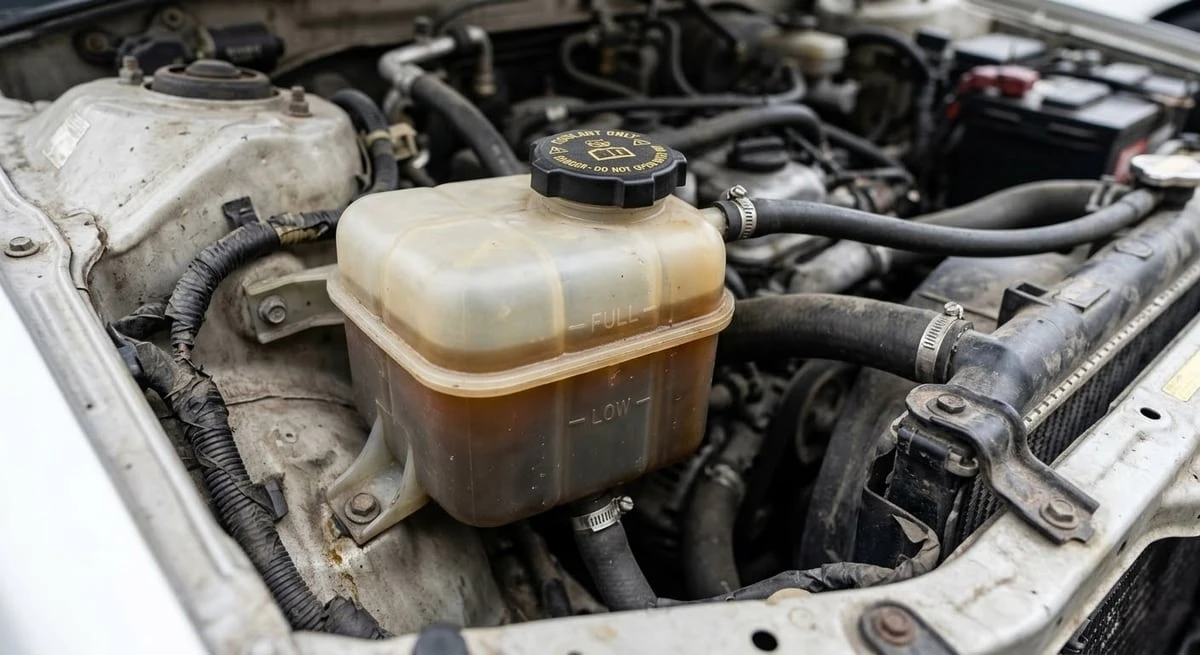
Coolant condition ends more International radiators than mileage does — and it is visible long before the gauge moves.
In this article
- The number on the door is a class code
- The A/C loop: where most International complaints start
- Coolant tanks and surge tanks
- Radiators: 67 parts, three classes of truck
- Six common International cooling and A/C faults
- Problems by series: ProStar, LoneStar, 9900i, WorkStar, DuraStar
- Diagnosing overheating and weak A/C
- International parts we stock in the GTA
- Frequently asked questions
The Number on the Door Is a Class Code
International is the hardest marque on the road to order cooling parts for, and the reason is the naming. A four-digit number tells you almost everything — if you know that the leading digit is a class code, not a model year or a trim level.
- 3000 and 4000 series — medium duty. DuraStar, TerraStar, the 4300 and 4400 that every rental fleet and box-truck operator knows. Class 5 to 7, and a cooling package sized for it.
- 5000 and 7000 series — severe service. WorkStar and PayStar, dump, mixer and construction. Constant low-speed, high-load running with little ram air, which is the hardest case a cooling system faces.
- 8000 and 9000 series — Class 8 highway, along with the named generations: ProStar, LoneStar, TranStar and the long-hood 9900i. Sustained highway load, ram air doing most of the work.
That is not trivia. It is the single most useful thing to know before you order, because the three classes do not share cooling parts — and our own stock shows exactly how far apart they are:
- Medium duty — 10 radiators, cores from 20.5″ to 36.625″
- Severe service — 22 radiators, cores from 17.75″ to 46.375″
- Class 8 highway — 20 radiators, cores from 22″ to 51.625″
Across all 67 International radiators we hold, core height runs from 17.75″ to 51.625″ — nearly a threefold range, and the widest of any make we stock. A DuraStar box truck and a 9900i long-hood tractor wear the same badge and share almost nothing up front.
The A/C Loop: Where Most International Complaints Start
More people ask us for International A/C parts than International cooling parts, and the pattern is consistent: expansion valves, pressure switches, driers and lines. These are the cheap parts that strand a driver with a hot cab, and they are the ones most often replaced in the wrong order.
The order that actually works:
- Measure both pressures before touching anything. High side and low side together tell you whether you have a charge problem, a restriction or a failing compressor. One gauge reading tells you almost nothing, and a compressor condemned on one reading is the most expensive mistake in the job.
- Check the pressure switch before the compressor. A failed switch stops the clutch engaging and presents exactly like a dead compressor, for a fraction of the cost.
- Suspect the expansion valve when the symptoms are odd. Cooling that works then fades, frost on the inlet, or a low side that will not come down usually points at the valve or a restriction, not at the charge.
- Find the leak before you charge. A system that lost refrigerant lost it somewhere. Dye or an electronic sniffer, fix it, then charge.
- Replace the drier whenever the system has been open. Its desiccant saturates the moment it meets atmosphere, and the moisture it releases back forms acid that attacks the new compressor. It is the cheapest part in the repair and the most commonly skipped.
- Replace every o-ring you disturb and pull a proper vacuum. A used o-ring has taken a set; it seals on the bench and weeps in service.
Not sure which part fits your International?
Send the VIN or the number off the old unit and we will confirm the exact part for your series. Same-day quotes, pickup in Vaughan.
Get a fitment checkCoolant Tanks and Surge Tanks
We hold 15 coolant tanks that fit International trucks — more than for any other make we carry — and they are one of the parts we are asked for most.
The failure is almost always the same. The tank is pressurised plastic that heat-cycles thousands of times, and cracks start at moulding seams and around the neck. A seam that only opens when hot and under pressure will pass a cold inspection while losing coolant every day, so the classic sign is a tank needing a weekly top-up with nothing on the ground beneath it.
| Part | Fits | Years | Price |
|---|---|---|---|
| TIT0011 | — | — | $189.07 |
| TIT0012 | — | — | $179.06 |
| TIT0013 | — | — | $249.17 |
| TIT0014 | — | — | $289.07 |
| TIT0015 | — | — | $198.72 |
| TIT0003 | 9900I, LT625 | 2019–2020 | quote |
| TIT0004 | 8600, PROSTAR | 2011–2015 | quote |
| TIT0008 | 4200, 4300 | 2011–2019 | quote |
| TIT0007 | PROSTAR | 2010–2014 | quote |
| TIT0010 | 4300, 7600, 8600 | 2007 | quote |
| TIT0002 | 1300, 3200, 4300, 4400, 8500, CE BUS | 2006–2018 | quote |
| TIT0009 | 5900, 9200, 9900, PROSTAR | 2003–2018 | quote |
| TIT0005 | 3800, 3800-4100-4200-4300-4400, 4600-4700-4800-4900 | 2002–2009 | quote |
| TIT0006 | 7300, 7400, 7500, 7600 | 2002–2012 | quote |
| TIT0001 | 5500I, 5600I, 5900, 9100I, 9200, 9400I, 9900I, 9900IX | 2001–2013 | quote |
All 15 International coolant tanks we stock. Tanks are matched on fitment rather than core size, so confirm by the number on the old tank or by VIN — send us either and we will check it.
Do not fit a new tank and stop there if the coolant itself is the problem. Brown or rusty coolant means corrosion is already underway; a sludge or gel usually means two inhibitor chemistries were mixed. Either way the system needs flushing first, or the new tank simply joins a dirty system. Our flush guide covers the procedure, and the degas bottle guide covers how these tanks work and why they crack.
Radiators: 67 Parts, Three Classes of Truck
Our International radiator range spans 1979 to 2026. The series narrows the field; the core dimensions decide it.
| Part | Fits | Years | Core in. H×W×D | Price |
|---|---|---|---|---|
| TIR0057 | HV | 2019 | 40.625× |
quote |
| TIR0060 | LT | 2018–2026 | 34.125× |
$1,281.87 |
| TIR0046 | HX515, HX520, HX615, HX620, LT, LT625, PROSTAR, RH, RH613 | 2017–2021 | 34× |
$1,098.17 |
| TIR0052 | 9900I, PAYSTAR | 2013–2026 | 35.25× |
$1,204.12 |
| TIR0053 | 9900I | 2013 | 35.25× |
quote |
| TIR0055 | WORKSTAR | 2013–2026 | 44.25× |
$1,509.17 |
| TIR0037 | PROSTAR | 2012–2013 | 38.5× |
quote |
| TIR0029 | 4300 LP, DURASTAR 4300 | 2011–2013 | 28.5× |
$1,008.67 |
| TIR0034 | 4300, DURASTAR 4200 | 2011–2015 | 36.625× |
$1,249.17 |
| TIR0020 | 7500, 7600, 7700 (LOW TEMP. 3 SECTION), WORKSTAR 7400 | 2010–2013 | 45.625× |
$989.17 |
| TIR0024 | LONESTAR | 2010–2013 | 51.625× |
$1,149.17 |
| TIR0028 | PROSTAR (HIGH TEMP. RADIATOR), TRANSTAR 8600 (HIGH TEMP. RADIATOR) | 2010–2017 | 35.125× |
quote |
| TIR0032 | PROSTAR (LOW TEMP 3 SECTION)/TRANSTAR | 2010–2017 | 36.625× |
$798.16 |
International radiators by year and core size — 67 in stock. Only rows carrying a year span, measured dimensions and a recognisable International series are listed.
Measure the core you are removing — height, width and depth — and check the inlet and outlet positions, which differ across series even where the core matches. If the truck has had a radiator fitted before, what is in it may not match the original build, which is why measuring beats looking up. Our International radiator listings carry the OE cross-references on every part.
Six Common International Cooling and A/C Faults
1 Cracked coolant reservoir
Covered above, and first on this list because it is the one we are asked about most. Pressurised plastic, thousands of heat cycles, cracks at the seams and the neck. Losing coolant with no visible puddle is the signature.
2 Expansion valve failure or restriction
Cooling that works and then fades, frost forming at the inlet, or a low side that will not come down. The valve meters refrigerant into the evaporator, and when it sticks or clogs the system behaves like it is undercharged when it is not. Recharging it will not help and can make things worse.
3 A/C pressure switch failure
The compressor clutch will not engage at all. It is designed to cut the compressor when pressure goes out of range, so a failed switch reads like a dead compressor. Test it before condemning anything expensive.
4 Receiver drier saturation
The drier holds a desiccant that absorbs moisture. Once the system has been open to atmosphere — any repair, any leak — it is saturated and must be replaced. Skipping it is the most common reason a fresh A/C repair fails again within a season.
5 Radiator leaks and core blockage
Aluminium core with plastic end tanks on most of the modern range. The tank-to-core crimp weeps rather than bursts, so it shows as a level that keeps falling. Internally, scale from tired coolant narrows the tubes and costs capacity long before anything leaks. On 5000 and 7000 series trucks the external side is worse — they pack with debris far faster than a highway tractor.
6 Charge air cooler leaks
Power loss under load, black smoke, rising exhaust temperature and worse fuel economy — none of which point obviously at the cooler, so trucks get diagnosed for turbo or injector faults first. Boost-test before replacing anything upstream. We stock 46 charge air coolers fitting International trucks, and the symptoms guide covers the full test procedure.
Problems by Series
ProStar (2008–2017)
The aero highway tractor that defined International's Class 8 range for a decade, MaxxForce 13 or Cummins ISX. Its tight aero nose packs the charge air cooler, radiator and condenser close together, so debris between the coolers matters more than on an older 9000-series truck. It is also our most-listed International model, so parts availability is good.
LoneStar and LT
The long-hood LoneStar and the LT that replaced the ProStar. Newer trucks, generally fewer cooling complaints, and fitment tied closely to build year.
9900i and the 9000 series
The classic long-hood highway tractors. A large frontal area means generous cooling capacity, so a 9900i that runs hot usually has a specific fault rather than a marginal system — check airflow and coolant condition before suspecting the radiator.
WorkStar and PayStar (7000 and 5000 series)
Severe service. Sustained low-speed, high-load work is the worst case for a cooling package, and vibration is far harder on A/C lines and tank seams than highway duty. On one running hot in the yard but fine on the road, check the fan clutch first — at low speed the fan is doing all the cooling.
DuraStar and the 4000 series
Medium duty, and a different truck from everything above despite the shared badge. Their cooling parts are not interchangeable with the Class 8 range. We stock them too — confirm by part number rather than by series name.
Diagnosing Overheating and Weak A/C — Step by Step
- Look at the front of the truck first. Most heat complaints are airflow, not components. Check the whole stack — condenser, charge air cooler, radiator — for packing. On a WorkStar or PayStar, check it far more often than you would on a highway truck.
- Check coolant level and condition. A dropping level with no puddle points at the surge tank or a weeping tank crimp. Brown or oily coolant is a separate and more serious problem.
- Note when it happens. Hot at low speed but fine on the highway points at the fan or fan clutch. Hot at highway speed points at flow or capacity: a blocked core, a failing water pump, a thermostat.
- Boost-test the charge air cooler if there is any power complaint at all, before touching the turbo.
- For weak A/C, measure both pressures, then check the pressure switch, then the expansion valve, and only then suspect the compressor.
- Find the leak before recharging. A compressor fitted into a leaking system fails again.
Need the part today?
We stock 190 International cooling and A/C parts — our largest range for any make — with same-day pickup in Vaughan and delivery across the GTA.
Browse International partsInternational Cooling and A/C Parts in the GTA
We carry 190 parts that fit International and Navistar trucks — medium duty, severe service and Class 8 alike. That is the largest range we hold for any make. Every listing carries the OE cross-reference numbers, so you can match against the number stamped on the part you are replacing rather than guessing from the series.
What We Stock for International
- International radiators — 67 covering ProStar, LoneStar, 9900i, the 8000/9000 series, WorkStar, PayStar and DuraStar
- Charge air coolers — 46 air-to-air units
- A/C condensers — 22 listings
- Coolant tanks and surge tanks — 15 listings, our deepest tank range for any make
- A/C compressors — 14 listings
- Receiver driers — 8 listings; replace at every A/C repair
- Pressure switches — 8 listings
- Evaporators — 5 listings
- Expansion valves — 5 listings
- A/C lines and hoses — ask us; these are sourced to order for International
- A/C o-rings and seals — replace every one you disturb
If what you need is not listed, ask anyway — we source beyond what is on the site. Contact us with your series and VIN, or the part number off the old unit, for a same-day quote. Pickup is in Vaughan, with delivery across Brampton, Mississauga, North York, Oshawa and the rest of the GTA.
Frequently Asked Questions
What do the numbers in an International model name mean?
The leading digit is a class code. 3000 and 4000 series are medium duty (DuraStar, TerraStar). 5000 and 7000 series are severe service (WorkStar, PayStar). 8000 and 9000 series are Class 8 highway, along with the named ProStar, LoneStar and TranStar. The three classes do not share cooling parts, which is why our 67 International radiators span core heights from 17.75" to 51.625" — the widest range of any make we stock.
Why does my International keep losing coolant with no puddle?
Nearly always the surge tank. It is pressurised plastic that heat-cycles thousands of times, and cracks form at moulding seams and around the neck. A seam that only opens when the system is hot and pressurised will pass a cold inspection and still lose coolant every day. Check the tank hot and under pressure, not cold. We stock 15 International coolant tanks.
My A/C compressor will not engage. Is the compressor dead?
Not necessarily, and this is worth checking before spending. The pressure switch cuts the compressor when system pressure goes out of range, so a failed switch presents exactly like a dead compressor. Test the switch first. After that, check the charge and the expansion valve. A compressor is the last thing to suspect, not the first.
Are DuraStar and ProStar cooling parts interchangeable?
No. A DuraStar is a Class 5 to 7 medium-duty truck and a ProStar is a Class 8 highway tractor; they share a badge and very little else up front. Our listings name every model a part fits, so check there rather than assuming the marque carries across.
Do you stock parts for older 9900i and 9400 trucks?
Yes. Our International range runs from 1979 to 2026 and covers the classic 8000 and 9000 series alongside the modern ProStar and LT. Older trucks are often easier to match because the cross-reference numbers are well documented — send us the number off the old part.
Can I get International cooling and A/C parts in Vaughan or Brampton?
Yes. We hold 190 International parts — radiators, charge air coolers, condensers, coolant tanks, compressors, driers, switches, evaporators and expansion valves — with same-day pickup in Vaughan and delivery across Brampton, Mississauga, North York and Oshawa. Send the VIN or the old part number and we will confirm fitment first.
How long should an International radiator last?
Coolant maintenance matters more than mileage, and duty cycle matters more than either. A flushed system on the correct coolant will outlast one topped up with whatever is to hand by a wide margin, because it is scale and corrosion — not wear — that ends most radiators. A WorkStar or PayStar also loads the cooling system far harder than a highway tractor, so the same part will not last as long on one.