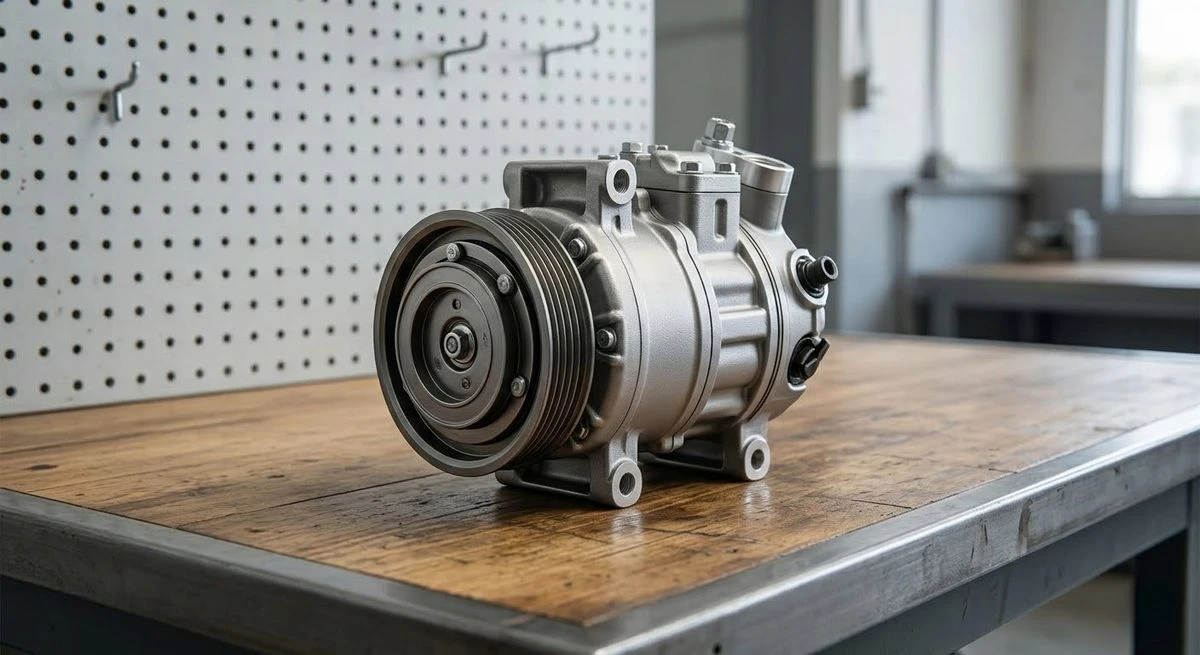
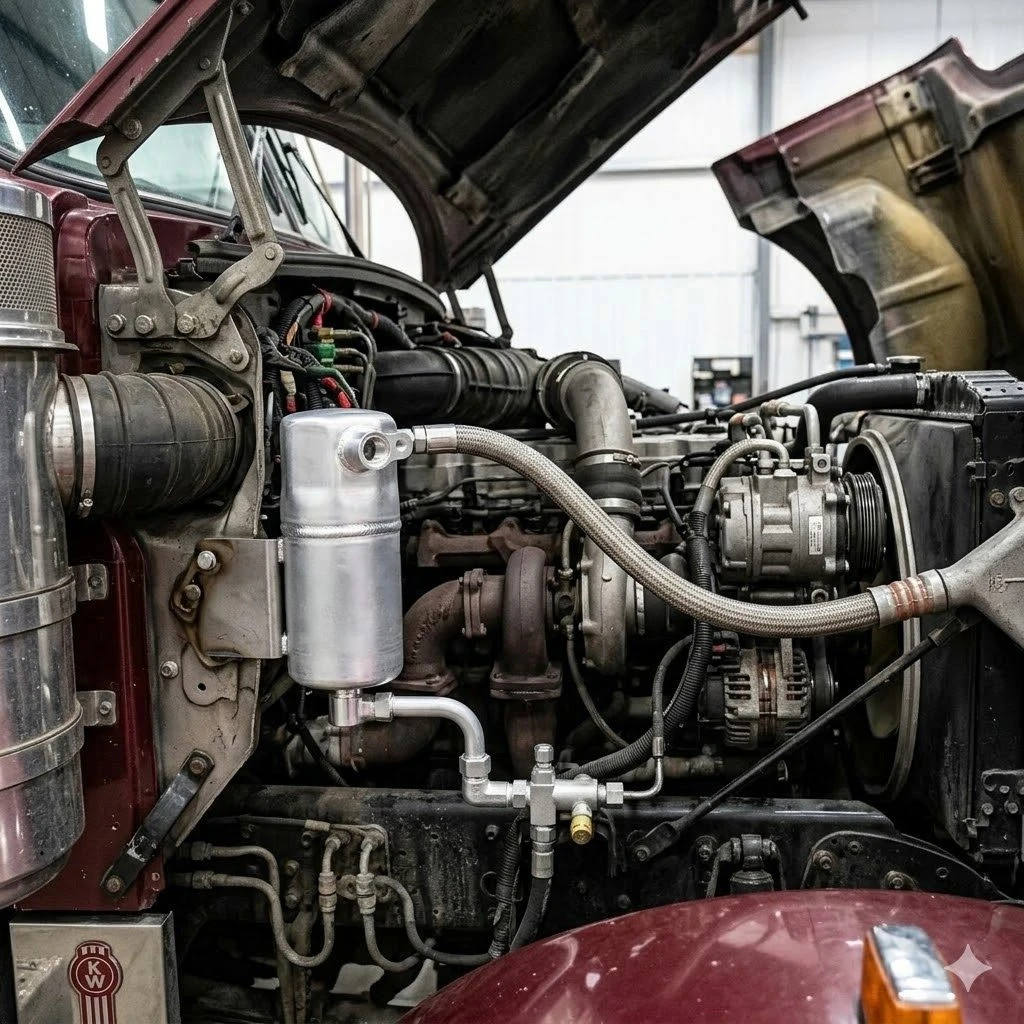
Your semi truck A/C compressor won't engage — but the refrigerant level is fine and the compressor itself tests good. In most cases, the problem is not the compressor at all. It's a $25–$60 pressure switch that has failed open, cutting power to the compressor clutch as a safety measure. Knowing how to identify and test a bad pressure switch saves hours of unnecessary diagnosis and prevents replacing expensive parts that don't need replacing.
This guide covers how high and low pressure switches work, the 5 symptoms that point to a faulty switch, how to test one with a multimeter in under 10 minutes, and what to check on your specific truck make.
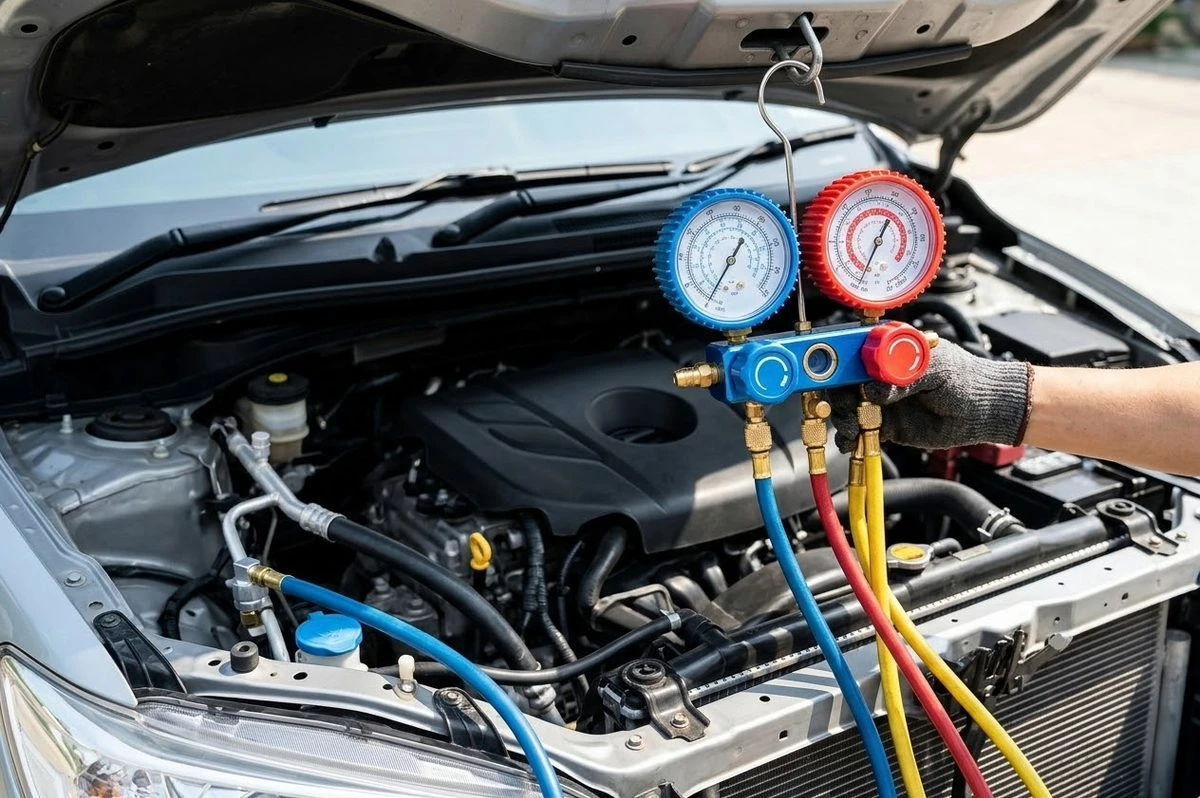
System pressure is the first check when diagnosing a pressure switch. A switch will not close — and the compressor will not engage — if system pressure is outside its designed operating range.
In this article
How Semi Truck A/C Pressure Switches Work
Every semi truck A/C system has at least two pressure switches — a high-pressure switch on the high side (between the compressor and condenser) and a low-pressure switch on the low side (between the evaporator and compressor). Some systems add a medium-pressure or trinary switch that also controls the condenser fan.
Both switches do the same job: protect the A/C system by cutting power to the compressor clutch if refrigerant pressure moves outside a safe operating range.
- Low-pressure switch: Opens the compressor clutch circuit if pressure drops too low — typically below 25–30 PSI. Low pressure usually means low refrigerant. Running the compressor on a low charge causes it to circulate oil-starved refrigerant, which destroys compressor internals quickly.
- High-pressure switch: Opens the circuit if high-side pressure exceeds a safe maximum — typically 350–450 PSI depending on the system. High pressure events are caused by a blocked condenser, overcharge, or a seized condenser fan. Letting the compressor run at extreme high pressure causes catastrophic failure.
Under normal operating conditions, both switches remain closed — completing the circuit that powers the compressor clutch. When a switch fails, it typically fails open: the circuit is broken, the clutch won't engage, and the A/C produces no cold air. Because the failure mode mimics low refrigerant, a failed pressure switch is frequently misdiagnosed — leading to unnecessary refrigerant top-ups or compressor replacements.
Key point: A pressure switch that fails open protects the system — it will not let the compressor run. So an A/C that suddenly stops working on a properly charged system is very likely a switch failure, not a compressor failure. Test the switches before touching anything else.
5 Symptoms of a Bad A/C Pressure Switch
1 A/C Compressor Clutch Won't Engage
The most direct symptom. Turn on the A/C, watch the compressor clutch pulley — the centre hub should spin with the belt. If the outer pulley spins freely but the centre hub does not engage, the compressor is not receiving power through the clutch circuit. A failed pressure switch is the most common reason this happens on a system with adequate refrigerant.
Before condemning the switch, confirm refrigerant charge with a gauge set. If high-side and low-side pressures are within spec and the clutch still won't engage, go directly to switch testing.

A pressure switch failure is one of the fastest A/C failures to fix — if you know to check it. The compressor, refrigerant, and rest of the system can be perfectly fine.
2 A/C Works Intermittently
The A/C blows cold for a while, then cuts out — then comes back later, seemingly on its own. This is a classic failing pressure switch that is opening and closing unpredictably. As the switch's internal contact corrodes or its spring weakens, it begins tripping at pressures within the normal operating range. Temperature changes can temporarily restore contact, which is why the A/C appears to "fix itself" after the cab cools down or the truck sits overnight.
Intermittent A/C is harder to diagnose because it won't always be failing when you look at it. If gauge pressures are normal and the A/C cuts out randomly on a hot day, a pressure switch on the edge of failure is the most likely culprit.
3 A/C Stops Working in High Ambient Temperatures
Some pressure switch failures only manifest in hot weather. As ambient temperature rises, so does refrigerant pressure — particularly on the high side. A high-pressure switch with a weakened spring or a lower-than-spec trip point will open prematurely when the system works hardest. The A/C runs fine in mild weather, then cuts out on hot summer days when it's needed most. This is often misdiagnosed as "the system can't keep up" when the real cause is a switch tripping at 320 PSI instead of 425 PSI.
4 A/C Compressor Cycles On and Off Rapidly
Rapid compressor cycling — turning on and off every few seconds instead of running for minutes at a time — points to a low-pressure switch on the edge of its trip point. The refrigerant charge may be slightly low, or the switch's calibration may have drifted. Each time the switch opens, pressure equalizes slightly and the switch closes again. This rapid cycling is hard on the compressor clutch and the compressor itself — address it quickly.
5 No A/C Fault Codes but System Won't Run
Modern trucks with J1939/CAN-bus diagnostics will log fault codes for many A/C failures, but a simple open-circuit pressure switch often produces no code — it just stops the compressor from running. If your diagnostic tool shows no A/C faults but the system won't engage, the pressure switches are the first components to test manually.
Need A/C pressure switches?
OEM-fit switches for Freightliner, Kenworth, Peterbilt, Hino, International & more. Same-day quotes, GTA.
How to Test an A/C Pressure Switch — Step by Step
You need a digital multimeter set to continuity or resistance (ohms). The test takes under 10 minutes and does not require evacuating the A/C system.
Locate the pressure switches
The high-pressure switch is typically on the high-side line between the compressor outlet and the condenser. The low-pressure switch is on the low-side line near the accumulator or receiver drier. Both have 2–3 wire electrical connectors.
Unplug the switch connector
Do not remove the switch from the system — you only need to unplug the electrical connector. The switch body stays threaded in; no refrigerant is released.
Test continuity across the switch terminals
Set the multimeter to continuity mode. Touch the probes to the two signal terminals on the switch body (not the wiring harness side). With the A/C system at normal operating pressure and the engine running, a good switch reads continuity (closed circuit). No continuity means the switch has failed open.
Bypass test (confirm the switch is the problem)
With the engine off and A/C system at rest, use a short jumper wire to bridge the two terminals in the wiring harness connector (not the switch). Start the engine and turn on A/C. If the compressor now engages, the switch is confirmed faulty. Remove the jumper and replace the switch — do not leave it bypassed.
Replace and retest
Thread out the faulty switch, thread in the replacement (use a new O-ring, lightly oiled). Plug in the connector, start the engine, and confirm the compressor engages and the A/C cools normally.
Do not leave a pressure switch bypassed. The switches are the primary protection against catastrophic compressor failure from low charge or condenser blockage. A bypassed switch that allows the compressor to run at 500+ PSI will destroy the compressor within minutes.
High Pressure Switch vs. Low Pressure Switch — Which One Failed?
Both switches produce the same symptom — compressor won't engage — but the context points to which one failed:
Low-Pressure Switch
- Trips when low-side pressure < 25–30 PSI
- Usually means low refrigerant charge
- Can also fail internally (stuck open)
- A/C stops working suddenly or won't start
- Check refrigerant level first — if charge is good, the switch itself has failed
High-Pressure Switch
- Trips when high-side pressure > 350–450 PSI
- Often caused by blocked condenser or failed condenser fan
- More common in high ambient temps or city stop-and-go
- A/C works in the morning, cuts out by afternoon
- Check condenser airflow before replacing the switch
A trinary switch — used on many Kenworth, Peterbilt, and Freightliner applications — combines both high and low pressure cutout functions with a third function: engaging the condenser fan at moderate pressure. If the condenser fan is also not running when the A/C is on, a failed trinary switch is likely the single cause of both problems.
Notes by Truck Make
Freightliner Cascadia
The Cascadia typically uses a trinary switch on the high-side line near the condenser. The switch also triggers the condenser fan relay — a failed switch can cause the condenser fan not to run, which then causes high-side pressure to rise until the switch trips. If the condenser fan is not spinning with the A/C on, the trinary switch is the first thing to check. The Cascadia switch connector is prone to corrosion on trucks operating in winter with road salt exposure — clean the connector before condemning the switch.
Kenworth T680 / Peterbilt 579
Both platforms use a similar PACCAR-spec A/C layout with a high-pressure cutout switch and a separate low-pressure switch. Kenworth and Peterbilt trucks with Thermo King or Carrier APUs have separate pressure switches for the APU A/C circuit — confirm you are testing the cab A/C circuit, not the APU circuit. The cab A/C compressor and the APU compressor are independent systems.
International LT / LoneStar
International trucks show up frequently in A/C pressure switch searches, and for good reason — the A/C pressure switch on the International LT is known to fail prematurely in high-heat conditions. The switch is located on the receiver drier on most configurations. If your International LT A/C cuts out in traffic on hot days with good refrigerant charge, the high-pressure switch is the first thing to test. We stock International-fit A/C pressure switches in the GTA.
Hino 268 / 338
Hino uses separate high and low pressure switches, typically mounted on or near the receiver drier assembly. Urban duty cycles with frequent A/C start-stop cycles — common on GTA delivery routes — accelerate switch contact wear. If a Hino A/C works in the morning and becomes intermittent by mid-route on a hot day, the high-pressure switch is the likely cause. Confirm by testing when the symptoms are present, not after the truck has sat and cooled down.
Volvo VNL / Mack Anthem
Both use a similar Volvo Group A/C layout. The pressure switches are accessible with the hood open and are straightforward to test. Volvo and Mack trucks with dual-zone A/C (driver and bunk) have separate circuits — a failed switch in one zone won't affect the other. Note which zone has failed before testing to avoid checking the wrong switch.
Confirmed bad switch? We have it in stock.
OEM-fit A/C pressure switches for all major makes. GTA pickup or ships Canada-wide. Same-day quotes.
Frequently Asked Questions
What does a semi truck A/C pressure switch do?
It monitors refrigerant pressure and cuts power to the compressor clutch if pressure goes outside a safe range — too low (low refrigerant) or too high (blocked condenser, overcharge). It protects the compressor from running under conditions that would destroy it within minutes.
How do I know if my A/C pressure switch is bad or if I just need refrigerant?
Connect a gauge set to the service ports. If both high-side and low-side pressures are within the normal range for your ambient temperature and the compressor still won't engage, the refrigerant charge is fine — the switch has likely failed open. If pressures are low, add refrigerant first and retest.
Can I bypass the A/C pressure switch to test it?
Yes — briefly, as a diagnostic step only. Jump the two terminals in the wiring harness connector (not the switch body) with the engine off, then start and test. If the compressor engages, the switch is confirmed bad. Remove the jumper immediately after confirming — never operate the system with a pressure switch bypassed.
How much does a semi truck A/C pressure switch cost?
Typically $25–$80 CAD for an OEM-fit switch depending on the make and whether it is a standard two-function switch or a trinary switch. Labour is minimal — the switch threads out in a few minutes with a wrench and does not require evacuating the system if done quickly (most refrigerant loss is negligible for a switch swap).
My A/C works fine in the morning but stops working by noon. Is it a pressure switch?
Very likely yes — specifically the high-pressure switch. As ambient temperature rises through the day, high-side refrigerant pressure rises with it. A high-pressure switch that has drifted to a lower trip point will open prematurely on hot afternoons. The other possibility is a condenser that is partially blocked — rising temperatures reduce its effectiveness until high-side pressure climbs past the switch's trip point. Check the condenser face for debris and test the high-pressure switch.
What is a trinary switch and does my truck have one?
A trinary switch combines high-pressure cutout, low-pressure cutout, and a condenser fan activation signal in one unit. Many Freightliner, Kenworth, and Peterbilt trucks use a trinary switch. If your condenser fan stops running at the same time the A/C cuts out, you likely have a trinary switch that has failed — replacing it restores both functions at once.