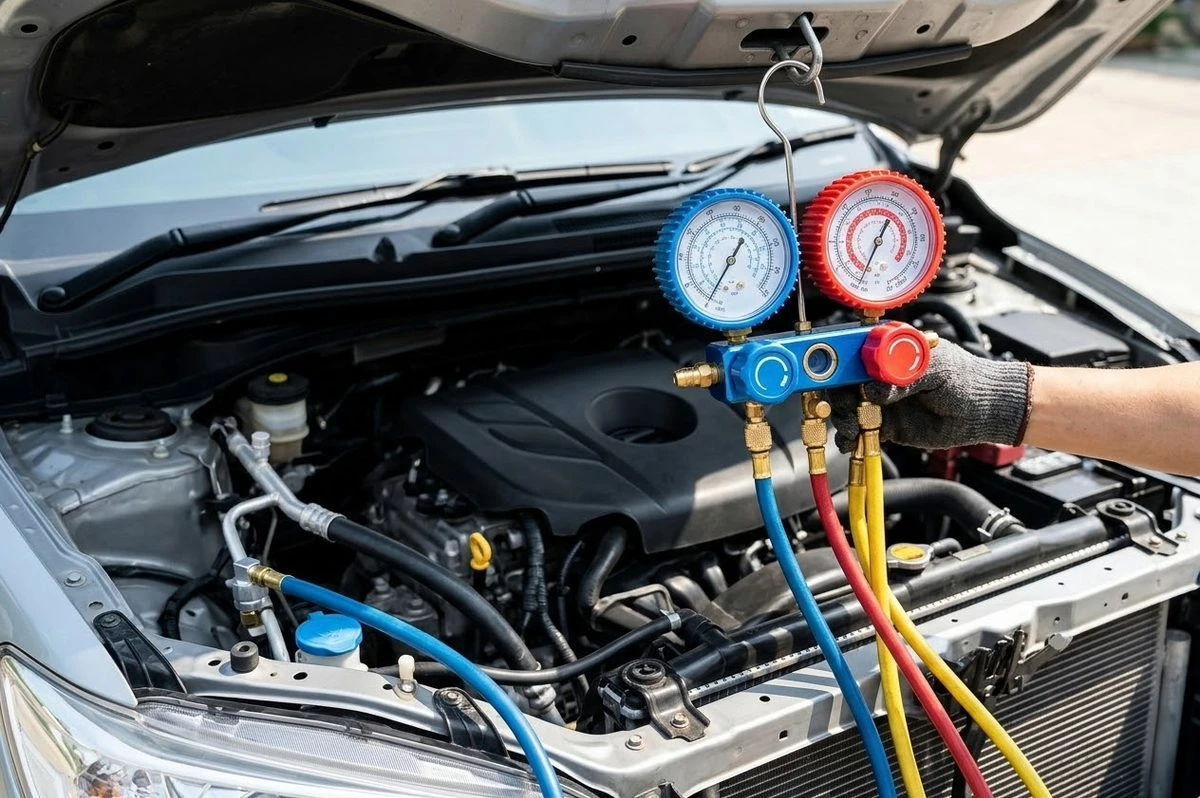
A sticking expansion valve and a dying compressor feel identical from the cab. Both gauges together tell them apart in about a minute.
In this article
What the Expansion Valve Actually Does
The expansion valve is the dividing line in an air conditioning system. Everything upstream of it — compressor, condenser, drier — is high pressure. Everything downstream is low pressure. The valve is what creates that drop.
Liquid refrigerant arrives under high pressure and is metered through a small orifice into the evaporator. Dropping the pressure drops the boiling point, the refrigerant flashes to vapour, and absorbing the heat needed for that change is what actually cools the cab. A sensing bulb on the evaporator outlet feeds temperature back to the valve so it opens and closes to match demand.
That makes it the only moving regulator in the loop. It is also, in most heavy-duty systems, the cheapest component in it.
The Cheap Part That Imitates the Expensive One
Here is the problem, and it is the reason this article exists. A failing expansion valve presents exactly like a failing compressor or a low charge. The cab blows warm. The system seems to lose performance. Everything points at the most expensive part in the system, and the valve sits there costing a fraction of it.
We see the asymmetry in what people search for. Queries about A/C compressors outnumber queries about expansion valves by more than two to one, and a share of those compressors did not need replacing. Fitting a compressor to a system with a restricted valve gives you a repair that disappoints immediately and a bill that did not have to happen.
The valve fails in two directions, and they look different on the gauges:
- Stuck closed or restricted — too little refrigerant reaches the evaporator. Low side goes very low, sometimes into vacuum. High side is normal or low. Cooling is poor to none.
- Stuck open — too much refrigerant floods through. Low side runs high, the evaporator cannot boil it all off, and liquid can reach the compressor. That is how a valve fault eventually becomes a genuine compressor failure.
Five Symptoms of a Failing Expansion Valve
1 Cooling that works, then fades
The classic one. Cold air for fifteen or twenty minutes, then progressively warmer. A valve that sticks as it cools, or an internal restriction that ices up, chokes flow once the system reaches temperature. Shut it down, let it thaw, and it works again for another twenty minutes.
2 Frost or ice at the valve or the inlet line
Visible frost forming at the valve body or on the line into the evaporator means refrigerant is expanding in the wrong place — it is dropping pressure across a restriction instead of across the orifice. Moisture in the system freezing at the orifice does the same thing, which is why a saturated drier and a failed valve often arrive together.
3 The compressor clutch cycles rapidly
Short-cycling — clutch engaging and disengaging every few seconds — usually means pressure is swinging past the switch thresholds faster than the system can settle. A valve metering erratically will do that. So will a genuinely low charge, which is why the gauges matter more than the symptom.
4 Low side reading that makes no sense
A low side in vacuum with a normal high side is close to diagnostic on its own. So is a low side sitting high while the cab stays warm. Either pattern points at metering, not at charge.
5 Cooling that is fine at speed and poor at idle, or the reverse
Airflow faults change with road speed; metering faults often do not. A system that behaves the same at idle and at highway speed, but simply will not get cold, is more likely a valve or a charge problem than an airflow one.
Know the symptom but not the part?
Send us the VIN or the number off the old valve and we will confirm the right one before you order. Same-day quotes, pickup in Vaughan.
Get a fitment checkTesting It: What the Gauges Tell You
You cannot diagnose this from the dash. Put a manifold set on it and read both sides together — one reading in isolation is the single most common cause of a wrong call.
- Read both pressures with the system running and stabilised. Note ambient temperature; the expected numbers move with it, so a reading without one is only half a measurement.
- Low very low or in vacuum, high normal or low. A restriction. The valve or the drier. If the drier has never been changed, suspect it first — it is cheaper and it may be the cause of the valve's problem.
- Low high, high low, little cooling. The valve is passing too much, or the compressor is no longer pumping. These two are told apart by whether the compressor can build pressure at all.
- Both sides low and even. Undercharge, not a valve. Find the leak before adding anything.
- Feel the inlet and outlet lines. A healthy valve shows a clear temperature difference across it. A frosted inlet with a warm evaporator is a restriction you can confirm by hand.
One caution worth stating plainly: if the system has been open to atmosphere, moisture is in it, and moisture freezing at the orifice mimics a failed valve perfectly. Replace the receiver drier and pull a proper vacuum before condemning the valve.
Why One Valve Fits So Many Trucks
Radiators splinter. One Peterbilt 379 can match eighteen different radiators in our stock, and the core dimensions decide which. Expansion valves do the opposite, and it makes them one of the easiest parts in the system to get right.
We hold 27 expansion valves covering 1973 to 2020 across 6 makes, and between them they carry 1,669 OE cross-reference numbers — a median of 37 each. TKX0002 alone supersedes 303 part numbers. A small number of valve designs serve an enormous range of trucks.
| Part | Fits | Years | OE numbers |
|---|---|---|---|
| TKX0002 | KENWORTH — T300, T400, T600, T800 +1 | 1997–2007 | 303 |
| TFX0005 | FREIGHTLINER — COLUMBIA | 1989–2000 | 177 |
| TVX0001 | VOLVO — VHD, VNL, VNM | 1996–2002 | 148 |
| TFX0007 | FREIGHTLINER — CENTURY CLASS, COLUMBIA, CORONADO | 1996–2012 | 110 |
| TKX0003 | KENWORTH — T2000, T700 | 1998–2012 | 110 |
| TIX0003 | INTERNATIONAL — 5000, 9000 | 2001–2012 | 85 |
| TFX0008 | FREIGHTLINER, VOLVO — WFT, WAH, WCA, WG +2 | 1973–1995 | 78 |
| TIX0004 | INTERNATIONAL — 2000, 4000, 4700, 8000 | 1995–2002 | 73 |
| TFX0004 | FREIGHTLINER — CASCADIA | 2008–2019 | 66 |
| TPX0002 | PETERBILT, VOLVO — 365, 367, 378, 386 +3 | 2003–2012 | 63 |
| TKX0001 | KENWORTH — T270, T370, T400, T660 +2 | 2008–2014 | 61 |
| TFX0001 | FREIGHTLINER — CENTURY CLASS, COLUMBIA, CORONADO | 2003–2015 | 58 |
The twelve most heavily cross-referenced expansion valves in our stock, of 27 total. The right-hand column is how many OE part numbers each one supersedes.
The practical consequence: match the number, not the truck. With a radiator you measure the core because the badge tells you little. With an expansion valve the number stamped on the old one, or any OE number from the service record, will usually land on a part we stock — even when the truck is decades old or the valve was fitted by a previous owner. Send us the number and we will check it against the cross-references.
Replacing It Without Doing the Job Twice
The valve itself is inexpensive. The labour to open an A/C system is not, so everything that should be done while it is open should be done now rather than next season.
- Replace the receiver drier in the same job. Not optional. Its desiccant saturates the moment the system meets atmosphere, and the moisture it releases is what froze the orifice in the first place. Skipping it is the most common reason this repair fails twice.
- Replace every o-ring you disturb. A used o-ring has taken a set; it seals on the bench and weeps in service. They cost almost nothing.
- Flush the system if the compressor has ever failed. Debris from a failed compressor lodges in the valve orifice. Fitting a new valve into an uncleaned system puts the same debris straight back into it.
- Pull a proper vacuum. A short pull-down is not a vacuum. Moisture left behind forms acid and re-freezes at the orifice, and you are back where you started.
- Charge by weight, not by sight. Topping up until the gauge "looks right" is how systems end up overcharged, which stresses everything downstream of the valve.
Need the valve and the drier together?
We stock both, plus the o-rings. Same-day pickup in Vaughan and delivery across the GTA.
Browse expansion valvesExpansion Valves We Stock
27 expansion valves fitting FREIGHTLINER, INTERNATIONAL, KENWORTH, MACK, PETERBILT, VOLVO trucks, spanning 1973 to 2020, with photographs on 25 of them and the full OE cross-reference list on every listing. See the complete range on our expansion valve page, which is where fitment, numbers and availability live.
The rest of the A/C loop, since this job is rarely only the valve: receiver driers (replace with the valve, every time), o-rings and seals, compressors, evaporators, condensers, pressure switches and lines and hoses.
Send the VIN or the number off the old valve to get a same-day quote. Pickup in Vaughan, delivery across Brampton, Mississauga, North York, Oshawa and the rest of the GTA.
Frequently Asked Questions
How do I know if it is the expansion valve or the compressor?
Read both gauge pressures together. A restricted valve drives the low side very low — sometimes into vacuum — while the high side stays normal or drops. A compressor that is no longer pumping cannot build pressure on the high side at all. The symptom in the cab is identical for both, which is why the gauges decide it and the symptom does not. Check the pressure switch too; a failed switch stops the clutch engaging and looks like a dead compressor for a fraction of the cost.
Can a bad expansion valve damage the compressor?
Yes, and this is the reason not to leave it. A valve stuck open floods the evaporator, the refrigerant does not fully boil off, and liquid reaching the compressor is what destroys it. A valve fault left alone is how a cheap repair becomes an expensive one.
Do I have to replace the receiver drier at the same time?
Yes. The drier's desiccant saturates as soon as the system is opened to atmosphere, and the moisture it then releases freezes at the valve orifice — recreating the exact fault you just paid to fix. It is the cheapest part in the job and the most commonly skipped.
Why does my A/C cool for twenty minutes and then stop?
That pattern points at icing. Either moisture in the system is freezing at the valve orifice, or the valve is sticking as it cools. Shutting down and letting it thaw restores cooling for another twenty minutes, which confirms it. The fix is usually the valve and the drier together, with a proper vacuum pulled before recharging.
Will an expansion valve from a different truck fit mine?
More often than you would expect. Unlike radiators, a small number of valve designs cover a very wide range of trucks — our 27 valves carry 1,669 OE cross-references between them, and TKX0002 alone supersedes 303 part numbers. Work from the number stamped on the old valve or from any OE number in the service record rather than from the make and model, and send it to us to confirm.
How much does a semi truck expansion valve cost?
It is among the least expensive parts in the air conditioning system — far below a compressor, a condenser or an evaporator. Pricing depends on the valve and the truck, so send us the number or the VIN for a same-day quote. The labour to open the system is the larger part of the job, which is why the drier and the o-rings should be done at the same time.