Not sure what the charge air cooler does? See what a charge air cooler is and how it works first.
In this article
What the Charge Air Cooler Does on a Kenworth T680
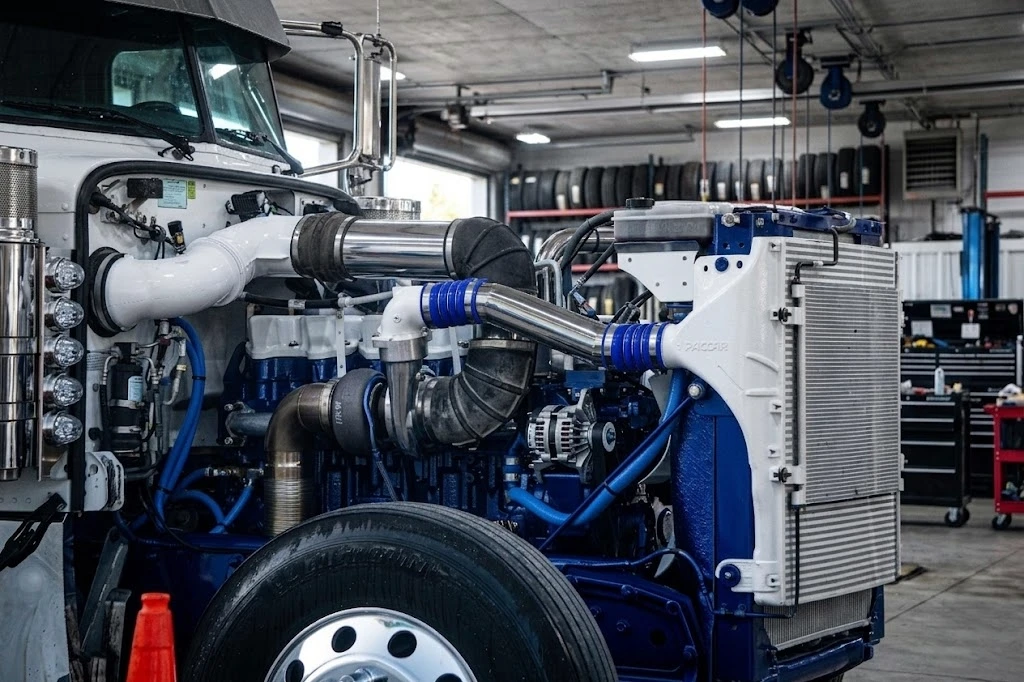
The T680 is Kenworth's flagship aerodynamic highway truck, and nearly every one on Canadian roads runs a turbocharged engine — most commonly the Paccar MX-13. When the MX-13's turbocharger compresses intake air, that air heats up dramatically, becoming less dense. Less dense air means fewer oxygen molecules per stroke, less combustion energy, and less torque at the wheels.
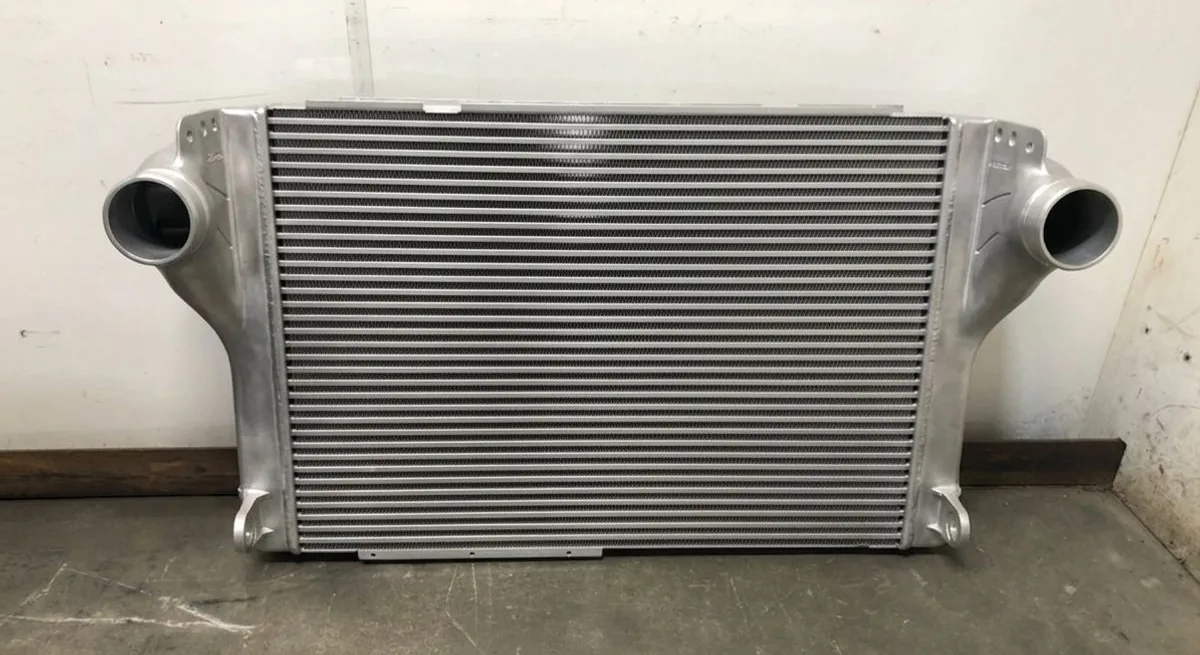
The charge air cooler (CAC) — also called an intercooler or air-to-air cooler — sits between the turbo outlet and the engine intake. On the T680 it mounts in front of the radiator behind the lower bumper fascia, directly in the path of incoming air. A working CAC drops charge air temperature by 50–80 °C, restoring air density before it enters the cylinders. That cooling is responsible for the T680's fuel efficiency numbers, its rated towing capacity, and its ability to hold highway speed at gross weight without the engine working harder than it needs to.
Kenworth T680 CAC Specs by Engine
The T680 has been built with three main engine options since its introduction in 2012. The CAC dimensions and part fitment vary by engine family — confirm your engine before ordering a replacement.
| Engine | Years | Core Size (approx.) | Notes |
|---|---|---|---|
| Paccar MX-13 | 2012–present | 920 × 620 × 52 mm | Most common T680 engine; plastic end-tank fatigue is the #1 failure mode after 600,000 km |
| Cummins ISX15 / X15 | 2012–2022 | 900 × 615 × 52 mm | Common in vocational and heavy-haul T680s; crimp joint between plastic tank and aluminium core is the weak point |
| Detroit DD15 | 2012–2020 | 950 × 630 × 52 mm | Less common in T680 than Cascadia; same end-tank failure mode; verify core dimensions — DD15 and MX-13 cores are not interchangeable |
The 2022+ T680 Next Gen introduced revised front-end architecture with relocated CAC mounting brackets but the core dimensions for the MX-13 are essentially unchanged. Always cross-reference your VIN or Kenworth ESPA parts lookup if you're uncertain which fitment you need.
5 Signs Your Kenworth T680 CAC Is Failing
A T680 CAC fails in one of two ways: it develops a boost leak (compressed air escapes before reaching the intake manifold) or it becomes internally fouled (oil from a turbo seal coats the fins and reduces airflow). Both hurt performance; a boost leak hurts it faster.
1 Power Loss Under Load — Especially on Grades and Headwinds
The most common complaint T680 drivers bring to us: "She's lazy going uphill. Used to pull hard — now I have to downshift a gear earlier than I should." A leaking CAC dumps boosted air into the engine bay instead of the intake. The MX-13 ECM detects lower-than-requested boost at the manifold and reduces fuelling to protect the engine from lean-burn damage. The power loss is proportional to the leak size — a small end-tank crack might cost 5–10% power at peak load; a failed crimp joint between the plastic tank and aluminium core can drop power 20–25% at highway grade.
If the loss happens gradually over months rather than suddenly, it's more likely oil fouling building up on the internal fins. If it came on suddenly after a gravel road or a rock strike, suspect physical damage to the core face.
2 Grey or White Smoke at Cold Start That Clears After Warm-Up
Oil vapour from a worn MX-13 turbo shaft seal enters the boost circuit and collects in the lowest point of the CAC overnight. At cold start that pooled oil burns off for 30–60 seconds before the system pressurizes and clears. It's often misdiagnosed as a head gasket issue because the smoke colour is similar — but a head gasket failure produces coolant vapour that smells sweet, while CAC oil burn smells like burning motor oil. Pull the lower boost boot from the CAC inlet and inspect the inside of the tube with a light: wet oily residue confirms oil is entering the charge circuit.
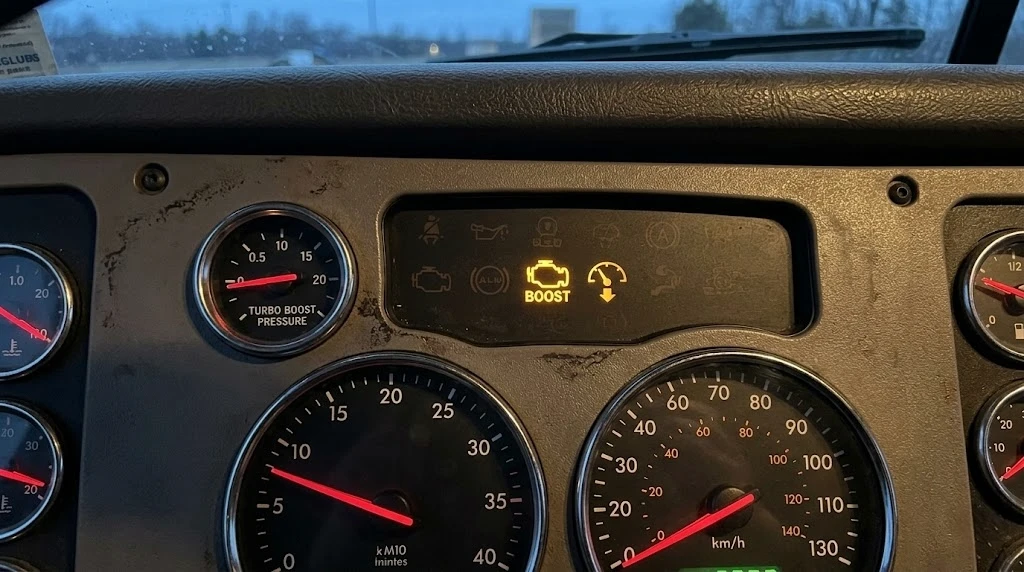
3 Fault Codes P0299, P003A, or SPN 102 / FMI 1
P0299 (Turbocharger Underboost) and SPN 102 FMI 1 (Manifold Air Pressure Below Normal) are the two codes that point directly at a boost circuit issue on the T680. P003A (Turbocharger B Underboost) appears on twin-turbo MX-13 configurations. These codes do not confirm a bad CAC — a cracked boost pipe, a stuck wastegate, or a failing variable-geometry turbo vane will produce the same codes. You need a pressure test to isolate the CAC specifically.
On trucks equipped with Paccar's Driver Performance System, an underboost condition will also flag a reduced-power event in the driver log, which is worth checking if you're servicing a fleet truck without a clear complaint from the driver.
Do not clear P0299 without diagnosis on an MX-13. The MX-13 adjusts fuelling based on boost pressure feedback. A persistent boost leak causes the engine to over-fuel at low boost, raising exhaust temperatures and accelerating DPF loading. This triggers more frequent active regeneration cycles, which can shorten DPF and SCR life significantly on trucks running stop-and-go freight routes.
4 Measurable Fuel Economy Drop — 5–10% Over a Dispatch Period
Less dense intake air means the MX-13 burns more fuel to achieve the same requested torque. On a T680 doing 200,000 km per year, a 7% fuel penalty adds up to several thousand dollars in extra diesel annually. If your fleet's per-unit fuel cost increased without a route or load change, a degraded CAC is one of the first things to check — along with tire pressure, alignment, and fuel injector wear. A temperature delta test (charge air temp before vs. after the CAC under load) gives you a quantitative reading: a drop below 40°C on a hot day at full load points to a fouled core.
5 Oily or Tacky Residue on Boost Couplers and Inlet Pipes
Squeeze each silicon coupler on the charge air circuit — both between the turbo outlet and the CAC inlet, and between the CAC outlet and the intake manifold. They should be dry and firm. If any coupler is tacky, wet, or visibly oil-coated on the outside, you have oil bypassing into the boost circuit. Also check the coupler clamps: on the T680 the lower outlet coupler is particularly prone to clamp migration from engine vibration, which creates a real boost leak that costs next to nothing to fix. A squeezed clamp is a free repair; a new CAC is not. Always check the clamps before condemning the core.
Rule of thumb: Two or more of these symptoms together is your cue to pressure-test the CAC before ordering any parts. A cracked silicon coupler produces all 5 symptoms and costs $40–$80 to fix. A pressure test takes 30 minutes and protects you from replacing a $600 core that was fine all along.
How to Diagnose a Kenworth T680 Boost Leak
Step 1 — Visual Inspection of the CAC Core and End Tanks
Remove the lower front fascia panel (typically 6–8 push-pin fasteners plus 2 bolts on the T680) to expose the CAC. Look at both end tanks — the plastic header tanks that cap the aluminium core on each side. Run your thumb along the crimp joint where the plastic tank meets the aluminium. A crack here often feels like a ridge or you may see a faint dark stain from escaping oil mist. Also look at the lower portion of the core face: if the bottom third is coated in black oily film with debris, the fins are partially blocked and airflow is reduced even if there's no structural crack.
Step 2 — Shop Air Pressure Test
With the engine off and cool, remove the two boost boots from the CAC. Block one opening with a rubber plug and connect shop air to the other through a fitting with a pressure gauge. Pressurize to 20–25 psi — above the T680's typical 15–18 psi operating boost at highway cruise, so you'll expose any weak points, but not so high that you damage the core. Spray soapy water across all surfaces of the CAC or submerge it if you've removed it. Bubbles confirm a leak. Any leak is cause for replacement; cracked CAC end tanks cannot be reliably repaired.
Keep test pressure below 30 psi. The T680 CAC core is designed for continuous duty at 150–200 kPa (22–29 psi) but the plastic end tanks are the weak point. Testing at 25 psi exposes failures without over-stressing a structurally sound core. Above 30 psi you risk fracturing a marginal tank that might have lasted another service interval.
Step 3 — Charge Air Temperature Delta Under Load
Using a diagnostic scanner (Paccar ServiceLink or a compatible J1939 reader), log IAT1 (intake air temperature after the turbo, before the CAC) and IAT2 (intake air temperature at the manifold, after the CAC) simultaneously while the truck is under full highway load. A healthy T680 CAC should produce a delta of at least 50°C on a warm day at full load. A delta below 30°C with normal ambient temperatures means the fins are fouled and airflow through the core is restricted. A delta approaching zero with underboost codes points to a major structural leak.
Step 4 — Check Boost Couplers and Clamps First
The most common T680 boost leak points to inspect before pulling the CAC:
- Lower outlet silicon coupler between CAC and intake manifold elbow — clamp frequently migrates off the bead from vibration
- Upper inlet coupler from turbo outlet — heat-cycles crack the silicon after 5–8 years on a T680; squeeze it hard and look for surface cracking
- EGR mixer coupler on the MX-13 — EGR system pressure can bleed into the intake side and look like a CAC leak symptom
- MAP sensor O-ring at the intake manifold — cheap part, causes P0299 codes when it starts seeping air
- Intercooler pipe welds between the turbo and CAC — on high-mileage MX-13s, the pipe welds at bends occasionally develop cracks from vibration fatigue
Shop Kenworth T680 Charge Air Coolers
MX-13, ISX15 and DD15 fitments. GTA pickup or Canada-wide shipping.
Why Kenworth T680 CACs Fail Early
A T680 CAC should last 800,000–1,000,000 km under normal Canadian highway use. Several factors specific to how these trucks are operated cut that number significantly:
Plastic End Tank Fatigue on the MX-13
The MX-13 runs at higher specific output than older diesels — it makes its 455–510 hp from a 12.9-litre displacement, which means it cycles boost pressure repeatedly throughout each load event. The CAC end tanks flex with each pressure cycle. In Canadian winters, the thermal swing from −30 °C overnight to full operating temperature under load creates cumulative stress at the plastic-to-aluminium crimp joint. Most T680 MX-13 CAC end-tank failures we see in the GTA show up between 500,000 and 750,000 km — earlier on trucks that idle heavily or do a lot of city stop-and-go versus highway.
Aerodynamic Front End and Road Debris
The T680's low, aerodynamic hood moves the cab forward and brings the grille opening much closer to the road surface than a conventional truck. That low grille intake is efficient at directing airflow — but it also catches more road debris, gravel spray, and splash from the truck ahead. The CAC sits directly behind that opening. Rock strikes that skip under the bumper and into the lower grille are a common source of pin-leaks in the core face that don't show up visually from outside. If the truck recently ran a gravel resource road or highway construction zone, inspect the core face closely with a light before concluding the CAC is structurally sound.
Road Salt and Fin-to-Tube Corrosion
Ontario's winter road salt hits the T680 CAC face every time the truck runs November through April. Aluminium fins corrode and the fin-to-tube bond weakens over multiple winter seasons. On trucks running the 401 corridor regularly, we see the bottom 20% of the CAC core face show detached fins and tube-to-fin separation by 600,000 km — even before any end-tank crack. This type of damage reduces cooling efficiency measurably but leaks slowly, so it often goes undiagnosed until a pressure test.
Turbo Seal Wear and Oil Fouling
The MX-13's variable-geometry turbocharger uses a cartridge-style CHRA (centre housing rotating assembly). When the CHRA shaft seals wear — typically after 700,000+ km — they allow oil vapour to enter the pressurized intake side. That oil accumulates in the CAC, coating internal fins with a progressive oil film that blocks airflow. Unlike a structural crack, oil fouling develops slowly and the driver may not notice until fuel economy has already dropped 6–8%. If you're replacing an oil-contaminated CAC, always inspect the turbocharger at the same time — otherwise the new CAC will foul at the same rate.
Kenworth T680 CAC Replacement Cost in Canada (2026)
The T680's front-access CAC design makes this a manageable job for a dealer or independent shop familiar with the truck. The lower bumper fascia comes off in about 20–30 minutes, the CAC unbolts in another 30, and reinstall and boost test adds another hour. Budget 2.5–3 hours labour at a competent heavy-duty shop.
| Item | DIY Cost (CAD) | Shop Total (CAD) | Notes |
|---|---|---|---|
| Aftermarket CAC (MX-13) | $500–$720 | $980–$1,300 | Full aluminium bar-and-plate core; most aftermarket units are all-aluminium vs. OEM plastic-tank design — structurally superior for high-km trucks |
| OEM Kenworth/Paccar CAC | $1,200–$1,800 | $1,900–$2,700 | Direct-fit; plastic end tanks; best for trucks still under Kenworth's APEX warranty or Paccar Financial service contracts |
| Silicon coupler kit | $55–$95 | $120–$180 | Replace all boost couplers and clamps while the front is off — same labour; heat-hardened couplers crack during removal |
| Labour only (GTA shops) | — | $240–$380 | 2.5–3 hrs at $95–$130/hr depending on shop; straightforward on T680 with proper grille tooling |
| CAC cleaning (oil fouling, no cracks) | $0 (DIY solvent) | $130–$220 | Valid only if pressure test confirms zero leaks; fix turbo seal first or the cleaned core re-fouls within 100,000 km |
One note specific to the T680 Next Gen (2022+): the revised front-end bracket system adds about 30 minutes to the remove-and-reinstall procedure compared to the pre-2022 T680. Budget closer to 3.5 hours labour at a shop that hasn't done one before.
OEM vs. Aftermarket T680 CAC: Which Should You Choose?
The honest answer for most Canadian T680 operators: aftermarket all-aluminium bar-and-plate cores outperform OEM plastic-tank units on high-mileage trucks. Here's the breakdown:
When OEM Makes Sense
- Truck is under the Kenworth APEX warranty or a Paccar Financial maintenance contract — aftermarket parts may void coverage on covered components
- Under 500,000 km and the rest of the cooling system is original and healthy
- Fleet spec requires identical OEM documentation for resale or lease return
- The MX-13 has specific emissions system integration that requires matched CAC inlet/outlet sizing for DPF/SCR performance verification
When Aftermarket Is the Better Call
- Truck is over 600,000 km — the OEM plastic end tanks will fail again before the engine overhaul; an all-aluminium core has no plastic failure point
- The truck already had one or two OEM CAC replacements — at that mileage, the root cause (road salt, turbo wear) won't change and the cheaper core makes economic sense
- Budget is a constraint — a quality aftermarket core at $600 delivers the same boost performance as a $1,500 OEM unit; what differs is end-tank material
- You need the truck back in service same-day — OEM Kenworth parts often require 3–5 business days; aftermarket cores for the MX-13 are typically in stock
What we stock: Our Kenworth T680 charge air cooler inventory includes aftermarket all-aluminium bar-and-plate cores for the MX-13, ISX15, and DD15. Most fitments are in stock for same-day pickup in Vaughan. We can also source OEM Paccar units on a 2–3 business day order.
Also worth reading: our general guide on charge air cooler symptoms across all makes, and the Freightliner Cascadia CAC problems guide if you run a mixed fleet.
Frequently Asked Questions
Can I keep driving my T680 with a cracked charge air cooler?
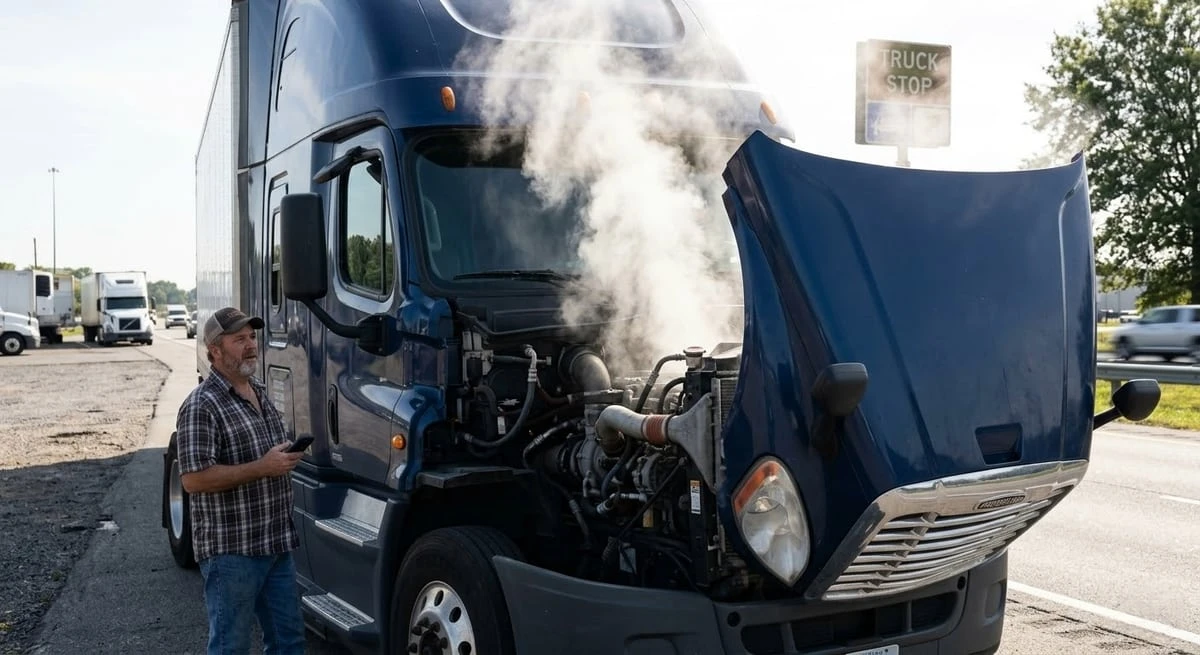
A small end-tank crack won't strand you immediately, but it will worsen with every heat cycle. More importantly, driving an MX-13 with a confirmed boost leak triggers frequent active regen cycles on the DPF (the engine over-fuels at reduced boost to maintain requested torque, raising exhaust temperature). On trucks running high-cycle freight routes around the GTA, this can shorten DPF life from 800,000 km to 500,000 km or less. Fix it within the current dispatch cycle.
Is the T680 CAC the same as a Peterbilt 579 CAC?
For MX-13 and ISX15 engine families, the T680 and Peterbilt 579 share many CAC dimensions — both trucks use Paccar's platform architecture and similar front-end layouts. However, mounting bracket holes, inlet/outlet orientation, and end-tank port positions can differ between model years. Always confirm fitment using your VIN rather than assuming cross-compatibility based on engine family alone.
How do I know if my T680 problem is the CAC or the turbo?
Do the shop air pressure test at 20–25 psi first. If the CAC holds pressure and you're seeing oil in the boost circuit, the turbo shaft seal is the source. If the CAC fails the pressure test with oily residue on the internal end-tank surfaces, you likely have both a worn turbo seal and a compromised CAC — fix both at the same time or the new CAC will foul again within 150,000 km.
What boost pressure should my T680 MX-13 show at highway speed?
A healthy MX-13 at 100 km/h at 80% gross weight will typically show 90–130 kPa (13–19 psi) of boost on flat highway, rising to 150–190 kPa (22–28 psi) on a grade at governed RPM. If your Paccar ServiceLink scanner shows manifold boost below 80 kPa under a load that should produce more, you have a boost circuit leak. The CAC is the first suspect but the coupler clamps are the cheapest first step.
Does a replacement T680 CAC come with new couplers and clamps?
No — almost all aftermarket and OEM CAC cores ship as bare cores without couplers, clamps, or hardware. Always order a silicon coupler kit at the same time. Heat-hardened couplers on a T680 with more than 500,000 km will crack during removal; replacing them while the fascia is already off adds $65 in parts and 20 minutes of labour to a job that already costs $1,000+.
How often should the T680 CAC be inspected?
Add a visual inspection of the CAC core face and all boost couplers to your annual pre-CVOR inspection. Check for fin corrosion, oil residue on the couplers, and squeeze-test each coupler for hardness. A pressure test every 300,000 km catches end-tank cracking before it turns into a performance problem on the road.
Need a Kenworth T680 Charge Air Cooler?
MX-13, ISX15 and DD15 fitments in stock. Same-day pickup in Vaughan (GTA) — Canada-wide shipping available.
Amir Kazemi
Heavy Duty Parts Specialist — True Truck Parts, GTA
Our team specializes in cooling and A/C parts for Class 8 semi trucks, serving fleet operators and owner-operators across the Greater Toronto Area and Canada. We stock OEM-fit parts for Freightliner, Kenworth, Peterbilt, Volvo, Mack, Hino, International and Western Star.